Free practice · Updated November 2026
Free CogAT practice for Kindergarten (Level 5/6)
Original questions, one at a time, with the answer and a short explanation after every choice. No sign-up and no timer.
 Questions from CogAT Test PrepFree app for iPhone, iPad and AndroidGet the app
Verbal practice
Picture relationships and word meanings ask a child to find a connection, finish a thought, or decide which examples belong together.
Question 1
The first two pictures go together. Which picture goes with the last picture in the same way?
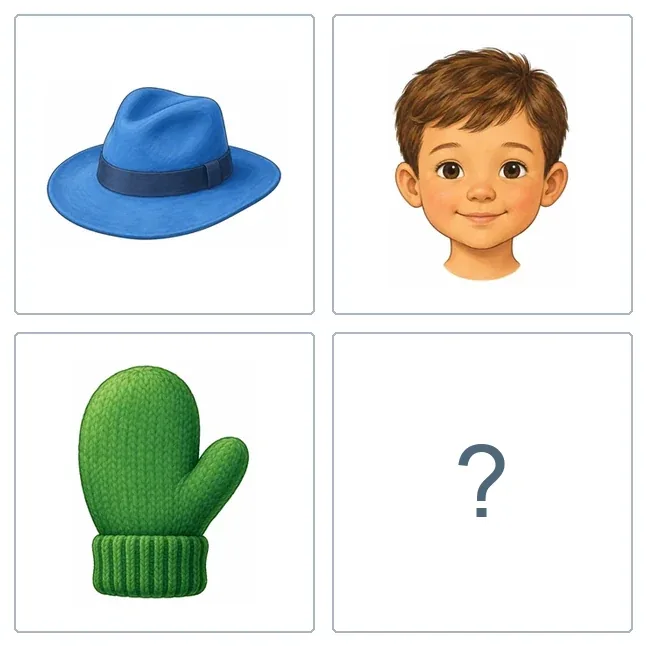
Correct answer: B.
Show answer
Answer: B. A hat covers the head; a mitten covers a hand.
Question 2
Which picture belongs with these three pictures?
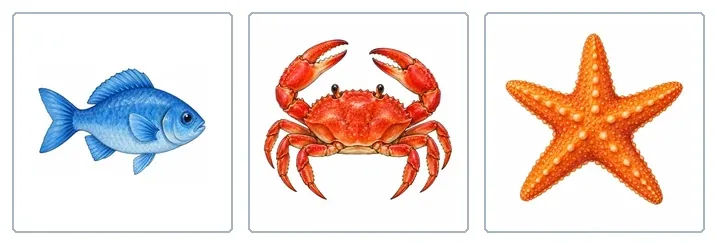
Correct answer: A.
Show answer
Answer: A. A fish, a crab, a starfish and an octopus all live in the sea.
Question 3
The first two pictures go together. Which picture goes with the last picture in the same way?
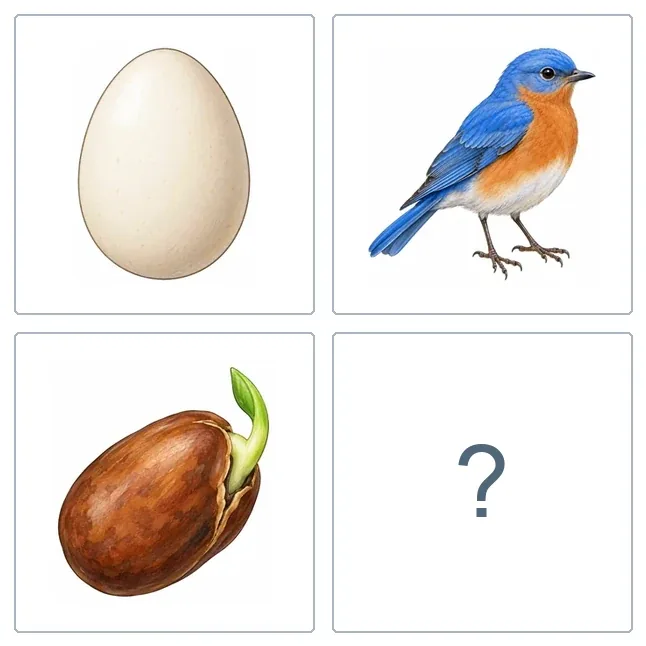
Correct answer: C.
Show answer
Answer: C. A bird can hatch from an egg; a tree can grow from a seed.
Question 4
Which picture belongs with these three pictures?
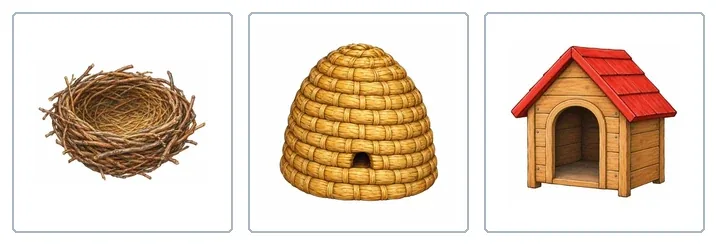
Correct answer: A.
Show answer
Answer: A. A nest, a beehive, a doghouse and a barn are all homes for animals. A bird lives in a nest, but a bird is not a home.
Question 5
Which one do we eat that grows under the ground?
Correct answer: C.
Show answer
Answer: C. We eat carrots, and they grow under the ground. Apples grow on trees, and we do not eat flowers.
Category complete
Your Verbal practice score
0 correct
Nice work exploring the rules. This short set is for practice only; it is not a school score.

Keep practicing in CogAT Test Prep
Free practice questions every day, each with an explanation.
Quantitative practice
Number analogies, puzzles, and series ask what changes between quantities.
Question 1
Each row follows the same number rule. What belongs in the empty box?
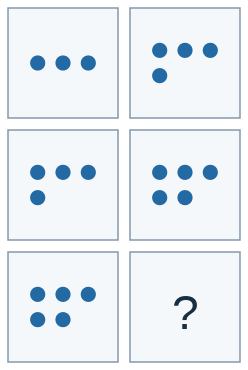
Correct answer: A.
Show answer
Answer: A. Add 1 to the first group in every row. The last group has 5, so the answer has 6.
Question 2
Make both sides equal. What belongs in the empty box?

Correct answer: C.
Show answer
Answer: C. The right side has 8 dots. The left side already shows 3, so the box needs 8 − 3 = 5. Wrong choices: 8 copies the total; 3 copies the group that is shown.
Question 3
Make both sides equal. What belongs in the empty box?
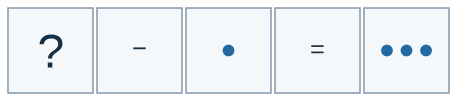
Correct answer: C.
Show answer
Answer: C. Start with 4. Taking away 1 leaves 3.
Question 4
Which group is missing?
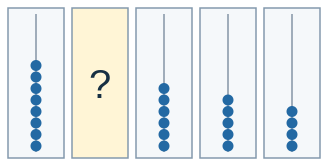
Correct answer: A.
Show answer
Answer: A. Each group has one bead fewer than the one before. Between 8 and 6 comes 7. Wrong choices: 8 copies the group on the left; 6 copies the group on the right.
Question 5
Each row follows the same number rule. What belongs in the empty box?
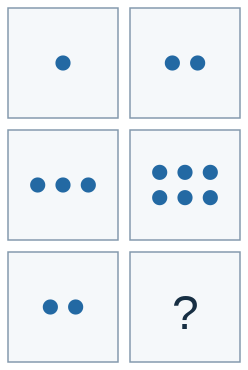
Correct answer: B.
Show answer
Answer: B. In every row the second box has double the dots of the first: 1 becomes 2, and 3 becomes 6. Double 2 is 4.
Category complete
Your Quantitative practice score
0 correct
Nice work exploring the rules. This short set is for practice only; it is not a school score.
Keep practicing in CogAT Test Prep
Free practice questions every day, each with an explanation.
Nonverbal practice
Figure matrices, classification, and paper folding rely on shape, position, count, and direction.
Question 1
Which figure completes the matrix?
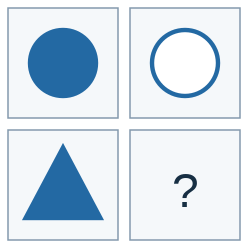
Correct answer: C.
Show answer
Answer: C. The top shape changes between filled and outline. Make the same change to the bottom shape, keeping its shape and color.
Question 2
The arrows show how the paper is folded. A hole is punched through every layer. What will the paper look like when opened?
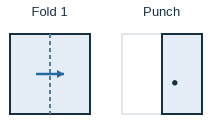
Correct answer: A.
Show answer
Answer: A. The left half is folded over onto the right half, so the punch goes through two layers. When you open the paper, the hole stays where it is and a second hole appears on the other side of the fold, the same distance away, like a mirror. So there are 2 holes side by side.
Question 3
The arrows show how the paper is folded. A hole is punched through every layer. What will the paper look like when opened?
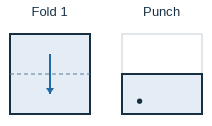
Correct answer: C.
Show answer
Answer: C. The top half is folded down over the bottom half, so the punch goes through two layers. When you open the paper, a second hole appears on the top half, the same distance from the fold, like a mirror. So there are 2 holes, one above the other, near the left side.
Question 4
Which figure belongs with all three examples?

Correct answer: B.
Show answer
Answer: B. Every box has exactly 2 shapes, even though the shapes change. The only choice with 2 shapes is the star and the circle.
Question 5
Which figure completes the matrix?
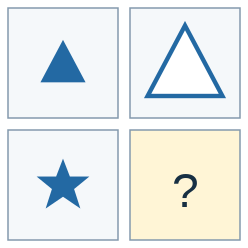
Correct answer: C.
Show answer
Answer: C. In the top row the figure gets bigger and changes from filled to outline. Make both changes to the bottom figure. Wrong choices: it keeps its size; it keeps its fill.
Category complete
Your Nonverbal practice score
0 correct
Nice work exploring the rules. This short set is for practice only; it is not a school score.
Choose another gradeKeep practicing in CogAT Test Prep
Free practice questions every day, each with an explanation.
About this grade’s practice
At kindergarten Level 5/6, begin with the picture rather than the letter beside an answer. Children this age often notice familiar objects quickly but may need time to explain why two go together. Read each prompt slowly, point to the examples, and let the child tell you the rule in ordinary words. These items move from approachable relationships to a few more demanding choices, so stopping after one battery is fine.
Inside the kindergarten Verbal set, two picture analogies ask how a piece of clothing fits a body part and how a living thing grows from where it starts; the classification items ask which animal or home joins a small group, and a listening item gives two clues about a food. Quantitative starts with a one-more dot analogy, then two number puzzles where a child finds the missing amount that balances a sum or a take-away, a counting-down bead rod and a doubling rule. Nonverbal opens with a shape that turns from filled to outlined, two single-fold paper punches, a count-based grouping and a matrix where size and fill change together. Every item can be solved by looking and counting, without letters or written words.
Riverside describes three batteries and nine subtests for CogAT Form 7/8. Its primary subtests usually take about 10–15 minutes each; schools choose the form and schedule. Publisher information checked November 2026. This page has a shorter, untimed practice set and does not estimate a school score.
A parent’s guide to this kindergarten set
Use the first item in each category as a warm-up. Ask your child to describe what they see before naming an answer. When a choice is wrong, look at the highlighted correct one and compare the details. A useful question is, “Which part of your idea still works, and which part needs to change?” That keeps the review about reasoning rather than speed.
For a child in kindergarten, read the prompt aloud without pointing to the right option. Pause at a shape or number diagram and let the child explain it in their own words. If the prompt uses a word they do not know, define it plainly before they choose. The practice then measures whether they can work through the relation, not whether they recognized one unfamiliar word.
Verbal
Picture relationships and word meanings ask a child to find a connection, finish a thought, or decide which examples belong together. At younger levels the pictures carry most of the work; at older levels a short sentence or word pair may carry the rule. Have your child describe the connection before looking at the choices.
Quantitative
Number analogies, puzzles, and series ask what changes between quantities. Some figures use dots so children can count the groups; others show numerals. The useful habit is to state the operation or pattern, then check it against every example before selecting a choice. A quick guess from one row can be misleading.
Nonverbal
Figure matrices, classification, and paper folding rely on shape, position, count, and direction. Children can point to each change they see. For a folding puzzle, imagine opening the paper one fold at a time. For a matrix, test the rule across a complete row before applying it to the empty position.
Each category is arranged in a gentle easy-to-harder order from the app’s own questions. The format is intentionally brief. If a child tires after a category, that is a natural stopping point. You can return another day and revisit the explanation without saving an account or handing over an email address.
Questions parents ask
Which CogAT level or format fits kindergarten?
Kindergarten maps to CogAT Level 5/6 in the publisher's grade guidance. Your school can confirm the form it will administer.
How should we use these practice questions?
Try one category at a time. After each answer, read the explanation together and ask your child to describe the rule. The short score describes only this practice set.
Are these CogAT questions from the publisher's test?
No. Every question here is an original practice item from CogAT Test Prep. These pages and apps are independent of Riverside Insights.
Can we continue after this kindergarten set?
Yes. CogAT Test Prep is a free download for iPhone, iPad, and Android and includes free daily practice questions. The other grade pages here also have different original items.
Publisher sources
Test structure and timing checked November 2026. Your school’s current administration plan controls local details.
CogAT® is a trademark of Riverside Assessments, LLC (Riverside Insights). These pages and apps are independent and are not affiliated with or endorsed by the publisher. Every question is an original practice item from the app, not a publisher test item. iOS: Neobile LLC. Android: KITEBLOOM LLC.