Verbal, quantitative, and nonverbal reasoning
CogAT question types explained for K–5 parents
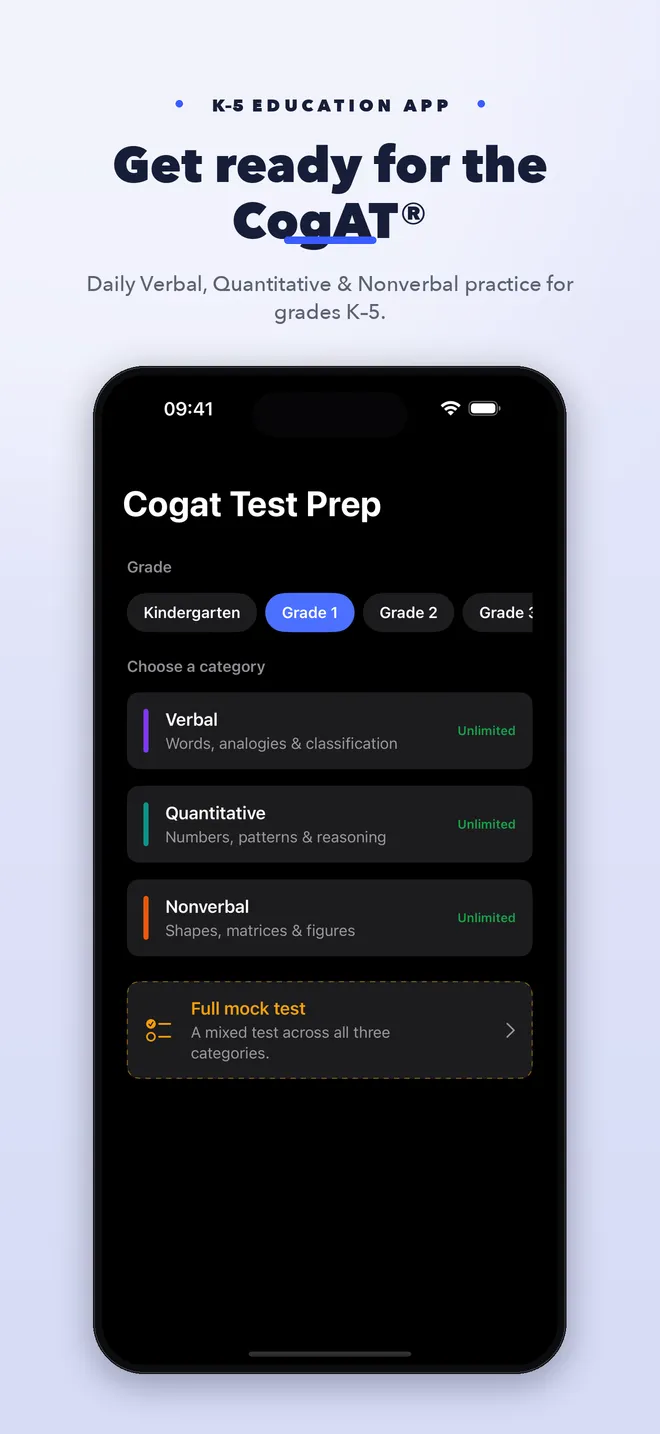
CogAT organizes reasoning into three batteries with three common subtests in each. Verbal questions use words or picture-language relationships, quantitative questions use number relationships, and nonverbal questions use figures and spatial patterns. Learn the directions first, then practice finding and explaining the complete rule.
Schools may use a complete battery, a screening form, or a different level and form. Treat this as a map of common formats and confirm the exact assessment with your school.
Free practice questions each day
01 / The assessment map
Three batteries, nine common reasoning formats
CogAT is designed to show how a student reasons with the kinds of symbols used in school. It is different from a standard achievement test that asks what curriculum content a student has mastered. The complete assessment groups questions into Verbal, Quantitative, and Nonverbal batteries.
The exact presentation depends on level. In kindergarten through second-grade levels, pictures commonly replace much of the reading found in upper levels. Directions still matter, so young children benefit from learning how to listen, scan all answer choices, and point to the relationship they see.
Verbal battery
Verbal reasoning asks a child to understand relationships, complete an idea, or identify a shared category. Lower levels may express these ideas with pictures.
Verbal or Picture Analogies
Find the relationship in one pair, then apply the same relationship to a new pair.
Sentence Completion
Choose the word or picture that makes the sentence or idea complete and logical.
Verbal or Picture Classification
Identify what several items share, then choose another item that belongs to the group.
Quantitative battery
Quantitative reasoning focuses on number patterns and relationships. The work is about seeing how quantities connect, rather than recalling a long list of school formulas.
Number Analogies
Determine how one number changes into another, then use that same rule on a new number.
Number Puzzles
Find the missing value that makes two quantities or parts of an equation balance.
Number Series
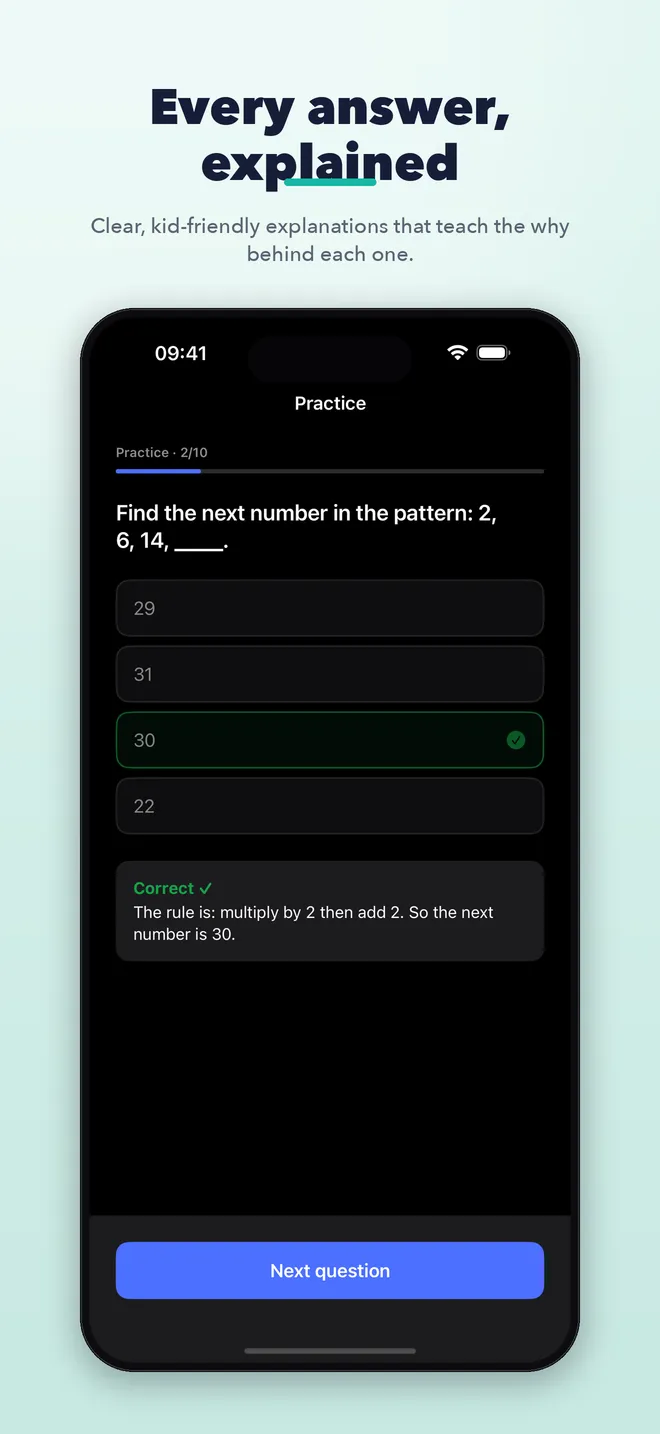
Identify the rule in a sequence and select the number that should come next.
Nonverbal battery
Nonverbal reasoning uses shapes and spatial relationships. It can reduce language demands, but children still need to notice precise visual changes and follow the directions.
Figure Matrices
Find the visual rule across a grid and select the figure that completes the missing space.
Paper Folding
Imagine how folds and punched holes will appear when a piece of paper is opened.
Figure Classification
Determine what a set of figures has in common and choose the figure that follows that property.
Riverside Insights describes all levels as having three batteries and three distinct subtests in each. Review the publisher’s CogAT assessment structure and CogAT overview.
02 / Practice the thinking process
Use the same four questions across every format
Children do not need a separate trick for every example. A small set of reasoning prompts can help across words, numbers, and figures. Begin without a timer so your child can say what they notice. Speed becomes useful only after the directions and process are understood.
What stays the same?
Look for a shared category, repeated amount, fixed position, color, size, direction, or operation.
What changes?
Name the transformation: add, subtract, rotate, reflect, combine, separate, move, or change category.
Does the rule fit everything?
Check the entire pair, sequence, sentence, or matrix. A complete rule should explain every relevant part.
Which choices can be removed?
Eliminate answers that break one part of the rule, then compare the remaining choices carefully.
After a missed item, let your child explain their first idea before giving the answer. This shows whether the challenge came from the directions, an incomplete rule, a calculation slip, or rushing. Use one new example later to see whether the reasoning transfers.
From explanation to next step
Practice all three reasoning areas in CogAT Test Prep
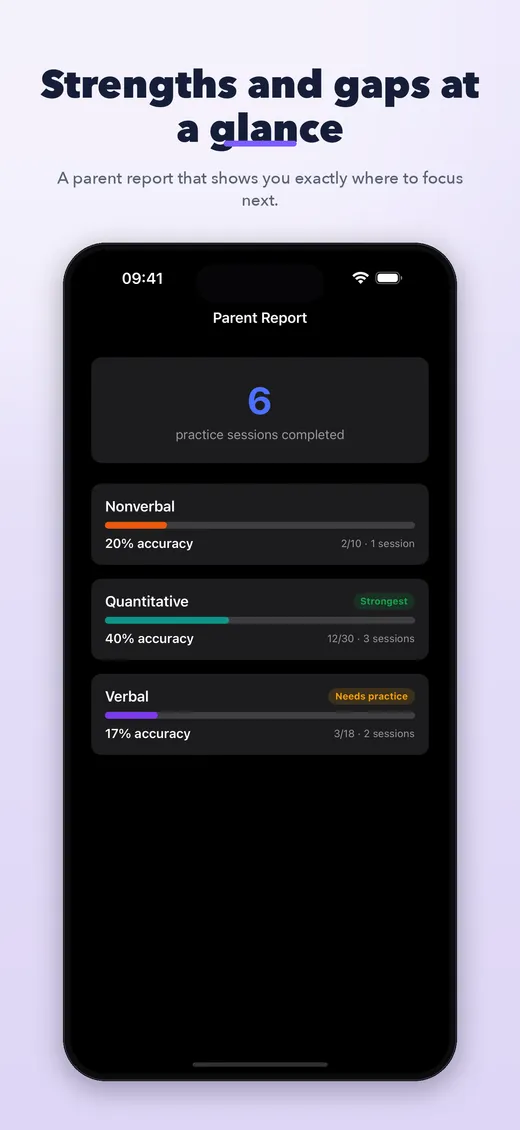
The app provides original practice for grades K–5 in verbal, quantitative, and nonverbal reasoning. Each answer includes an explanation. Families can also use mock tests, the mistakes notebook, progress history, and category reports to keep review focused.
- Grades K–5
- English and Spanish
- Free practice questions each day
- iPhone and iPad
Free practice questions each day
03 / Put the map to work
Choose a practical next step
Parent FAQ
CogAT question types FAQ
What are the three CogAT batteries?
The three batteries are Verbal, Quantitative, and Nonverbal. Each looks at reasoning through a different symbol system: words or language, numbers, and figures or spatial patterns.
How many CogAT question types are there?
The complete CogAT structure uses three subtests in each of the three batteries, for nine common question formats. Names and presentation can differ between lower pictorial levels and upper levels, and a school may administer a screening form instead of the complete battery.
Do kindergarten, first-grade, and second-grade children need to read?
At the lower CogAT levels commonly used from kindergarten through second grade, the publisher says questions are pictorial except for optional Sentence Completion. Confirm the exact level and subtests with your school.
Which CogAT battery should my child practice most?
Start with a small balanced sample. Spend extra time on unfamiliar directions or reasoning processes, while continuing brief practice in stronger areas. A single app report is a practice aid and is not an official CogAT score prediction.
Are practice questions the same as real CogAT questions?
They should not be. Useful preparation uses original questions that introduce the format and reasoning process without copying secure assessment content. CogAT Test Prep uses original practice questions and is independent from Riverside Insights.
CogAT® is a registered trademark of Riverside Insights. CogAT Test Prep is an independent Neobile LLC product. It is not affiliated with, authorized by, or endorsed by Riverside Insights and does not guarantee any score or program placement.