Free practice · Updated November 2026
Free CogAT practice for Grade 1 (Level 7)
Original questions, one at a time, with the answer and a short explanation after every choice. No sign-up and no timer.
 Questions from CogAT Test PrepFree app for iPhone, iPad and AndroidGet the app
Verbal practice
Picture relationships and word meanings ask a child to find a connection, finish a thought, or decide which examples belong together.
Question 1
Which picture belongs with these three pictures?
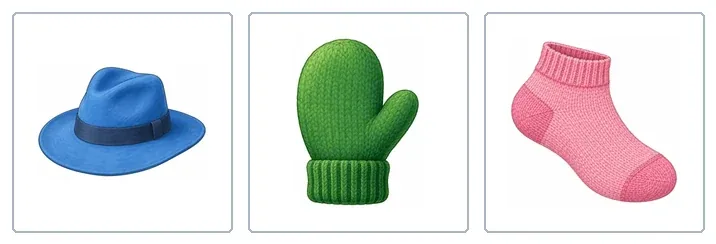
Correct answer: B.
Show answer
Answer: B. A hat, a mitten and a sock are all things we wear. A shoe is something we wear too.
Question 2
Which one do you blow out on a birthday cake?
Correct answer: D.
Show answer
Answer: D. You blow out the candles on a birthday cake.
Question 3
The first two pictures go together. Which picture goes with the last picture in the same way?
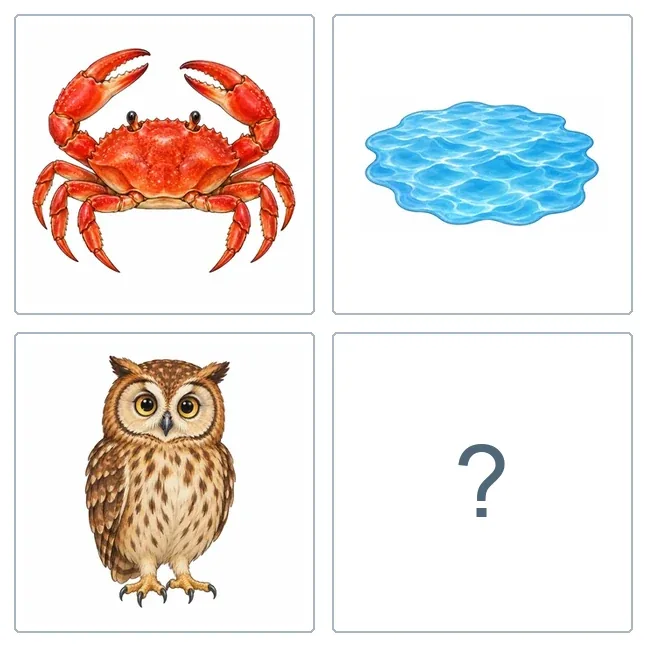
Correct answer: D.
Show answer
Answer: D. A crab lives in the water. An owl lives in a tree. A house is a home for people, and an owl eats mice; neither is the owl's home.
Question 4
Which animal starts as a caterpillar and later has big colorful wings?
Correct answer: C.
Show answer
Answer: C. A caterpillar grows wings and becomes a butterfly. The caterpillar is how it starts, not what it becomes.
Question 5
Which picture belongs with these three pictures?
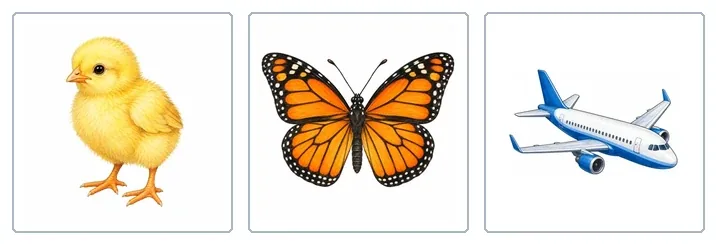
Correct answer: B.
Show answer
Answer: B. A chick, a butterfly, a plane and a bee all have wings. A chick comes from an egg, but an egg has no wings. A caterpillar has no wings yet, and a cloud has none.
Category complete
Your Verbal practice score
0 correct
Nice work exploring the rules. This short set is for practice only; it is not a school score.

Keep practicing in CogAT Test Prep
Free practice questions every day, each with an explanation.
Quantitative practice
Number analogies, puzzles, and series ask what changes between quantities.
Question 1
Make both sides equal. What belongs in the empty box?

Correct answer: B.
Show answer
Answer: B. The right side has 9 dots. The left side already has 3 and 1, which make 4. 9 − 4 = 5, so the box needs 5 dots.
Question 2
Which group comes next?
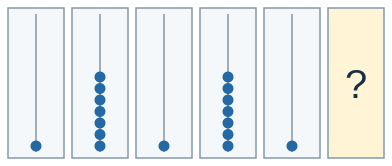
Correct answer: C.
Show answer
Answer: C. The rods take turns: 1 bead, 7 beads, 1 bead, 7 beads, 1 bead. After 1 comes 7.
Question 3
Make both sides equal. What belongs in the empty box?

Correct answer: B.
Show answer
Answer: B. Start with 8. Taking away 2 leaves 6.
Question 4
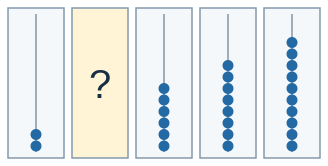
Which group is missing?
Correct answer: A.
Show answer
Answer: A. Each rod has 2 more beads than the one before: 2, 4, 6, 8, 10. The missing rod has 4.
Question 5
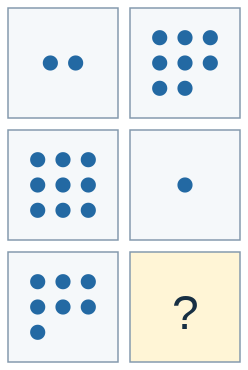
Each row follows the same number rule. What belongs in the empty box?
Correct answer: C.
Show answer
Answer: C. In every row the two boxes together make 10: 2 + 8 = 10 and 9 + 1 = 10. 7 needs 3 more to make 10, so the answer has 3 dots.
Category complete
Your Quantitative practice score
0 correct
Nice work exploring the rules. This short set is for practice only; it is not a school score.
Keep practicing in CogAT Test Prep
Free practice questions every day, each with an explanation.
Nonverbal practice
Figure matrices, classification, and paper folding rely on shape, position, count, and direction.
Question 1
Which figure belongs with all three examples?

Correct answer: A.
Show answer
Answer: A. All three examples are filled in with colour, even though their shapes and colours change. The green arrow is filled in too; the other choices are only outlines.
Question 2
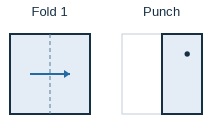
The arrows show how the paper is folded. A hole is punched through every layer. What will the paper look like when opened?
Correct answer: D.
Show answer
Answer: D. The left half is folded over onto the right half, so the punch goes through two layers. When you open the paper, a second hole appears on the left half, the same distance from the fold. So there are 2 holes near the top, one near each side.
Question 3
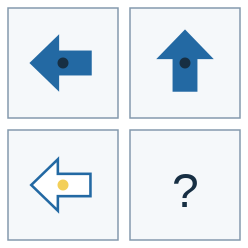
Which figure completes the matrix?
Correct answer: B.
Show answer
Answer: B. The top arrow turns a quarter-turn clockwise. Turn the bottom arrow the same way; keep its outline and center dot.
Question 4
Which figure belongs with all three examples?

Correct answer: B.
Show answer
Answer: B. Every example has exactly 4 straight sides. The answer is the only other 4-sided shape. Wrong choices: it has 3 sides; it has 5 sides; it has no straight sides.
Question 5
The arrows show how the paper is folded. A hole is punched through every layer. What will the paper look like when opened?
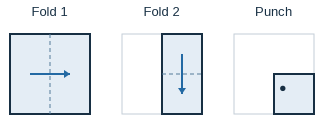
Correct answer: A.
Show answer
Answer: A. The paper is folded twice, so it has 4 layers and one punch makes 4 holes. Each time you unfold, the holes are copied to the other side of the fold like a mirror. The 4 holes make a small square around the middle of the paper.
Category complete
Your Nonverbal practice score
0 correct
Nice work exploring the rules. This short set is for practice only; it is not a school score.
Choose another gradeKeep practicing in CogAT Test Prep
Free practice questions every day, each with an explanation.
About this grade’s practice
First-grade Level 7 keeps visual examples central while asking for more careful comparisons. A child may see a broad similarity, such as two animals, while missing a narrower relationship, such as a home and its occupant. Invite a short explanation before the tap. The sets on this page are deliberately brief; they help you notice whether the child checks every choice without making the session feel like a school exam.
The grade 1 Verbal questions mix three formats. Two picture groupings ask what things we wear have in common and which items share wings, two listening sentences describe a birthday and a stage of an animal’s life, and one analogy links animals to where they live. Quantitative has a three-part number sentence, an alternating bead pattern, a take-away puzzle, a skip-counting rod and a pair of rows that each make ten. In Nonverbal, children sort shapes by filled or outlined while ignoring colour, find a figure with four straight sides among very different outlines, predict holes after one and then two folds, and follow an arrow that makes a quarter turn inside a matrix.
Riverside describes three batteries and nine subtests for CogAT Form 7/8. Its primary subtests usually take about 10–15 minutes each; schools choose the form and schedule. Publisher information checked November 2026. This page has a shorter, untimed practice set and does not estimate a school score.
A parent’s guide to this grade 1 set
Use the first item in each category as a warm-up. Ask your child to describe what they see before naming an answer. When a choice is wrong, look at the highlighted correct one and compare the details. A useful question is, “Which part of your idea still works, and which part needs to change?” That keeps the review about reasoning rather than speed.
For a child in grade 1, read the prompt aloud without pointing to the right option. Pause at a shape or number diagram and let the child explain it in their own words. If the prompt uses a word they do not know, define it plainly before they choose. The practice then measures whether they can work through the relation, not whether they recognized one unfamiliar word.
Verbal
Picture relationships and word meanings ask a child to find a connection, finish a thought, or decide which examples belong together. At younger levels the pictures carry most of the work; at older levels a short sentence or word pair may carry the rule. Have your child describe the connection before looking at the choices.
Quantitative
Number analogies, puzzles, and series ask what changes between quantities. Some figures use dots so children can count the groups; others show numerals. The useful habit is to state the operation or pattern, then check it against every example before selecting a choice. A quick guess from one row can be misleading.
Nonverbal
Figure matrices, classification, and paper folding rely on shape, position, count, and direction. Children can point to each change they see. For a folding puzzle, imagine opening the paper one fold at a time. For a matrix, test the rule across a complete row before applying it to the empty position.
Each category is arranged in a gentle easy-to-harder order from the app’s own questions. The format is intentionally brief. If a child tires after a category, that is a natural stopping point. You can return another day and revisit the explanation without saving an account or handing over an email address.
Questions parents ask
Which CogAT level or format fits grade 1?
Grade 1 maps to CogAT Level 7 in the publisher's grade guidance. Your school can confirm the form it will administer.
How should we use these practice questions?
Try one category at a time. After each answer, read the explanation together and ask your child to describe the rule. The short score describes only this practice set.
Are these CogAT questions from the publisher's test?
No. Every question here is an original practice item from CogAT Test Prep. These pages and apps are independent of Riverside Insights.
Can we continue after this grade 1 set?
Yes. CogAT Test Prep is a free download for iPhone, iPad, and Android and includes free daily practice questions. The other grade pages here also have different original items.
Publisher sources
Test structure and timing checked November 2026. Your school’s current administration plan controls local details.
CogAT® is a trademark of Riverside Assessments, LLC (Riverside Insights). These pages and apps are independent and are not affiliated with or endorsed by the publisher. Every question is an original practice item from the app, not a publisher test item. iOS: Neobile LLC. Android: KITEBLOOM LLC.