Free · K–5 · Updated November 2026
Free CogAT practice test by grade
Pick your child’s grade and start. Every answer is explained. No sign-up, no timer.Every question is original, and the answer and a short explanation appear after each choice. No account, no email address, no timer.

The app behind these practice pages
CogAT Test Prep
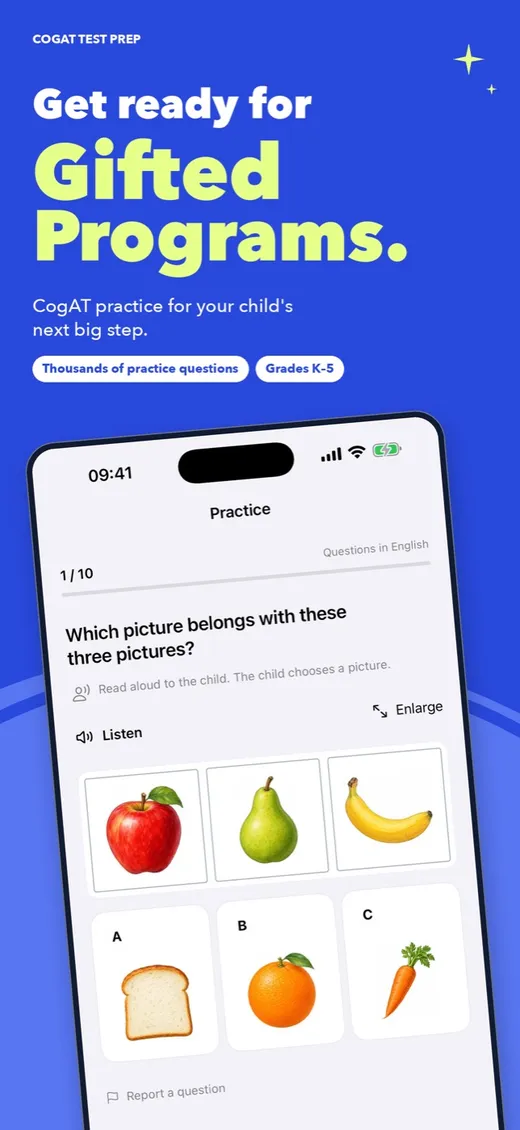
The app behind these pages. Free practice questions every day.Free practice questions every day, each with an explanation. Free to download for iPhone, iPad and Android.
What each grade practices
Open a grade to start a short category. Each category shows one question at a time, and the answer appears as soon as your child taps a choice. Categories stay separate, so a child can pause after one and return later to try another kind of puzzle.
Kindergarten
Verbal · Quantitative · Nonverbal
At kindergarten Level 5/6, begin with the picture rather than the letter beside an answer. Children this age often notice familiar objects quickly but may need time to explain why two go together. Read each prompt slowly, point to the examples, and let the child tell you the rule in ordinary words. These items move from approachable relationships to a few more demanding choices, so stopping after one battery is fine.
Start kindergarten practice Level 7Grade 1
Verbal · Quantitative · Nonverbal
First-grade Level 7 keeps visual examples central while asking for more careful comparisons. A child may see a broad similarity, such as two animals, while missing a narrower relationship, such as a home and its occupant. Invite a short explanation before the tap. The sets on this page are deliberately brief; they help you notice whether the child checks every choice without making the session feel like a school exam.
Start grade 1 practice Level 8Grade 2
Verbal · Quantitative · Nonverbal
Second-grade Level 8 is the last of the primary picture levels. Children still hear the directions and answer with pictures rather than reading, so these original questions use the same picture formats, one step harder than the grade 1 set. They are for getting familiar with Level 8, and their difficulty is not calibrated to a publisher norm. If an item feels unusually easy or hard, discuss the rule rather than treating the score as a prediction.
Start grade 2 practice Level 9Grade 3
Verbal · Quantitative · Nonverbal
Third-grade Level 9 adds more language and multi-step reasoning to this practice mix. A child who did well with simple picture pairs may now need to compare several possible word meanings or keep a number operation in mind while scanning choices. Ask for a verbal description of the rule, then a second check against the examples. The page is a small skill sampler rather than a timed version of the school assessment.
Start grade 3 practice Level 10Grade 4
Verbal · Quantitative · Nonverbal
Fourth-grade Level 10 often rewards patience with details. In these original questions, the tempting choices can satisfy only part of a number or figure rule. Have your child mark the feature that changed first, then look for another feature before answering. Reading a word item together is reasonable during practice; the goal here is to understand the reasoning, not to use this set as a measure of independent reading.
Start grade 4 practice Level 11Grade 5
Verbal · Quantitative · Nonverbal
Fifth-grade Level 11 brings more abstract vocabulary and longer numerical relationships. A child might need to consider two candidate meanings or test a rule across more than one step. Let them explain why a distractor fails, even after a correct answer. That conversation shows more than a short score and gives you a practical way to choose the next category for a later session.
Start grade 5 practiceWhat is CogAT?
Riverside describes CogAT Form 7/8 as three batteries: Verbal, Quantitative, and Nonverbal. Together they contain nine subtests. The primary levels are picture-based; each subtest commonly takes about 10–15 minutes. Schools may give a screening form or a fuller set. These publisher facts were checked November 2026 against the sources below. The grade pages on this site are independent practice, so their length, order, and untimed experience differ from a school administration.
The CogAT is used by many schools as one piece of information about how students reason with words and pictures, numbers, and figures. The three batteries do not all feel alike to a child. One item might ask for a relationship between two everyday objects, another for a number rule, and another for a missing figure. A child who understands one format may still need to learn how to inspect a different one.
At the youngest CogAT levels, many tasks rely on familiar pictures and spoken directions. By later elementary grades, words and more complicated numeric relationships appear in the practice mix. This change is why the grade switcher matters: a question that is interesting to an older student may feel like a vocabulary puzzle to a kindergartner. Begin with the grade your school identifies, then use neighboring grade pages only as extra playful practice.
CogAT practice without pressure
A useful CogAT session begins by choosing one battery rather than attempting everything at once. In the Verbal battery, ask what two pictures or words have in common. In Quantitative work, let a child test a number relation on every visible row. In Nonverbal work, encourage attention to orientation as well as shape. By the end of a short set, the child should be able to name a rule in their own words. That matters more than finishing quickly.
What a short session can show
When your child reaches the end of a CogAT category, ask how their strategy changed from the first item. Did they begin by naming the relationship, counting a set, or tracing a figure? Those observations can tell you which directions are familiar and which need another calm example. The page supplies an answer immediately because practice is most helpful while the puzzle is still in mind. A school report is a separate document; nothing on this site converts practice answers into its scores.
What does each category ask a child to do?
Read these descriptions before choosing a grade if the names are unfamiliar. These are the names our practice uses; a district’s score report may group results differently. The child-facing page keeps each category short and gives feedback only after an answer, so the child can first try to discover the rule on their own.
Verbal
Picture relationships and word meanings ask a child to find a connection, finish a thought, or decide which examples belong together. At younger levels the pictures carry most of the work; at older levels a short sentence or word pair may carry the rule. Have your child describe the connection before looking at the choices.
Quantitative
Number analogies, puzzles, and series ask what changes between quantities. Some figures use dots so children can count the groups; others show numerals. The useful habit is to state the operation or pattern, then check it against every example before selecting a choice. A quick guess from one row can be misleading.
Nonverbal
Figure matrices, classification, and paper folding rely on shape, position, count, and direction. Children can point to each change they see. For a folding puzzle, imagine opening the paper one fold at a time. For a matrix, test the rule across a complete row before applying it to the empty position.
How should a parent use the practice pages?
- Choose the grade named by your school. A school can confirm the test and level it will give. Begin with one category, then stop if your child has had enough.
- Let the child try first. Ask what looks the same and what changes. For K–2, read a prompt aloud in a calm voice, and leave the choice to the child.
- Read the explanation aloud after the tap. A missed question is useful if your child can name the overlooked feature on the second look. Revisit the picture rather than moving quickly to the next score.
- Make a plan from the rule, not the number. A short practice score is too small to describe ability. If rotation was hard, try one more shape puzzle another day; if a number series was fun, try a different series.
- Keep the experience light. This site has no timer or account requirement. A child who enjoys figuring out why an answer works is more likely to stay curious than one asked to race through every category.
For CogAT grade 2 (Level 8), the questions stay picture-based, as at Levels 5/6 and 7: a child listens to the directions and picks a picture. The grade 2 set therefore keeps the picture formats and steps the difficulty up from grade 1. Like every set here, it is practice, not a calibrated Level 8 form.
Publisher format at a glance
The table is a brief orientation, not a substitute for school instructions. Use the cited publisher pages for full administration details; a district decides how an assessment fits into its identification process.
| Area | Publisher description | Practice here |
|---|---|---|
| Structure | Riverside describes CogAT Form 7/8 as three batteries: Verbal, Quantitative, and Nonverbal. Together they contain nine subtests. The primary levels are picture-based; each subtest commonly takes about 10–15 minutes. Schools may give a screening form or a fuller set. | Original items in every available category |
| Feedback | School testing follows publisher administration rules | Immediate answer and a short explanation |
| Timing | About 10–15 minutes per primary subtest | Untimed; pause after any category |
Questions parents ask
Which CogAT level matches each grade?
Riverside maps kindergarten to Levels 5/6, grade 1 to Level 7, grade 2 to Level 8, grade 3 to Level 9, grade 4 to Level 10, and grade 5 to Level 11. Your school confirms its form.
Do these questions predict a CogAT score?
No. A short, untimed practice page cannot be converted into a CogAT score or percentile. Use it to learn how your child explains a rule.
Where can my child keep practicing after these pages?
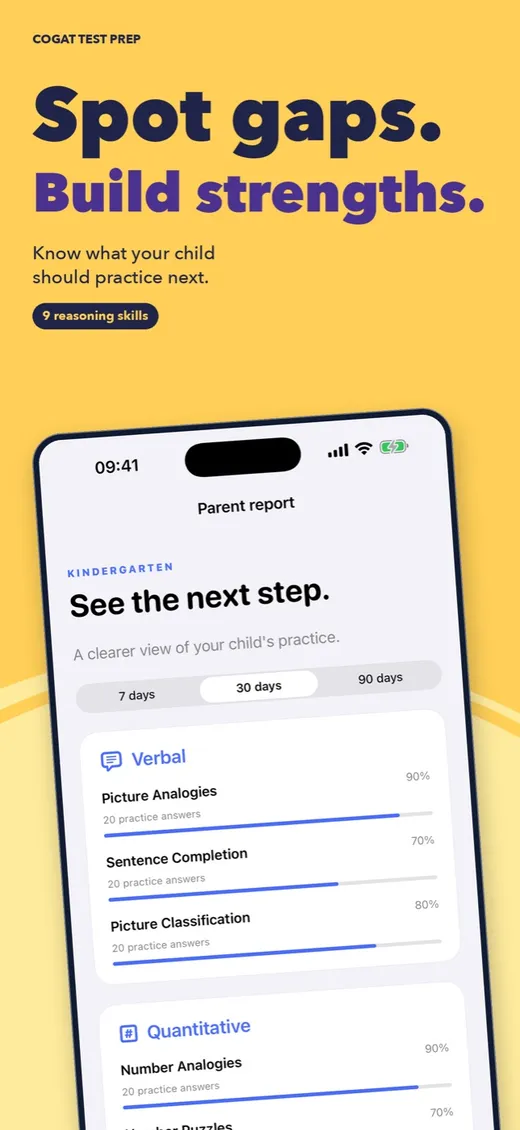
In CogAT Test Prep, the app these questions come from, free to download for iPhone, iPad and Android. It follows your child’s grade in all nine CogAT skills with an explanation after each question, adds a full mock test across the three batteries and screening-length practice for grades 2–5, and its parent report shows each skill over 7, 30 or 90 days.
Sources
Publisher information checked November 2026. For local decisions, ask your child’s school.
CogAT® is a trademark of Riverside Assessments, LLC (Riverside Insights). These pages and apps are independent and are not affiliated with or endorsed by the publisher. Every question is an original practice item from the app, not a publisher test item. iOS: Neobile LLC. Android: KITEBLOOM LLC.