Free practice · Updated November 2026
Free CogAT practice for Grade 4 (Level 10)
Original questions, one at a time, with the answer and a short explanation after every choice. No sign-up and no timer.
 Questions from CogAT Test PrepFree app for iPhone, iPad and AndroidGet the app
Verbal practice
Picture relationships and word meanings ask a child to find a connection, finish a thought, or decide which examples belong together.
Question 1
author : novel :: composer : ?
Correct answer: A.
Show answer
Answer: A. A novel is a work created by an author; a symphony is a work created by a composer.
Question 2
Which word belongs with: whisper, murmur, mutter?
Correct answer: E.
Show answer
Answer: E. All three examples are ways to speak in a low or indistinct voice. Mumble belongs to that group.
Question 3
carpenter : wood :: sculptor : ?
Correct answer: B.
Show answer
Answer: B. A carpenter shapes wood. A sculptor shapes stone. A chisel is a tool and a statue is the finished work, not the material.
Question 4
Which word belongs with: bud, sapling, seedling?
Correct answer: E.
Show answer
Answer: E. All three examples are young or newly developing plant growth. Sprout belongs to that group.
Question 5
Kai apologized sincerely, hoping to ____ the misunderstanding.
Correct answer: D.
Show answer
Answer: D. Kai is sorry and wants to fix the misunderstanding, so he hopes to resolve it.
Category complete
Your Verbal practice score
0 correct
Nice work exploring the rules. This short set is for practice only; it is not a school score.

Keep practicing in CogAT Test Prep
Free practice questions every day, each with an explanation.
Quantitative practice
Number analogies, puzzles, and series ask what changes between quantities.
Question 1
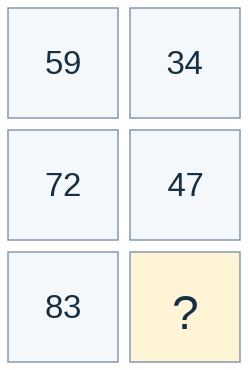
Each row follows the same number rule. What belongs in the empty box?
Correct answer: A.
Show answer
Answer: A. Each second number is 25 less than the first: 59 − 25 = 34 and 72 − 25 = 47. So 83 − 25 = 58.
Question 2
? × 4 + 13 = 61
Correct answer: A.
Show answer
Answer: A. First subtract 13: 61 − 13 = 48. Then divide by 4: ? = 12.
Question 3
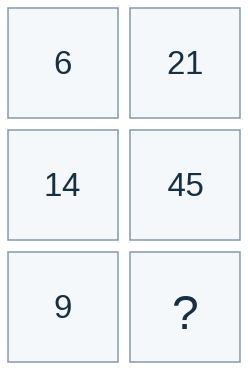
Each row follows the same number rule. What belongs in the empty box?
Correct answer: D.
Show answer
Answer: D. Multiply by 3, then add 3: 6 × 3 + 3 = 21 and 14 × 3 + 3 = 45. So 9 × 3 + 3 = 30.
Question 4
? × 3 − 9 = 4 × 6
Correct answer: E.
Show answer
Answer: E. The right side is 4 × 6 = 24, so ? × 3 − 9 = 24. Add 9 back: ? × 3 = 33. Divide by 3: ? = 11.
Question 5
What number comes next? 6, 39, 9, 37, 12, 35, ?
Correct answer: B.
Show answer
Answer: B. Two patterns take turns. The 1st, 3rd and 5th numbers go up by 3: 6, 9, 12. The 2nd, 4th and 6th go down by 2: 39, 37, 35. The next number belongs to the first pattern: 12 + 3 = 15.
Category complete
Your Quantitative practice score
0 correct
Nice work exploring the rules. This short set is for practice only; it is not a school score.
Keep practicing in CogAT Test Prep
Free practice questions every day, each with an explanation.
Nonverbal practice
Figure matrices, classification, and paper folding rely on shape, position, count, and direction.
Question 1
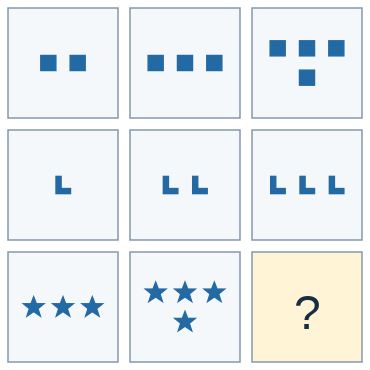
Which figure completes the matrix?
Correct answer: E.
Show answer
Answer: E. In each row the number of shapes grows by one from left to right: 2, 3, 4. The star row has 3 and then 4 stars, so the last box has 5 stars.
Question 2
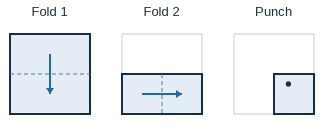
The arrows show how the paper is folded. A hole is punched through every layer. What will the paper look like when opened?
Correct answer: C.
Show answer
Answer: C. The paper is folded twice, so one punch makes 4 holes. Each time you unfold, the holes are copied to the other side of the fold like a mirror. The 4 holes make a square around the middle of the paper.
Question 3
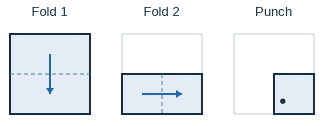
The arrows show how the paper is folded. A hole is punched through every layer. What will the paper look like when opened?
Correct answer: D.
Show answer
Answer: D. The paper is folded twice, so one punch makes 4 holes. Each time you unfold, the holes are copied across the fold like a mirror. That gives 2 holes near the top and 2 near the bottom, close to the middle line.
Question 4
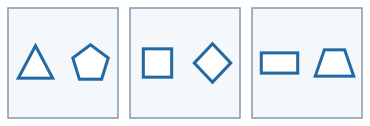
Which figure belongs with all three examples?
Correct answer: A.
Show answer
Answer: A. In every example the two shapes have 8 sides altogether (3 + 5, 4 + 4, 4 + 4). The triangle and the 5-sided shape also make 3 + 5 = 8.
Question 5
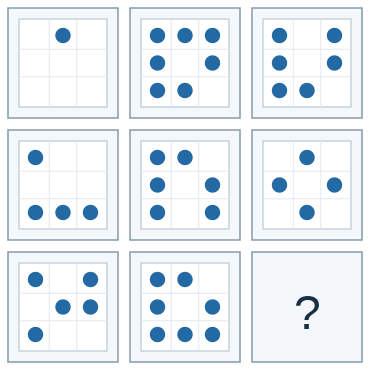
Which figure completes the matrix?
Correct answer: C.
Show answer
Answer: C. In each row, compare the first two boxes spot by spot. A spot with a dot in only one of them gets a dot in the third box. A spot with a dot in both boxes stays empty. Do the same for the bottom row.
Category complete
Your Nonverbal practice score
0 correct
Nice work exploring the rules. This short set is for practice only; it is not a school score.
Choose another gradeKeep practicing in CogAT Test Prep
Free practice questions every day, each with an explanation.
About this grade’s practice
Fourth-grade Level 10 often rewards patience with details. In these original questions, the tempting choices can satisfy only part of a number or figure rule. Have your child mark the feature that changed first, then look for another feature before answering. Reading a word item together is reasonable during practice; the goal here is to understand the reasoning, not to use this set as a measure of independent reading.
The fourth-grade Verbal set asks for precise word knowledge: an analogy from author to novel, another from worker to material with tempting tool and product choices, a group of words for speaking quietly, a group of words for a young plant and a sentence that turns on the purpose of an apology. Quantitative steps up to regrouping in a subtraction analogy, two-step equations with multiplication, a multiply-then-add rule and two series woven together. Nonverbal includes a matrix where each row keeps its shape while the count grows, two-fold punches with holes in a square and near the fold line, a grouping by the total number of sides and a dot matrix that keeps only the dots found in one box.
Riverside describes three batteries and nine subtests for CogAT Form 7/8. Its primary subtests usually take about 10–15 minutes each; schools choose the form and schedule. Publisher information checked November 2026. This page has a shorter, untimed practice set and does not estimate a school score.
A parent’s guide to this grade 4 set
Use the first item in each category as a warm-up. Ask your child to describe what they see before naming an answer. When a choice is wrong, look at the highlighted correct one and compare the details. A useful question is, “Which part of your idea still works, and which part needs to change?” That keeps the review about reasoning rather than speed.
Verbal
Picture relationships and word meanings ask a child to find a connection, finish a thought, or decide which examples belong together. At younger levels the pictures carry most of the work; at older levels a short sentence or word pair may carry the rule. Have your child describe the connection before looking at the choices.
Quantitative
Number analogies, puzzles, and series ask what changes between quantities. Some figures use dots so children can count the groups; others show numerals. The useful habit is to state the operation or pattern, then check it against every example before selecting a choice. A quick guess from one row can be misleading.
Nonverbal
Figure matrices, classification, and paper folding rely on shape, position, count, and direction. Children can point to each change they see. For a folding puzzle, imagine opening the paper one fold at a time. For a matrix, test the rule across a complete row before applying it to the empty position.
Each category is arranged in a gentle easy-to-harder order from the app’s own questions. The format is intentionally brief. If a child tires after a category, that is a natural stopping point. You can return another day and revisit the explanation without saving an account or handing over an email address.
Questions parents ask
Which CogAT level or format fits grade 4?
Grade 4 maps to CogAT Level 10 in the publisher's grade guidance. Your school can confirm the form it will administer.
How should we use these practice questions?
Try one category at a time. After each answer, read the explanation together and ask your child to describe the rule. The short score describes only this practice set.
Are these CogAT questions from the publisher's test?
No. Every question here is an original practice item from CogAT Test Prep. These pages and apps are independent of Riverside Insights.
Can we continue after this grade 4 set?
Yes. CogAT Test Prep is a free download for iPhone, iPad, and Android and includes free daily practice questions. The other grade pages here also have different original items.
Publisher sources
Test structure and timing checked November 2026. Your school’s current administration plan controls local details.
CogAT® is a trademark of Riverside Assessments, LLC (Riverside Insights). These pages and apps are independent and are not affiliated with or endorsed by the publisher. Every question is an original practice item from the app, not a publisher test item. iOS: Neobile LLC. Android: KITEBLOOM LLC.