Free practice · Updated November 2026
Free NGAT practice for Grade 4
Original questions, one at a time, with the answer and a short explanation after every choice. No sign-up and no timer.
 Questions from NGAT Test PrepFree app for iPhone, iPad and AndroidGet the app
Verbal practice
These picture concepts use familiar objects or visible attributes.
Question 1
Which picture does not belong?
Correct answer: E.
Show answer
Answer: E. Five pictures show musical instruments. The jellyfish is not a musical instrument.
Question 2
Which picture does not belong?
Correct answer: D.
Show answer
Answer: D. Five pictures have the same objects in both rows, in a different order. The picture with the car, the cheese, the cup and the paintbrush on top does not.
Question 3
Which picture does not belong?
Correct answer: F.
Show answer
Answer: F. Five pictures follow this rule: whenever the top part shows an empty container, the two objects at the bottom match; otherwise they are different. The other picture breaks it: its top part does not show an empty container, but the two objects at the bottom match.
Question 4
Which picture does not belong?
Correct answer: B.
Show answer
Answer: B. Five pictures have every object moved one place to the left (the first one goes to the end). The picture with the fork, the book, the paper and the snow on top does not.
Question 5
Which picture does not belong?
Correct answer: D.
Show answer
Answer: D. Five pictures show things used to measure. The pencil is not used to measure.
Category complete
Your Verbal practice score
0 correct
Nice work exploring the rules. This short set is for practice only; it is not a school score.

Keep practicing in NGAT Test Prep
New free practice questions every day, each with an explanation.
Nonverbal practice
Shape patterns can change by count, rotation, placement, or more than one feature at once.
Question 1
Which answer completes the pattern?
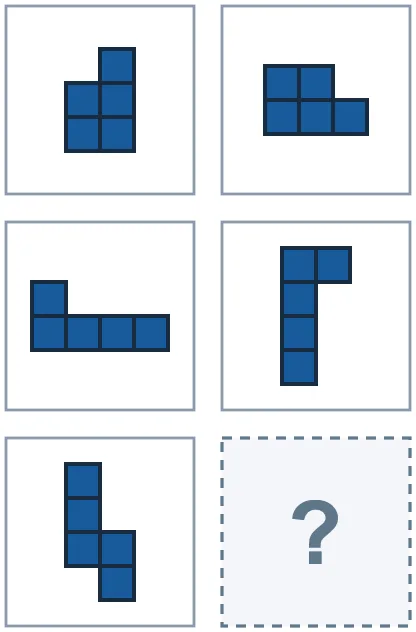
Correct answer: E.
Show answer
Answer: E. Every row uses the same move: turn it a quarter turn clockwise. Do the same to the last shape.
Question 2
Which answer completes the pattern?
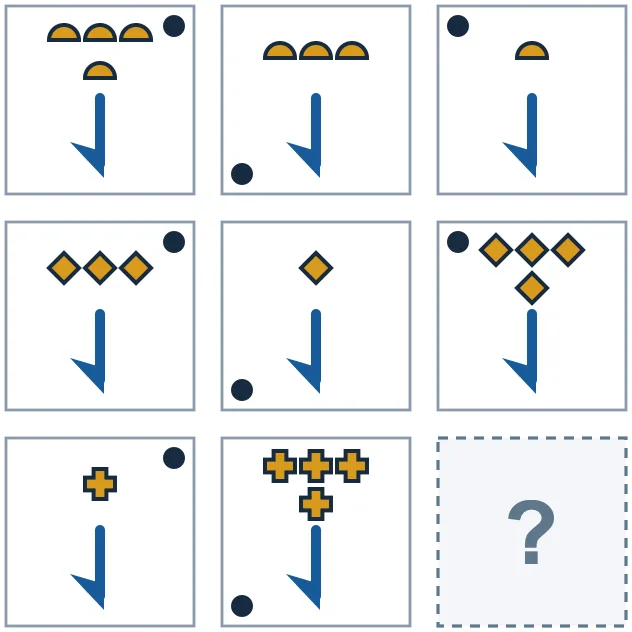
Correct answer: C.
Show answer
Answer: C. For the number of small shapes, the missing picture takes the one that its row and its column do not have yet.
Question 3
Which answer completes the pattern?
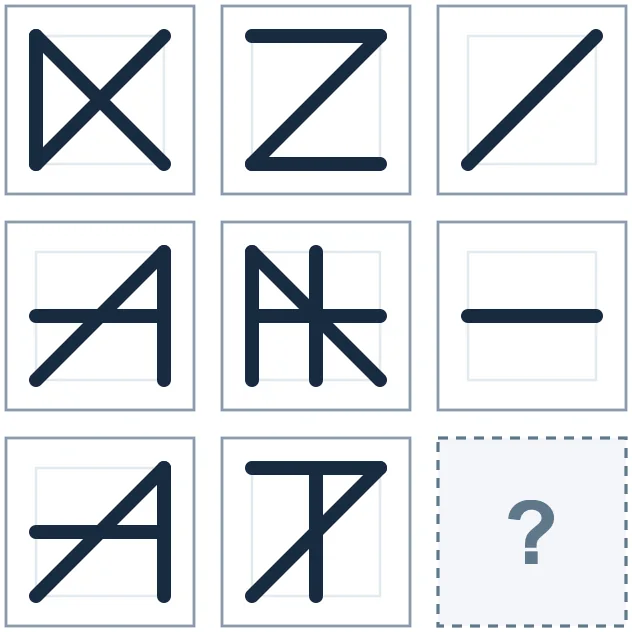
Correct answer: B.
Show answer
Answer: B. Keep only the lines that are in both figures.
Question 4
Which answer completes the pattern?
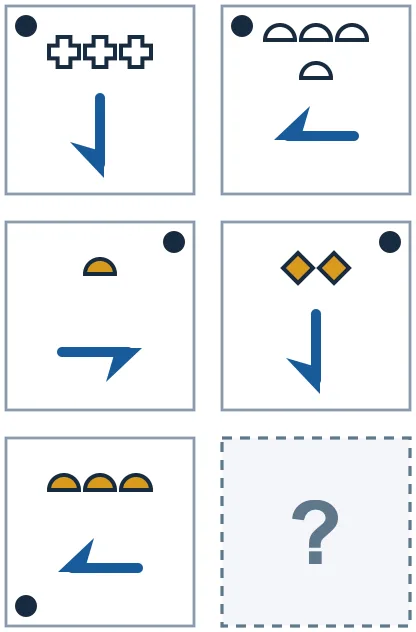
Correct answer: D.
Show answer
Answer: D. Do the same to the third picture.
Question 5
Which answer completes the pattern?
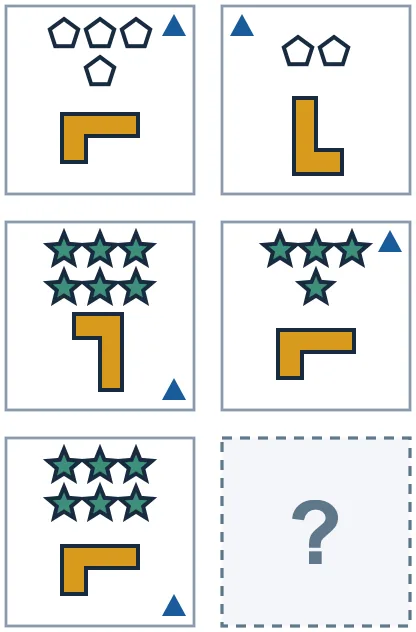
Correct answer: C.
Show answer
Answer: C. The change: take away 2 small shapes, turn the boot shape a quarter turn to the left and move the mark one corner counterclockwise.
Category complete
Your Nonverbal practice score
0 correct
Nice work exploring the rules. This short set is for practice only; it is not a school score.
Keep practicing in NGAT Test Prep
New free practice questions every day, each with an explanation.
Quantitative practice
Number items may use sequences, small equations, or grids.
Question 1
Which answer completes the pattern?

Correct answer: C.
Show answer
Answer: C. Each number is 12 less than the one before: 35 − 12 = 23.
Question 2
Which answer completes the pattern?
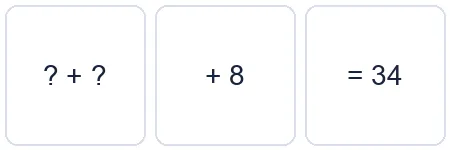
Correct answer: A.
Show answer
Answer: A. Check: 13 + 13 + 8 = 34.
Question 3
Which answer completes the pattern?
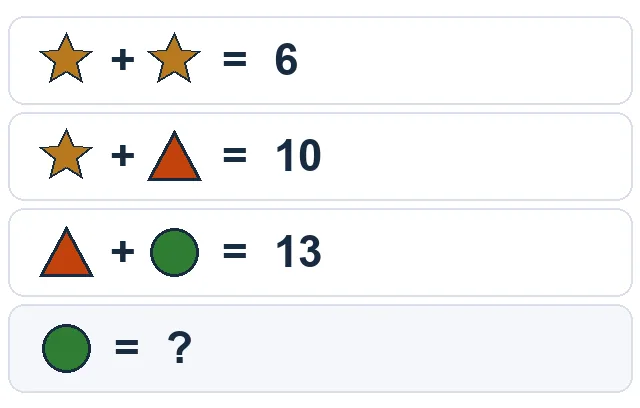
Correct answer: C.
Show answer
Answer: C. Row 3: one triangle + one circle = 13, so the circle is 13 − 7 = 6.
Question 4
Which answer completes the pattern?
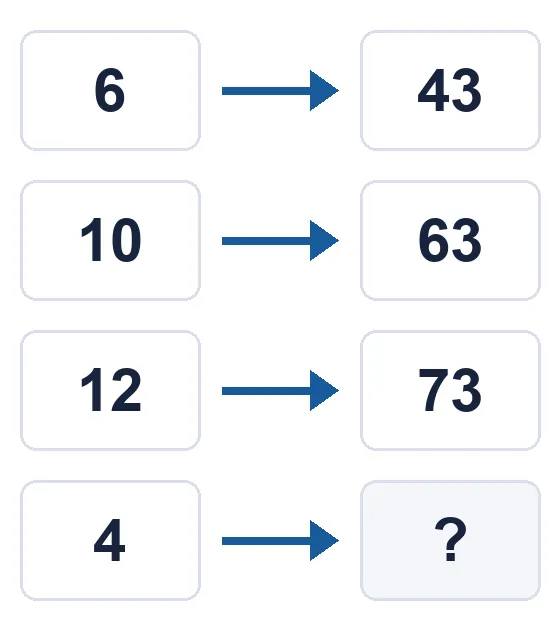
Correct answer: B.
Show answer
Answer: B. The machine multiplies by 5, then adds 13: 5 × 4 + 13 = 33.
Question 5
Which answer completes the pattern?

Correct answer: B.
Show answer
Answer: B. Each number is the sum of the two numbers before it: 5 + 9 = 14, 9 + 14 = 23, 14 + 23 = 37. So 1 + ? must make 5, and the missing number is 4. Check: 4 + 5 = 9.
Category complete
Your Quantitative practice score
0 correct
Nice work exploring the rules. This short set is for practice only; it is not a school score.
Choose another gradeKeep practicing in NGAT Test Prep
New free practice questions every day, each with an explanation.
About this grade’s practice
For grade 4, try asking your child to defend a choice before showing feedback. A quick answer may match a visible feature while overlooking a second relationship. The picture-concept set, shape set, and number set are separate, so you can pause between them. Read the choice-specific reason after a wrong answer; it explains the tempting part of the rule as well as the missing part.
For grade 4 the Verbal set again cycles through category, relationship and state, now with pictures whose shared idea is less literal. Nonverbal questions use rotation across a row, a Latin grid, an overlay that keeps only the lines both figures share, and two analogies that add or take away parts. The Quantitative items include a series that falls by twelve, a subtraction written as a visual equation, a two-row shape-value puzzle with stars, a number machine and a closing sequence in which each number depends on the two before it. That last item is a good one to talk through slowly, because the rule is not a single fixed step. Fourth graders can usually read the prompts on their own, so try letting them work a whole category independently and then review the explanations together. Noticing which skill caused the misses tells you more than the score does. A child who misses mostly number items, for example, may simply need more practice with two-step rules rather than more practice overall.
MHS describes three separate NGAT tests. The time limit per test is 35 minutes for this grade band. A school may choose which tests to give. Publisher information checked November 2026. This page has a shorter, untimed practice set and does not estimate a school score.
A parent’s guide to this grade 4 set
Use the first item in each category as a warm-up. Ask your child to describe what they see before naming an answer. When a choice is wrong, look at the highlighted correct one and compare the details. A useful question is, “Which part of your idea still works, and which part needs to change?” That keeps the review about reasoning rather than speed.
Verbal
These picture concepts use familiar objects or visible attributes. Five options usually follow one idea and one does not. Ask your child to name the idea shared by the majority; then test whether the odd choice truly breaks it. The task is about the relationship among pictures, not reading a word aloud.
Nonverbal
Shape patterns can change by count, rotation, placement, or more than one feature at once. It helps to narrate one change at a time: first the number, then the position, then the orientation. The right tile must satisfy the whole pattern.
Quantitative
Number items may use sequences, small equations, or grids. The child needs to compare how numbers change, then apply the same rule. A useful check is to work backward from a candidate answer. If the rule fails on an earlier example, try a different one.
Each category is arranged in a gentle easy-to-harder order from the app’s own questions. The format is intentionally brief. If a child tires after a category, that is a natural stopping point. You can return another day and revisit the explanation without saving an account or handing over an email address.
Questions parents ask
Which NGAT level or format fits grade 4?
NGAT uses grade-based forms rather than the lettered levels shown for some other tests. Ask the school which of the three NGAT tests it gives in grade 4.
How should we use these practice questions?
Try one category at a time. After each answer, read the explanation together and ask your child to describe the rule. The short score describes only this practice set.
Are these NGAT questions from the publisher's test?
No. Every question here is an original practice item from NGAT Test Prep. These pages and apps are independent of MHS (Multi-Health Systems).
Can we continue after this grade 4 set?
Yes. NGAT Test Prep is a free download for iPhone, iPad, and Android and includes free daily practice questions. The other grade pages here also have different original items.
Publisher sources
Test structure and timing checked November 2026. Your school’s current administration plan controls local details.
NGAT is published by MHS (Multi-Health Systems). These pages and apps are independent and are not affiliated with or endorsed by the publisher. Every question is an original practice item from the app, not a publisher test item. iOS: Neobile LLC. Android: KITEBLOOM LLC.