Free · K–5 · Updated November 2026
Free NGAT practice test by grade
Pick your child’s grade and start. Every answer is explained. No sign-up, no timer.Every question is original, and the answer and a short explanation appear after each choice. No account, no email address, no timer.

The app behind these practice pages
NGAT Test Prep
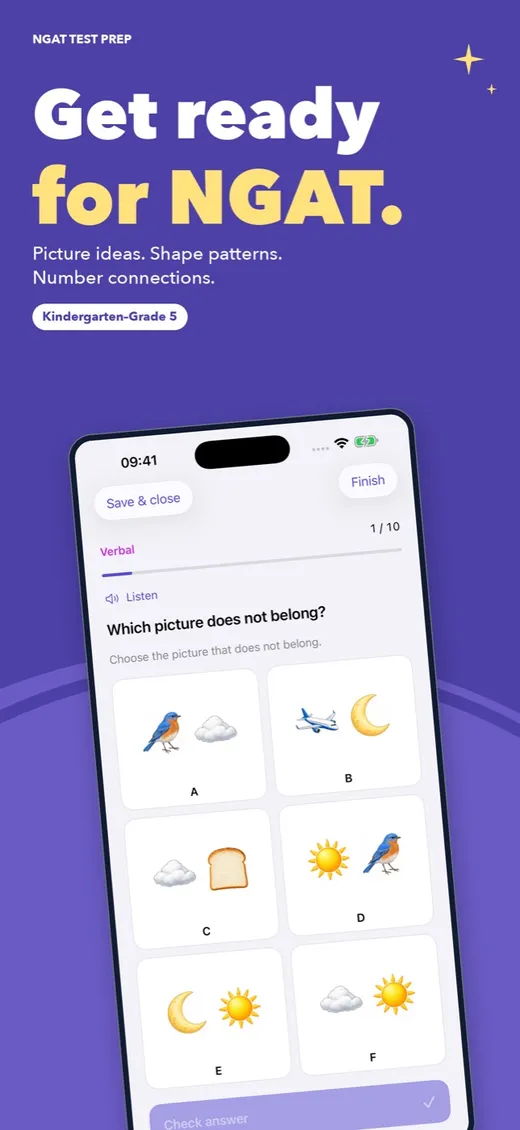
The app behind these pages. Free practice questions every day.New free practice questions every day, each with an explanation. Free to download for iPhone, iPad and Android.
What each grade practices
Open a grade to start a short category. Each category shows one question at a time, and the answer appears as soon as your child taps a choice. Categories stay separate, so a child can pause after one and return later to try another kind of puzzle.
Kindergarten
Verbal · Nonverbal · Quantitative
For a kindergartner, begin with concrete pictures and short pauses. Ask which five objects share an idea before naming the odd one, and let your child count or point when numbers appear. The three sets introduce picture concepts, shape patterns, and number relationships separately. They are original app practice items, so their result can guide a conversation about a rule without standing in for a school assessment.
Start kindergarten practiceGrade 1
Verbal · Nonverbal · Quantitative
First-grade children may be ready to explain a pattern with two changes rather than one. When a picture pair seems confusing, let them describe what stayed the same first. For a number sequence, invite counting aloud; for a shape matrix, trace one row at a time. These sets are meant to make the formats familiar while preserving the pleasure of solving a puzzle together.
Start grade 1 practiceGrade 2
Verbal · Nonverbal · Quantitative
In grade 2, Fairfax County Public Schools gives the online NGAT to second graders, according to its local screening information. Elsewhere, school use and timing may differ, so ask your district what it administers. The original questions here span the three MHS categories. Give your child room to test a rule across several examples before choosing, especially when a tempting answer fits only part of the picture.
Start grade 2 practiceGrade 3
Verbal · Nonverbal · Quantitative
Third-grade NGAT practice can include richer number and shape rules. A child may need to hold two changes in mind, such as a count and a position, or infer why five pictures belong together. The set is arranged from easier to harder within each area. After a miss, compare the chosen choice with the correct one and describe the exact feature that breaks the pattern.
Start grade 3 practiceGrade 4
Verbal · Nonverbal · Quantitative
For grade 4, try asking your child to defend a choice before showing feedback. A quick answer may match a visible feature while overlooking a second relationship. The picture-concept set, shape set, and number set are separate, so you can pause between them. Read the choice-specific reason after a wrong answer; it explains the tempting part of the rule as well as the missing part.
Start grade 4 practiceGrade 5
Verbal · Nonverbal · Quantitative
Fifth-grade items ask for careful comparison across visual and numerical examples. Have your child check a proposed rule on every completed row before applying it to the empty place. When two options look close, look for a count, direction, or position that differs. A short set is enough for one sitting, and the explanations are more useful than a single combined score.
Start grade 5 practiceWhat is NGAT?
MHS describes the NGAT as three separate tests: Verbal, Nonverbal, and Quantitative. The time limit is 30 minutes per test for K–2 and 35 minutes for grades 3–9. A district may choose which tests it administers. These publisher facts were checked November 2026 against the sources below. The grade pages on this site are independent practice, so their length, order, and untimed experience differ from a school administration.
The Naglieri General Ability Tests use three different kinds of reasoning. Picture concepts ask which image breaks a shared idea. Shape patterns ask how a figure changes or which tile completes a design. Number items ask for a relationship among quantities. A school may choose its own combination of these tests, so knowing the local plan matters more than trying to rehearse every possible format.
MHS distinguishes the three NGAT tests in both content and timing. Younger children may need an adult to read a page prompt aloud even when the actual school test presents directions differently. Letting a child point, count, and describe what they see can make a short session more informative. The feedback on our grade pages explains both a chosen wrong option and the correct one.
NGAT practice without pressure
NGAT practice can begin with a picture concept that a child can explain aloud. The child may first see that five images are animals; later the shared idea may be a position or arrangement instead. Shape items invite a second look at each row of a matrix. Number items invite checking a proposed operation against every example. The three areas feel different, so choose one set and let the child finish while still curious. A later session can explore another area. For a second-grade family in Fairfax County, the online administration is a specific local event; for a fourth grader elsewhere, the school may use a different plan altogether. Use the grade card as a route to practice, and use your school’s notice to understand the actual assessment day. The pictures here are original app examples rather than secure publisher content.
What a short session can show
A short NGAT set gives a parent a chance to hear how a child names a rule. In a picture concept, listen for the shared idea across five images; in a matrix, listen for a change across both rows and columns; in a number sequence, listen for a check against earlier numbers. If the child changes an answer after explaining it, that can be a sign of careful thinking. This independent page does not use MHS scoring and cannot tell you how a school will interpret its assessment.
What does each category ask a child to do?
Read these descriptions before choosing a grade if the names are unfamiliar. These are the names our practice uses; a district’s score report may group results differently. The child-facing page keeps each category short and gives feedback only after an answer, so the child can first try to discover the rule on their own.
Verbal
These picture concepts use familiar objects or visible attributes. Five options usually follow one idea and one does not. Ask your child to name the idea shared by the majority; then test whether the odd choice truly breaks it. The task is about the relationship among pictures, not reading a word aloud.
Nonverbal
Shape patterns can change by count, rotation, placement, or more than one feature at once. It helps to narrate one change at a time: first the number, then the position, then the orientation. The right tile must satisfy the whole pattern.
Quantitative
Number items may use sequences, small equations, or grids. The child needs to compare how numbers change, then apply the same rule. A useful check is to work backward from a candidate answer. If the rule fails on an earlier example, try a different one.
How should a parent use the practice pages?
- Choose the grade named by your school. A school can confirm the test and level it will give. Begin with one category, then stop if your child has had enough.
- Let the child try first. Ask what looks the same and what changes. For K–2, read a prompt aloud in a calm voice, and leave the choice to the child.
- Read the explanation aloud after the tap. A missed question is useful if your child can name the overlooked feature on the second look. Revisit the picture rather than moving quickly to the next score.
- Make a plan from the rule, not the number. A short practice score is too small to describe ability. If rotation was hard, try one more shape puzzle another day; if a number series was fun, try a different series.
- Keep the experience light. This site has no timer or account requirement. A child who enjoys figuring out why an answer works is more likely to stay curious than one asked to race through every category.
For NGAT grade 2, Fairfax County Public Schools is a useful local example: FCPS gives the online NGAT to second graders. This does not mean every district uses the same grade, form, or schedule. Ask your school what will happen locally before planning any practice.
Publisher format at a glance
The table is a brief orientation, not a substitute for school instructions. Use the cited publisher pages for full administration details; a district decides how an assessment fits into its identification process.
| Area | Publisher description | Practice here |
|---|---|---|
| Structure | MHS describes the NGAT as three separate tests: Verbal, Nonverbal, and Quantitative. The time limit is 30 minutes per test for K–2 and 35 minutes for grades 3–9. A district may choose which tests it administers. | Original items in every available category |
| Feedback | School testing follows publisher administration rules | Immediate answer and a short explanation |
| Timing | 30 minutes per test in K–2; 35 minutes in grades 3–9 | Untimed; pause after any category |
Questions parents ask
Is the NGAT one test or three?
MHS describes three tests: Verbal, Nonverbal, and Quantitative. Schools may administer one, two, or all three.
What happens in Fairfax County in grade 2?
FCPS says its second-grade students take the online NGAT. Families outside Fairfax should ask their own school about local screening.
Are these publisher NGAT items?
No. All questions here were made for NGAT Test Prep and are original practice items, independent of MHS.
Where can my child keep practicing after these pages?
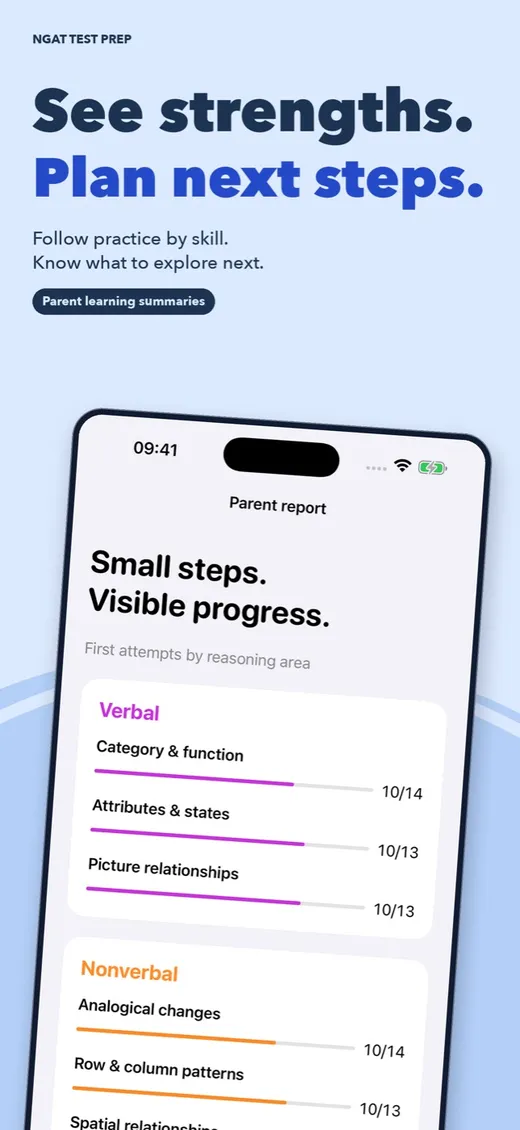
In NGAT Test Prep, the app these questions come from, free to download on the App Store (on Google Play it is listed as NGAT Rehearsal: Gifted Prep). It practices Verbal, Nonverbal and Quantitative reasoning at your child’s grade with a step-by-step explanation after each question, adds Form A and Form B full-length rehearsals with optional timers, practice of missed questions and a parent report by area.
Sources
Publisher information checked November 2026. For local decisions, ask your child’s school.
NGAT is published by MHS (Multi-Health Systems). These pages and apps are independent and are not affiliated with or endorsed by the publisher. Every question is an original practice item from the app, not a publisher test item. iOS: Neobile LLC. Android: KITEBLOOM LLC.