Free practice · Updated November 2026
Free NGAT practice for Grade 1
Original questions, one at a time, with the answer and a short explanation after every choice. No sign-up and no timer.
 Questions from NGAT Test PrepFree app for iPhone, iPad and AndroidGet the app
Verbal practice
These picture concepts use familiar objects or visible attributes.
Question 1
Which picture does not belong?
Correct answer: B.
Show answer
Answer: B. Five pictures show tools. The moon is not a tool.
Question 2
Which picture does not belong?
Correct answer: E.
Show answer
Answer: E. Five pictures show the bird on top. The picture with the bird and the carrot does not.
Question 3
Which picture does not belong?
Correct answer: D.
Show answer
Answer: D. Five pictures show the object in a closed frame. The picture with the banana does not.
Question 4
Which picture does not belong?
Correct answer: A.
Show answer
Answer: A. Five pictures show furniture. The paint palette is not furniture.
Question 5
Which picture does not belong?
Correct answer: A.
Show answer
Answer: A. Five pictures have the lower row in reverse order. The picture with the sock, the dog and the petal on top does not.
Category complete
Your Verbal practice score
0 correct
Nice work exploring the rules. This short set is for practice only; it is not a school score.

Keep practicing in NGAT Test Prep
New free practice questions every day, each with an explanation.
Nonverbal practice
Shape patterns can change by count, rotation, placement, or more than one feature at once.
Question 1
Which answer completes the pattern?
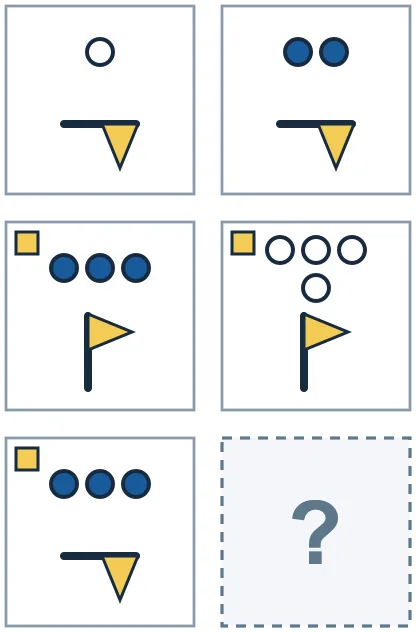
Correct answer: B.
Show answer
Answer: B. The change: switch the small shapes between solid and outline and add 1 small shape. Do the same to the third picture.
Question 2
Which answer completes the pattern?
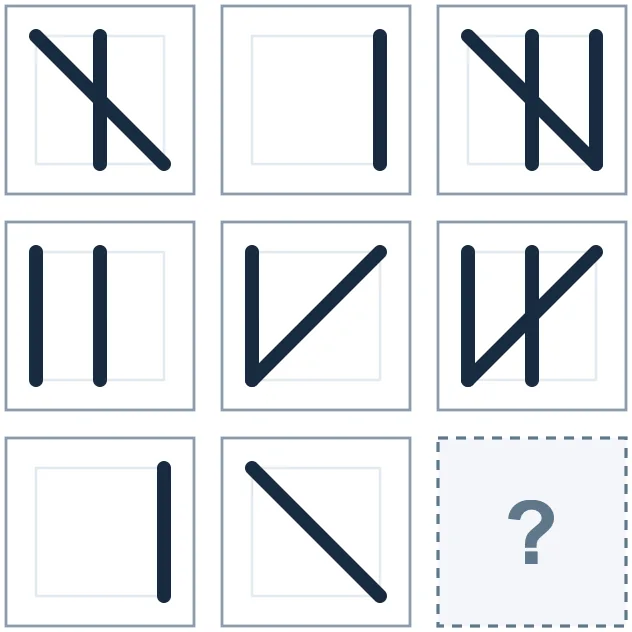
Correct answer: B.
Show answer
Answer: B. Put the two figures together: every line of both appears.
Question 3
Which answer completes the pattern?
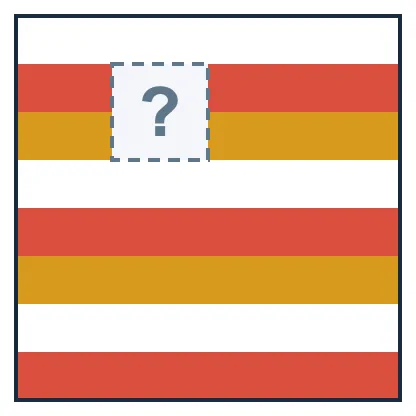
Correct answer: A.
Show answer
Answer: A. The pattern is three-color horizontal stripes. The missing piece continues it exactly.
Question 4
Which answer completes the pattern?
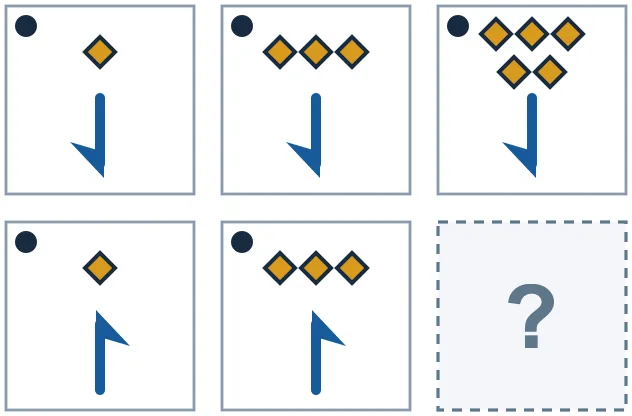
Correct answer: B.
Show answer
Answer: B. The two rows differ only in the direction of the hook, and that difference stays the same in every column.
Question 5
Which answer completes the pattern?
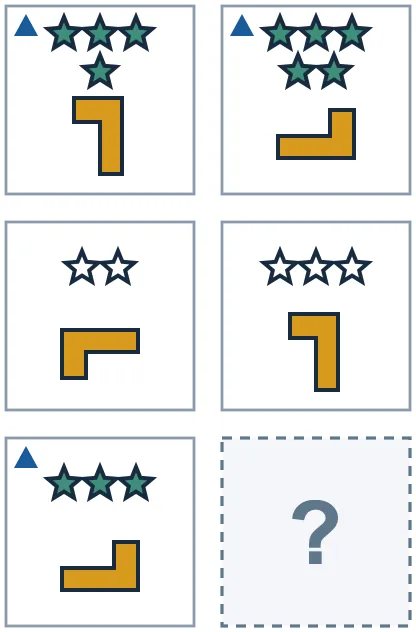
Correct answer: C.
Show answer
Answer: C. The change: add 1 small shape and turn the boot shape a quarter turn clockwise. Do the same to the third picture.
Category complete
Your Nonverbal practice score
0 correct
Nice work exploring the rules. This short set is for practice only; it is not a school score.
Keep practicing in NGAT Test Prep
New free practice questions every day, each with an explanation.
Quantitative practice
Number items may use sequences, small equations, or grids.
Question 1
Which answer completes the pattern?
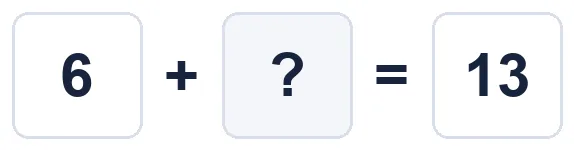
Correct answer: C.
Show answer
Answer: C. Think: which number goes with 6 to make 13? 13 − 6 = 7. Check: 6 + 7 = 13.
Question 2
Which answer completes the pattern?

Correct answer: B.
Show answer
Answer: B. Each number is 5 more than the one before: 32 + 5 = 37, then 37 + 5 = 42.
Question 3
Which answer completes the pattern?
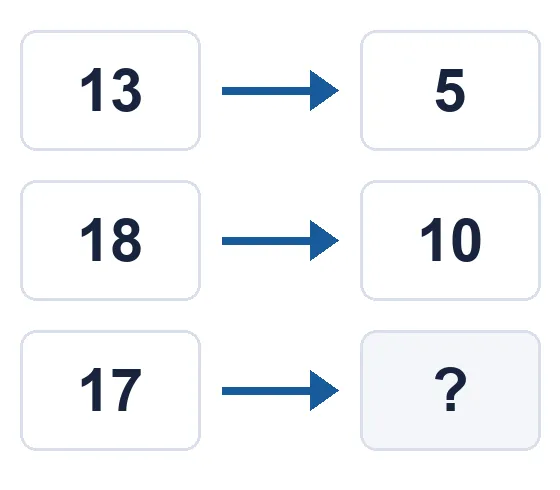
Correct answer: D.
Show answer
Answer: D. The machine takes away 8: 17 − 8 = 9.
Question 4
Which answer completes the pattern?
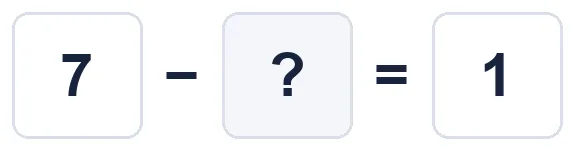
Correct answer: A.
Show answer
Answer: A. Think: 7 take away which number leaves 1? 7 − 1 = 6. Check: 7 − 6 = 1.
Question 5
Which answer completes the pattern?
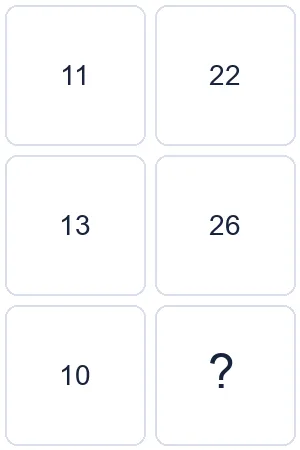
Correct answer: C.
Show answer
Answer: C. So 2 × 10 = 20.
Category complete
Your Quantitative practice score
0 correct
Nice work exploring the rules. This short set is for practice only; it is not a school score.
Choose another gradeKeep practicing in NGAT Test Prep
New free practice questions every day, each with an explanation.
About this grade’s practice
First-grade children may be ready to explain a pattern with two changes rather than one. When a picture pair seems confusing, let them describe what stayed the same first. For a number sequence, invite counting aloud; for a shape matrix, trace one row at a time. These sets are meant to make the formats familiar while preserving the pleasure of solving a puzzle together.
In grade 1 the Verbal set rotates through three skills: a category or job that five pictures share, a state such as open or broken that five pictures show, and a relationship between two parts of each picture. Nonverbal items switch colours in an analogy, put two figures together to make a third, continue a patterned patch, follow a change along each row and finish with an analogy that adds a part. The Quantitative questions use a balance to show which number makes both sides equal, a series that grows by five, a machine that applies one rule to each input, a take-away balance and a two-step rule that turns one number into the next. If the balance pictures are new, set out real coins or blocks and act one out together first. For the shape items, ask your child to cover the answer tiles with a hand and describe what the missing piece should look like before peeking, which keeps a near-match from looking right.
MHS describes three separate NGAT tests. The time limit per test is 30 minutes for this grade band. A school may choose which tests to give. Publisher information checked November 2026. This page has a shorter, untimed practice set and does not estimate a school score.
A parent’s guide to this grade 1 set
Use the first item in each category as a warm-up. Ask your child to describe what they see before naming an answer. When a choice is wrong, look at the highlighted correct one and compare the details. A useful question is, “Which part of your idea still works, and which part needs to change?” That keeps the review about reasoning rather than speed.
For a child in grade 1, read the prompt aloud without pointing to the right option. Pause at a shape or number diagram and let the child explain it in their own words. If the prompt uses a word they do not know, define it plainly before they choose. The practice then measures whether they can work through the relation, not whether they recognized one unfamiliar word.
Verbal
These picture concepts use familiar objects or visible attributes. Five options usually follow one idea and one does not. Ask your child to name the idea shared by the majority; then test whether the odd choice truly breaks it. The task is about the relationship among pictures, not reading a word aloud.
Nonverbal
Shape patterns can change by count, rotation, placement, or more than one feature at once. It helps to narrate one change at a time: first the number, then the position, then the orientation. The right tile must satisfy the whole pattern.
Quantitative
Number items may use sequences, small equations, or grids. The child needs to compare how numbers change, then apply the same rule. A useful check is to work backward from a candidate answer. If the rule fails on an earlier example, try a different one.
Each category is arranged in a gentle easy-to-harder order from the app’s own questions. The format is intentionally brief. If a child tires after a category, that is a natural stopping point. You can return another day and revisit the explanation without saving an account or handing over an email address.
Questions parents ask
Which NGAT level or format fits grade 1?
NGAT uses grade-based forms rather than the lettered levels shown for some other tests. Ask the school which of the three NGAT tests it gives in grade 1.
How should we use these practice questions?
Try one category at a time. After each answer, read the explanation together and ask your child to describe the rule. The short score describes only this practice set.
Are these NGAT questions from the publisher's test?
No. Every question here is an original practice item from NGAT Test Prep. These pages and apps are independent of MHS (Multi-Health Systems).
Can we continue after this grade 1 set?
Yes. NGAT Test Prep is a free download for iPhone, iPad, and Android and includes free daily practice questions. The other grade pages here also have different original items.
Publisher sources
Test structure and timing checked November 2026. Your school’s current administration plan controls local details.
NGAT is published by MHS (Multi-Health Systems). These pages and apps are independent and are not affiliated with or endorsed by the publisher. Every question is an original practice item from the app, not a publisher test item. iOS: Neobile LLC. Android: KITEBLOOM LLC.