Free practice · Updated November 2026
Free NGAT practice for Grade 3
Original questions, one at a time, with the answer and a short explanation after every choice. No sign-up and no timer.
 Questions from NGAT Test PrepFree app for iPhone, iPad and AndroidGet the app
Verbal practice
These picture concepts use familiar objects or visible attributes.
Question 1
Which picture does not belong?
Correct answer: F.
Show answer
Answer: F. Five pictures show two objects of the same kind. In the other picture, the sun and the apple are different kinds of things.
Question 2
Which picture does not belong?
Correct answer: D.
Show answer
Answer: D. Five pictures show sea animals. The giraffe is not a sea animal.
Question 3
Which picture does not belong?
Correct answer: C.
Show answer
Answer: C. Five pictures have every object moved one place to the left (the first one goes to the end). The picture with the banana, the flower and the leaf on top does not.
Question 4
Which picture does not belong?
Correct answer: D.
Show answer
Answer: D. Five pictures show things made by people. The ant is not made by people.
Question 5
Which picture does not belong?
Correct answer: E.
Show answer
Answer: E. This picture has new objects in the lower row, but they repeat in a different pattern.
Category complete
Your Verbal practice score
0 correct
Nice work exploring the rules. This short set is for practice only; it is not a school score.

Keep practicing in NGAT Test Prep
New free practice questions every day, each with an explanation.
Nonverbal practice
Shape patterns can change by count, rotation, placement, or more than one feature at once.
Question 1
Which answer completes the pattern?
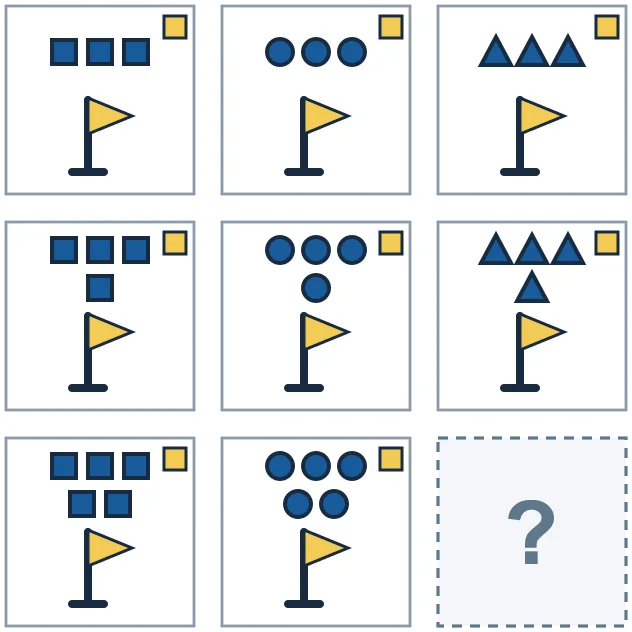
Correct answer: E.
Show answer
Answer: E. The missing picture follows both rules.
Question 2
Which answer completes the pattern?
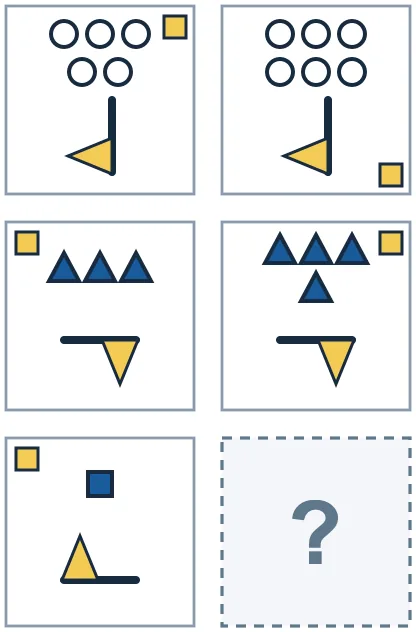
Correct answer: C.
Show answer
Answer: C. The change: add 1 small shape and move the mark one corner clockwise. Do the same to the third picture.
Question 3
Which answer completes the pattern?
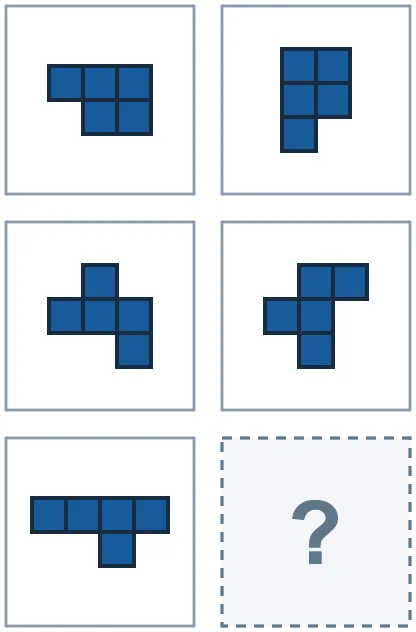
Correct answer: A.
Show answer
Answer: A. Every row uses the same move: turn it a quarter turn counterclockwise. Do the same to the last shape.
Question 4
Which answer completes the pattern?
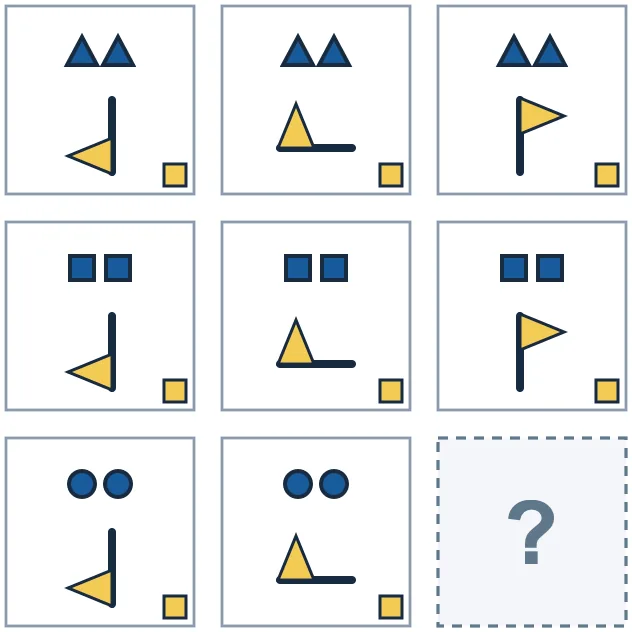
Correct answer: B.
Show answer
Answer: B. The missing picture follows both rules.
Question 5
Which answer completes the pattern?
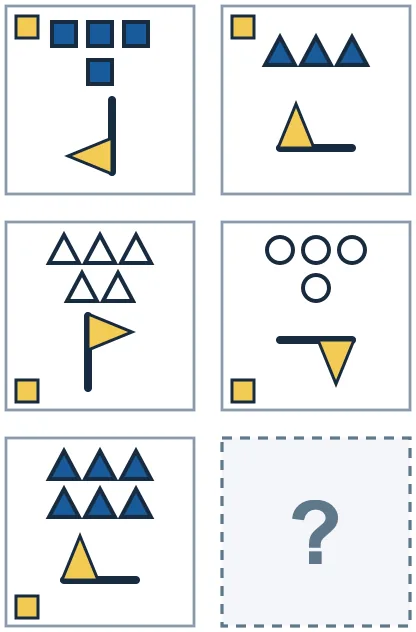
Correct answer: B.
Show answer
Answer: B. The change: take away 1 small shape, change the small shapes in the order circle → square → triangle → circle and turn the flag a quarter turn clockwise. Do the same to the third picture.
Category complete
Your Nonverbal practice score
0 correct
Nice work exploring the rules. This short set is for practice only; it is not a school score.
Keep practicing in NGAT Test Prep
New free practice questions every day, each with an explanation.
Quantitative practice
Number items may use sequences, small equations, or grids.
Question 1
Which answer completes the pattern?
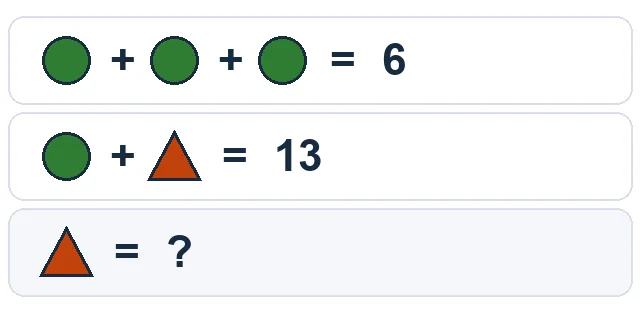
Correct answer: E.
Show answer
Answer: E. Row 2: one circle + one triangle = 13, so the triangle is 13 − 2 = 11.
Question 2
Which answer completes the pattern?

Correct answer: C.
Show answer
Answer: C. Each number is 11 more than the one before: 16 + 11 = 27, then 27 + 11 = 38.
Question 3
Which answer completes the pattern?
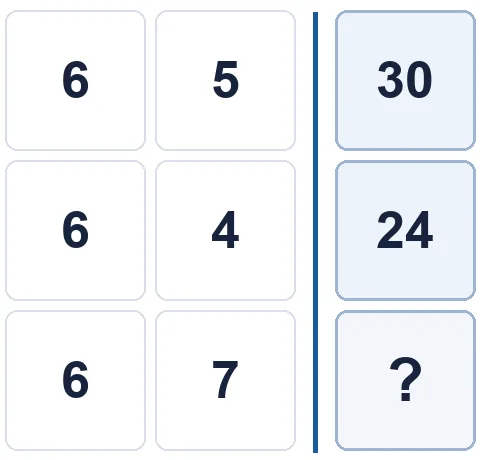
Correct answer: A.
Show answer
Answer: A. So 6 × 7 = 42.
Question 4
Which answer completes the pattern?

Correct answer: C.
Show answer
Answer: C. Two steps take turns: + 5, then − 1. Here the step is + 5: 13 + 5 = 18.
Question 5
Which answer completes the pattern?
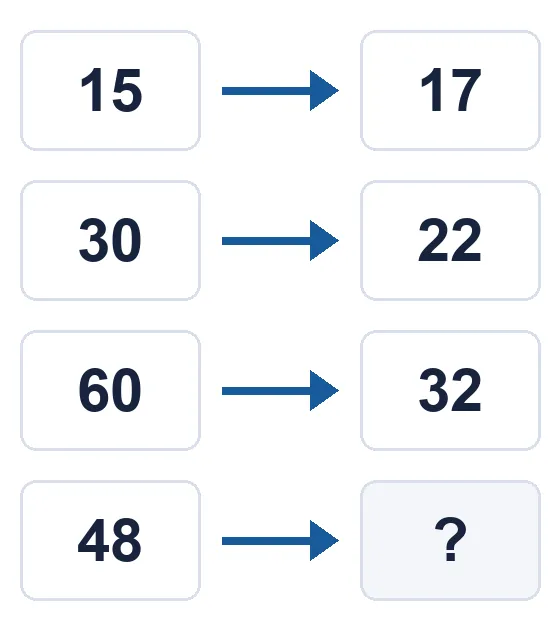
Correct answer: B.
Show answer
Answer: B. The machine divides by 3, then adds 12: 48 ÷ 3 + 12 = 28.
Category complete
Your Quantitative practice score
0 correct
Nice work exploring the rules. This short set is for practice only; it is not a school score.
Choose another gradeKeep practicing in NGAT Test Prep
New free practice questions every day, each with an explanation.
About this grade’s practice
Third-grade NGAT practice can include richer number and shape rules. A child may need to hold two changes in mind, such as a count and a position, or infer why five pictures belong together. The set is arranged from easier to harder within each area. After a miss, compare the chosen choice with the correct one and describe the exact feature that breaks the pattern.
Grade 3 Verbal questions ask a child to spot the one picture that breaks a state, a category or a picture relationship, and the relationships become less obvious toward the end of the set. Nonverbal items follow a change along each row, add one part in an analogy, turn figures through a row and finish with an analogy that removes a part. In Quantitative the visual equation uses three shapes, the series falls by eleven, a grid applies a multiplication rule, a second series alternates two steps, and a number machine closes the set. Children who like explaining their thinking usually find the number machines the most satisfying items here. From grade 3 the publisher allows 35 minutes per test, a little longer than in the primary grades, which reflects the extra steps in items like these. Encourage your child to write the rule in a few words on scrap paper and test it on every pair. If an answer was right for the wrong reason, the choice-specific feedback will usually show it, so read that line even after a correct tap.
MHS describes three separate NGAT tests. The time limit per test is 35 minutes for this grade band. A school may choose which tests to give. Publisher information checked November 2026. This page has a shorter, untimed practice set and does not estimate a school score.
A parent’s guide to this grade 3 set
Use the first item in each category as a warm-up. Ask your child to describe what they see before naming an answer. When a choice is wrong, look at the highlighted correct one and compare the details. A useful question is, “Which part of your idea still works, and which part needs to change?” That keeps the review about reasoning rather than speed.
Verbal
These picture concepts use familiar objects or visible attributes. Five options usually follow one idea and one does not. Ask your child to name the idea shared by the majority; then test whether the odd choice truly breaks it. The task is about the relationship among pictures, not reading a word aloud.
Nonverbal
Shape patterns can change by count, rotation, placement, or more than one feature at once. It helps to narrate one change at a time: first the number, then the position, then the orientation. The right tile must satisfy the whole pattern.
Quantitative
Number items may use sequences, small equations, or grids. The child needs to compare how numbers change, then apply the same rule. A useful check is to work backward from a candidate answer. If the rule fails on an earlier example, try a different one.
Each category is arranged in a gentle easy-to-harder order from the app’s own questions. The format is intentionally brief. If a child tires after a category, that is a natural stopping point. You can return another day and revisit the explanation without saving an account or handing over an email address.
Questions parents ask
Which NGAT level or format fits grade 3?
NGAT uses grade-based forms rather than the lettered levels shown for some other tests. Ask the school which of the three NGAT tests it gives in grade 3.
How should we use these practice questions?
Try one category at a time. After each answer, read the explanation together and ask your child to describe the rule. The short score describes only this practice set.
Are these NGAT questions from the publisher's test?
No. Every question here is an original practice item from NGAT Test Prep. These pages and apps are independent of MHS (Multi-Health Systems).
Can we continue after this grade 3 set?
Yes. NGAT Test Prep is a free download for iPhone, iPad, and Android and includes free daily practice questions. The other grade pages here also have different original items.
Publisher sources
Test structure and timing checked November 2026. Your school’s current administration plan controls local details.
NGAT is published by MHS (Multi-Health Systems). These pages and apps are independent and are not affiliated with or endorsed by the publisher. Every question is an original practice item from the app, not a publisher test item. iOS: Neobile LLC. Android: KITEBLOOM LLC.