Free practice · Updated November 2026
Free NNAT3 practice for Kindergarten (Level A)
Original questions, one at a time, with the answer and a short explanation after every choice. No sign-up and no timer.
 Questions from NNAT Test PrepFree app for iPhone, iPad and AndroidGet the app
Reasoning by analogy practice
A completed pair shows a change, and the child applies that change to a new figure.
Question 1
The completed pairs show the same change. Which figure completes the last pair?
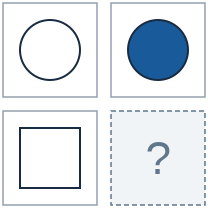
Correct answer: B.
Show answer
Answer: B. Fill the outline with the same color as the example. Keep its shape and size.
Question 2
The first pair shows a change. Which figure completes the second pair?
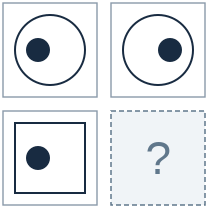
Correct answer: D.
Show answer
Answer: D. The dot moves from left to right. Move the dot the same way in the second pair. Keep the outline unchanged.
Question 3
The completed pairs show the same change. Which figure completes the last pair?
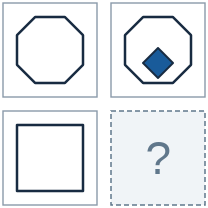
Correct answer: B.
Show answer
Answer: B. A small blue diamond is added near the bottom inside the shape. Add the same small shape in the same place. A adds a different shape in the wrong place. C adds it in the wrong place. D adds a different shape in a different color. E adds a different small shape. Choose B.
Question 4
Which figure belongs in the space with the question mark?
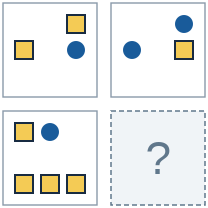
Correct answer: D.
Show answer
Answer: D. In the first pair every yellow square becomes a blue circle and every blue circle becomes a yellow square. Nothing moves. Make the same swap in the last box.
Question 5
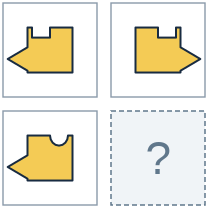
The completed pairs show the same change. Which figure completes the last pair?
Correct answer: A.
Show answer
Answer: A. The figure flips left to right, like its mirror image. Flip the new figure the same way. B is flipped the other way. C is given a half turn instead. D is turned, not flipped. E is flipped across the other slanted line. Choose A.
Category complete
Your Reasoning by analogy practice score
0 correct
Nice work exploring the rules. This short set is for practice only; it is not a school score.

Keep practicing in NNAT Test Prep
Free practice questions every day at your child’s grade, each with an explanation.
Pattern completion practice
A larger design has a piece missing.
Question 1
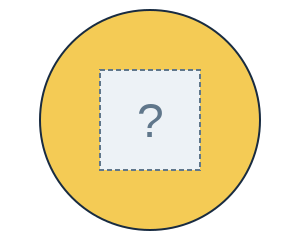
Which piece completes the picture?
Correct answer: C.
Show answer
Answer: C. The missing piece lies inside one solid colored region. Continue that same solid color.
Question 2
Which piece completes the picture?

Correct answer: B.
Show answer
Answer: B. The line between blue and yellow goes straight down through the gap. Blue stays on the left and yellow on the right.
Question 3
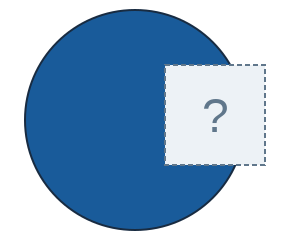
Which piece completes the picture?
Correct answer: C.
Show answer
Answer: C. The gap sits on the right edge of the big blue circle. The piece is blue with the circle's round edge on its right, and white beyond it.
Question 4
Which piece completes the picture?

Correct answer: D.
Show answer
Answer: D. Two curved lines pass through the gap: the blue one inside and the dark one outside. The piece keeps both curves in the same order.
Question 5
Which piece completes the picture?

Correct answer: B.
Show answer
Answer: B. Two straight lines cross inside the gap. Continue both lines; each of the four parts keeps the color it has outside the gap. A is a mirror image, so its edges do not line up with the picture. C has two colors in the wrong places. D continues only one of the two lines. E is turned, so its edges do not line up with the picture. Choose B.
Category complete
Your Pattern completion practice score
0 correct
Nice work exploring the rules. This short set is for practice only; it is not a school score.
Choose another gradeKeep practicing in NNAT Test Prep
Free practice questions every day at your child’s grade, each with an explanation.
About this grade’s practice
Kindergarten Level A starts with large figures and clear missing pieces. Invite your child to point to the gap and name one feature that should continue into it, such as color or edge direction. These original puzzles cover the two categories selected for this level. If a visual looks confusing, enlarge the page or pause; there is no reason to rush a five-year-old through a shape rule.
The kindergarten Pattern completion items start with a gap inside one solid colour and build to a gap where a straight boundary, a round edge, two curves or a corner run through the missing square. Your child chooses the tile whose colours and edges line up with the picture around it. The Reasoning by analogy set shows one clear change in the example pair: an outline that fills with colour, a dot that moves to the opposite side, a small part that is added, two marks that swap places and, last, an irregular shape that is mirrored. Distractors usually get one feature right and one wrong, which is why looking at the whole tile matters before tapping. Level A has no written directions at all, so a quiet demonstration with your finger is the best way to explain what to do.
Pearson describes NNAT3 as a 30-minute assessment made of figure questions, with levels A–G. This grade is commonly mapped to Level A; the school confirms the level. Publisher information checked November 2026. This page has a shorter, untimed practice set and does not estimate a school score.
A parent’s guide to this kindergarten set
Use the first item in each category as a warm-up. Ask your child to describe what they see before naming an answer. When a choice is wrong, look at the highlighted correct one and compare the details. A useful question is, “Which part of your idea still works, and which part needs to change?” That keeps the review about reasoning rather than speed.
For a child in kindergarten, read the prompt aloud without pointing to the right option. Pause at the figure and let the child describe it in their own words: which shapes they see, what is shaded, and what turns. If a direction word such as “pattern” or “pair” is new, explain it plainly before they choose. The practice then shows whether they can work through the relation, not whether they understood the instruction.
Reasoning by analogy
A completed pair shows a change, and the child applies that change to a new figure. The change might involve color, position, number of parts, or a turn. Say what happened in the example pair before inspecting the last set of choices.
Pattern completion
A larger design has a piece missing. Look at the borders of the empty area, the fill, and any repeated marks before trying the answer tiles. The piece must continue the design, not simply resemble a shape elsewhere in the picture.
Each category is arranged in a gentle easy-to-harder order from the app’s own questions. The format is intentionally brief. If a child tires after a category, that is a natural stopping point. You can return another day and revisit the explanation without saving an account or handing over an email address.
Questions parents ask
Which NNAT3 level or format fits kindergarten?
Kindergarten maps to NNAT3 Level A in the publisher's grade guidance. Your school can confirm the form it will administer.
How should we use these practice questions?
Try one category at a time. After each answer, read the explanation together and ask your child to describe the rule. The short score describes only this practice set.
Are these NNAT3 questions from the publisher's test?
No. Every question here is an original practice item from NNAT Test Prep. These pages and apps are independent of Pearson.
Can we continue after this kindergarten set?
Yes. NNAT Test Prep is a free download for iPhone, iPad, and Android and includes free daily practice questions. The other grade pages here also have different original items.
Publisher sources
Test structure and timing checked November 2026. Your school’s current administration plan controls local details.
NNAT® is a trademark of Pearson. These pages and apps are independent and are not affiliated with or endorsed by the publisher. Every question is an original practice item from the app, not a publisher test item. iOS: Neobile LLC. Android: KITEBLOOM LLC.