Free · K–5 · Updated November 2026
Free NNAT3 practice test by grade
Pick your child’s grade and start. Every answer is explained. No sign-up, no timer.Every question is original, and the answer and a short explanation appear after each choice. No account, no email address, no timer.

The app behind these practice pages
NNAT Test Prep
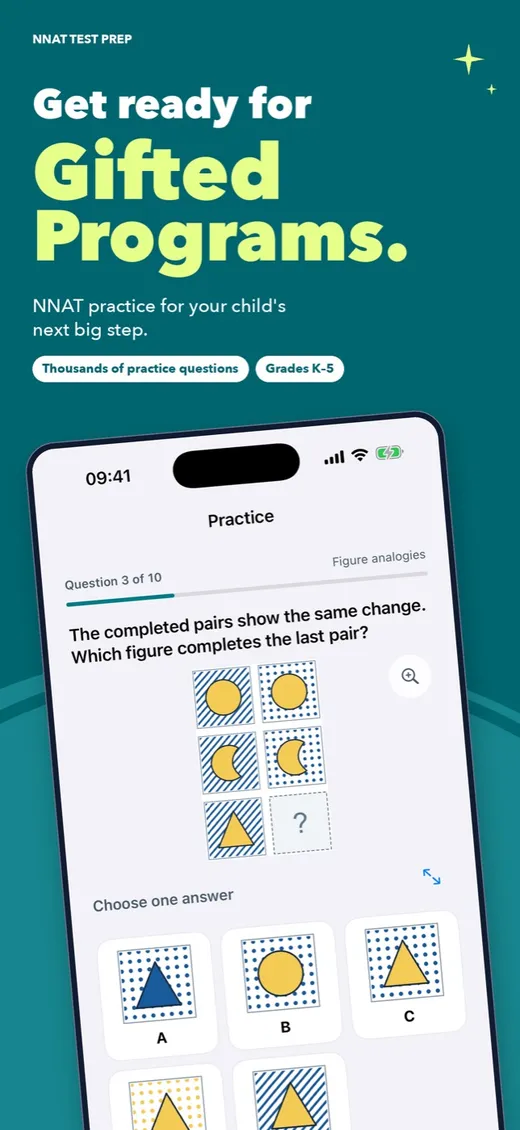
The app behind these pages. Free practice questions every day.Free practice questions every day at your child’s grade, each with an explanation. Free to download for iPhone, iPad and Android.
What each grade practices
Open a grade to start a short category. Each category shows one question at a time, and the answer appears as soon as your child taps a choice. Categories stay separate, so a child can pause after one and return later to try another kind of puzzle.
Kindergarten
Reasoning by analogy · Pattern completion
Kindergarten Level A starts with large figures and clear missing pieces. Invite your child to point to the gap and name one feature that should continue into it, such as color or edge direction. These original puzzles cover the two categories selected for this level. If a visual looks confusing, enlarge the page or pause; there is no reason to rush a five-year-old through a shape rule.
Start kindergarten practice Level BGrade 1
Reasoning by analogy · Pattern completion · Serial reasoning
At first-grade Level B, the picture may change in more than one way. Ask your child to compare a completed example before choosing an answer for the new figure. Pattern completion, analogy, and serial reasoning are each arranged here to become more involved. The goal is to build a habit of checking the entire design, not to memorize the look of one particular tile.
Start grade 1 practice Level CGrade 2
Reasoning by analogy · Pattern completion · Serial reasoning · Spatial visualization
Second-grade Level C is a good point to introduce the fourth category, spatial visualization. The child may need to picture a turn or a combination that cannot be seen directly. Let them trace the movement with a finger while keeping the original orientation in mind. This page covers all four categories; a short break between categories can help more than a fast, uninterrupted run.
Start grade 2 practice Level DGrade 3
Reasoning by analogy · Pattern completion · Serial reasoning · Spatial visualization
Third-grade Level D includes a wider mix of figure relationships. Some choices look right at first glance but break a color, orientation, or position rule. Encourage your child to compare each answer with the complete pattern rather than choosing the first plausible tile. The explanations are written for a parent and child to read together after a selection, even when the first choice was correct.
Start grade 3 practice Level DGrade 4
Reasoning by analogy · Pattern completion · Serial reasoning · Spatial visualization
Fourth-grade Level D remains the publisher level for this grade, although the practice examples here are chosen from fourth-grade app material. A child can slow down when two tiles differ by a tiny turn or an exchanged part. Use the larger picture and choice tiles on a phone, and invite a spoken explanation of how a rule works. A careful wrong answer can still reveal a useful next step.
Start grade 4 practice Level EGrade 5
Reasoning by analogy · Pattern completion · Serial reasoning · Spatial visualization
Fifth-grade Level E asks for sustained visual attention. The selected original items include pattern, analogy, serial, and spatial puzzles with several details to track. Have your child identify the stable parts before looking at what changes. For a combined or folded shape, mentally separate the pieces and then rebuild them. A short set makes it easier to review the full explanation while the reasoning is fresh.
Start grade 5 practiceWhat is NNAT3?
Pearson describes NNAT3 as a 30-minute test made of multiple-choice figure questions. Its levels run A–G, and schools select a level by grade. The test uses visual directions and does not require spoken or written language to solve the figures. These publisher facts were checked November 2026 against the sources below. The grade pages on this site are independent practice, so their length, order, and untimed experience differ from a school administration.
The NNAT3 is a nonverbal ability measure made of figures rather than a reading passage. A child sees a design with a missing part or a set of figures that change across a grid. Solving it involves noticing a visual relationship and applying it to an answer choice. Parents can help by asking for an explanation of the pattern, without giving the direction of the change away.
Pearson assigns different levels to different grades, but a level letter does not mean that every question on this page matches a secure publisher item. These are original practice figures drawn for the app. The purpose is to make comparing shapes feel familiar. It is especially useful to look for a second change after a child notices the first; many plausible distractors preserve one feature while breaking another.
NNAT3 practice without pressure
NNAT practice is most useful when children learn to compare complete figures. A child may notice that a blue mark moves and miss that the outline also turns. Give them enough room on a phone to inspect the choices, especially when dots and paths are small. Ask which detail rules out a tempting choice. That simple discussion can turn a missed item into a clearer picture of the pattern without treating the result as a school score.
What a short session can show
A short NNAT sequence can reveal a child’s approach to unfamiliar figures. Some children scan for color first; others look for turns, shapes, or the missing area. Ask them to explain an answer they chose confidently and another that took longer. If a dot or path is small on a phone, let them zoom or use a larger screen. The purpose is to see the whole relationship clearly. Pearson’s secure assessment and its scoring are distinct from these independent app puzzles.
What does each category ask a child to do?
Read these descriptions before choosing a grade if the names are unfamiliar. These are the names our practice uses; a district’s score report may group results differently. The child-facing page keeps each category short and gives feedback only after an answer, so the child can first try to discover the rule on their own.
Reasoning by analogy
A completed pair shows a change, and the child applies that change to a new figure. The change might involve color, position, number of parts, or a turn. Say what happened in the example pair before inspecting the last set of choices.
Pattern completion
A larger design has a piece missing. Look at the borders of the empty area, the fill, and any repeated marks before trying the answer tiles. The piece must continue the design, not simply resemble a shape elsewhere in the picture.
Serial reasoning
A row or grid changes in a sequence. Compare the same position in neighboring figures, and check both direction and count. If one candidate seems right, look for a second rule that might rule it out.
Spatial visualization
These puzzles ask children to imagine a figure moved, turned, folded, or combined. Trace the parts mentally or with a finger, while keeping track of which side is facing up. Slowing down helps when two answers differ by only one small detail.
How should a parent use the practice pages?
- Choose the grade named by your school. A school can confirm the test and level it will give. Begin with one category, then stop if your child has had enough.
- Let the child try first. Ask what looks the same and what changes. For K–2, read a prompt aloud in a calm voice, and leave the choice to the child.
- Read the explanation aloud after the tap. A missed question is useful if your child can name the overlooked feature on the second look. Revisit the picture rather than moving quickly to the next score.
- Make a plan from the rule, not the number. A short practice score is too small to describe ability. If rotation was hard, try one more shape puzzle another day; if a number series was fun, try a different series.
- Keep the experience light. This site has no timer or account requirement. A child who enjoys figuring out why an answer works is more likely to stay curious than one asked to race through every category.
For NNAT, the number of categories varies here by grade. Kindergarten has pattern completion and analogy; grade 1 adds serial reasoning; grades 2 through 5 add spatial visualization. This follows the curated practice selection rather than claiming to reproduce a publisher form.
Publisher format at a glance
The table is a brief orientation, not a substitute for school instructions. Use the cited publisher pages for full administration details; a district decides how an assessment fits into its identification process.
| Area | Publisher description | Practice here |
|---|---|---|
| Structure | Pearson describes NNAT3 as a 30-minute test made of multiple-choice figure questions. Its levels run A–G, and schools select a level by grade. The test uses visual directions and does not require spoken or written language to solve the figures. | Original items in every available category |
| Feedback | School testing follows publisher administration rules | Immediate answer and a short explanation |
| Timing | 30 minutes | Untimed; pause after any category |
Questions parents ask
How do NNAT3 levels map to grades?
Pearson assigns Level A to kindergarten, B to grade 1, C to grade 2, D to grades 3 and 4, and E to grade 5. Schools confirm the level.
Why are there fewer kindergarten categories?
This curated kindergarten set contains pattern completion and analogy. First grade adds serial reasoning, and grades 2–5 also include spatial visualization.
Are the figures from Pearson?
No. Every puzzle here is an original practice item from the NNAT Test Prep app. The page and app are independent of Pearson.
Where can my child keep practicing after these pages?
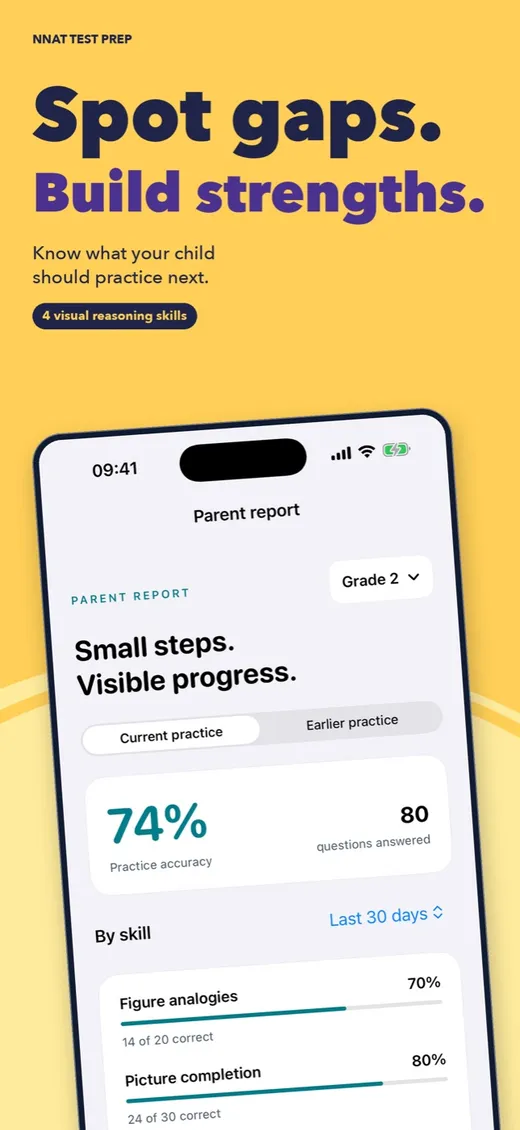
In NNAT Test Prep, the app these figure puzzles come from, free to download for iPhone, iPad and Android. It practices the four NNAT question types at your child’s grade with an explanation for each, adds full-length practice with an optional timer, a mistakes notebook for missed puzzles and a parent report by question type.
Sources
Publisher information checked November 2026. For local decisions, ask your child’s school.
NNAT® is a trademark of Pearson. These pages and apps are independent and are not affiliated with or endorsed by the publisher. Every question is an original practice item from the app, not a publisher test item. iOS: Neobile LLC. Android: KITEBLOOM LLC.