Free practice · Updated November 2026
Free NNAT3 practice for Grade 3 (Level D)
Original questions, one at a time, with the answer and a short explanation after every choice. No sign-up and no timer.
 Questions from NNAT Test PrepFree app for iPhone, iPad and AndroidGet the app
Reasoning by analogy practice
A completed pair shows a change, and the child applies that change to a new figure.
Question 1
The completed pairs show the same change. Which figure completes the last pair?
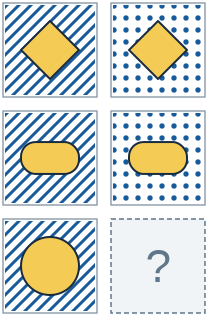
Correct answer: D.
Show answer
Answer: D. Only the background changes: the stripes become dots. The yellow shape and the blue color stay the same.
Question 2
The completed pairs show the same change. Which figure completes the last pair?
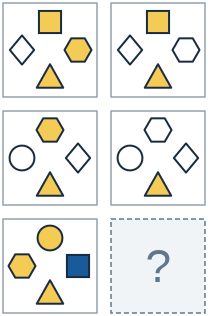
Correct answer: E.
Show answer
Answer: E. Only the hexagon changes: it turns white. The other parts stay the same. A changes the part in the place that changed before. B changes the wrong part. C changes the right part to the wrong color. D changes a part of the color that changed before. Choose E.
Question 3
The completed pairs show the same change. Which figure completes the last pair?
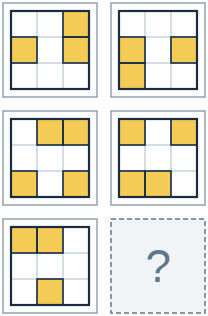
Correct answer: E.
Show answer
Answer: E. Each board gets a half turn, and every colored square moves with it. Do the same to the last board. A shows the board flipped across the other diagonal. B shows the board flipped left to right, not turned. C shows the board flipped top to bottom. D shows the board turned a quarter clockwise. Choose E.
Question 4
The completed pairs show the same change. Which figure completes the last pair?
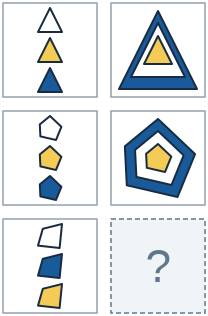
Correct answer: A.
Show answer
Answer: A. The three small shapes fit inside each other: the bottom shape becomes the outside, the top shape becomes the middle, and the middle shape goes in the center. Colors stay with their shapes.
Question 5
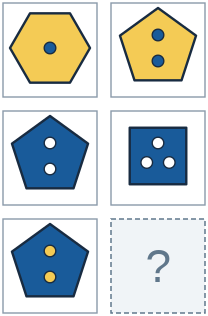
The completed pairs show the same change. Which figure completes the last pair?
Correct answer: C.
Show answer
Answer: C. Each new shape has one fewer side and one more dot than the shape before it. Count the sides and the dots of the last shape. A changes the sides but not the dots. B makes the change twice. D has two dots too few. E makes the change the opposite way. Choose C.
Category complete
Your Reasoning by analogy practice score
0 correct
Nice work exploring the rules. This short set is for practice only; it is not a school score.

Keep practicing in NNAT Test Prep
Free practice questions every day at your child’s grade, each with an explanation.
Pattern completion practice
A larger design has a piece missing.
Question 1
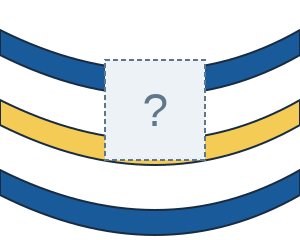
Which piece completes the picture?
Correct answer: D.
Show answer
Answer: D. The gap covers the blue band and the yellow band below it. Follow both bands across: blue on top, yellow underneath, both dipping in the middle.
Question 2
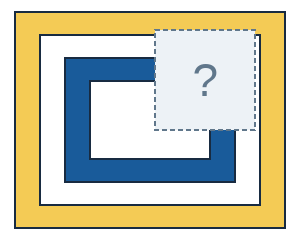
Which piece completes the picture?
Correct answer: A.
Show answer
Answer: A. The missing piece is the top-right corner of the blue frame, with white space around it and a thin strip of the yellow frame along the top.
Question 3
Which piece completes the picture?

Correct answer: D.
Show answer
Answer: D. The dark bar lies on top of the rings. In the gap you see the white center, the blue ring around it, and the dark bar going down to the right.
Question 4
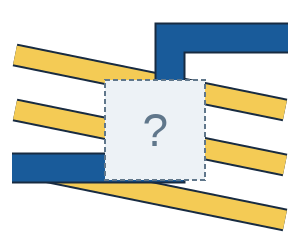
Which piece completes the picture?
Correct answer: C.
Show answer
Answer: C. The blue band comes down through the gap and turns left at the bottom. It lies on top of the yellow stripes, which pass underneath it.
Question 5
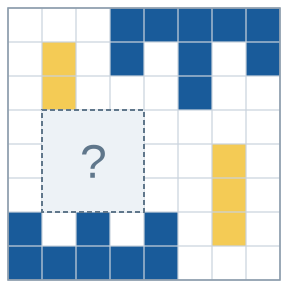
Which piece completes the picture?
Correct answer: C.
Show answer
Answer: C. The design looks the same after a half turn around its center. The missing part is the matching part on the other side, turned around. A is flipped top to bottom instead of turned. B is flipped left to right instead of turned. D copies the matching part of the picture without turning it. E is turned only a quarter turn. Choose C.
Category complete
Your Pattern completion practice score
0 correct
Nice work exploring the rules. This short set is for practice only; it is not a school score.
Keep practicing in NNAT Test Prep
Free practice questions every day at your child’s grade, each with an explanation.
Serial reasoning practice
A row or grid changes in a sequence.
Question 1
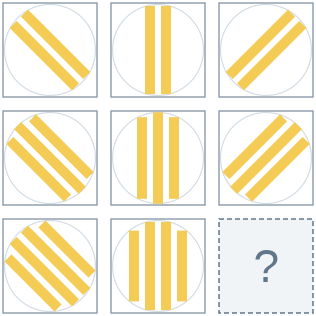
Find the pattern across the rows and down the columns. Which figure is missing?
Correct answer: D.
Show answer
Answer: D. Along each row the stripes turn one step the same way, and each row has one more stripe than the row above. Turn the stripes once more in the last row and count the stripes of that row. A turns the stripes one step too far and takes the number of stripes from the first row. B turns the stripes one step too far and has one stripe too many. C turns the stripes one step too far. E stops the turn one step short. Choose D.
Question 2
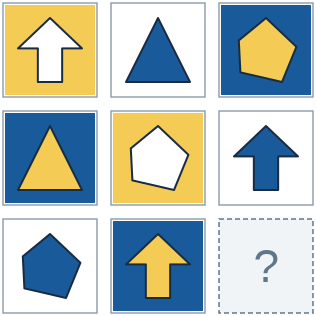
Find the pattern across the rows and down the columns. Which figure is missing?
Correct answer: E.
Show answer
Answer: E. Each row has one arrow, one pentagon and one triangle, and uses each color style once (white on yellow, blue on white, yellow on blue). Find the shape and the color style the last row is missing. The last row is missing the triangle, drawn white on yellow and pointing up.
Question 3
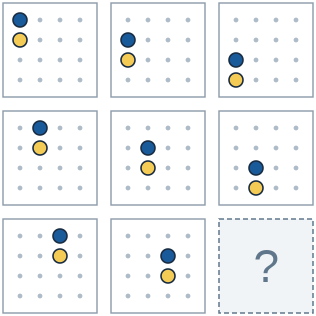
Find the pattern across the rows and down the columns. Which figure is missing?
Correct answer: D.
Show answer
Answer: D. Both dots move one step down from box to box along a row, and one step right from row to row. Use the row and the column to place them. A moves the blue dot along the row only and moves the yellow dot one step too few. B moves the yellow dot along the row only. C moves the blue dot along the row only and moves the yellow dot along the row only. E moves the blue dot along the row only. Choose D.
Question 4
Find the pattern across the rows and down the columns. Which figure is missing?
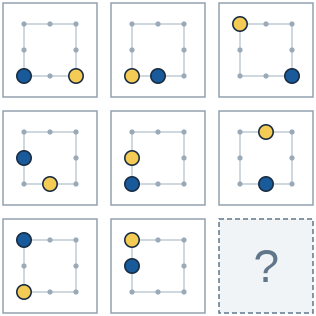
Correct answer: B.
Show answer
Answer: B. From box to box the blue dot walks one point counterclockwise and the yellow dot walks two points clockwise. Each new row starts both of them one point clockwise further on. A leaves the blue dot one step behind. C moves the blue dot two points a step, like the yellow one. D leaves the blue dot one step behind and leaves the yellow dot one step behind. E moves the blue dot as if each row started in the same place. Choose B.
Question 5
Find the pattern across the rows and down the columns. Which figure is missing?
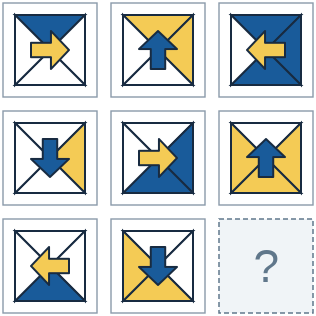
Correct answer: A.
Show answer
Answer: A. Along each row one more triangle of the square gets colored, going around clockwise, and the arrow turns a quarter turn counterclockwise. The colors take turns between blue and yellow.
Category complete
Your Serial reasoning practice score
0 correct
Nice work exploring the rules. This short set is for practice only; it is not a school score.
Keep practicing in NNAT Test Prep
Free practice questions every day at your child’s grade, each with an explanation.
Spatial visualization practice
These puzzles ask children to imagine a figure moved, turned, folded, or combined.
Question 1
Look at how the shapes change or combine in the completed examples. Which figure is missing?
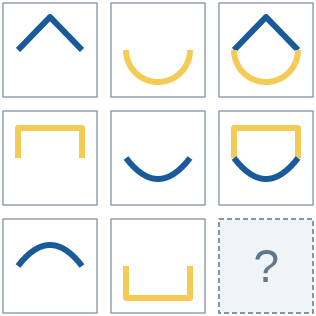
Correct answer: A.
Show answer
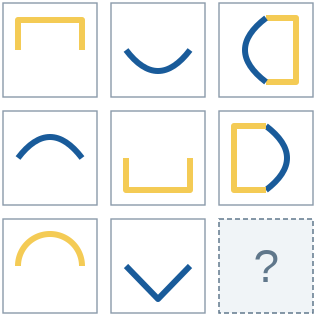
Answer: A. Put the two pieces together at their ends: the blue piece goes on top and the yellow piece goes underneath.
Question 2
Look at how the shapes change or combine in the completed examples. Which figure is missing?
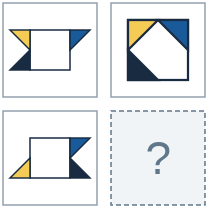
Correct answer: E.
Show answer
Answer: E. Fold each colored flap over the edge it hangs from, onto the square. Each flap lands in the corner next to where it was and keeps its color. The square does not turn.
Question 3
Look at how the shapes change or combine in the completed examples. Which figure is missing?
Correct answer: A.
Show answer
Answer: A. Join the two pieces at their ends (the top piece above, the bottom piece below), then turn the whole outline a quarter turn clockwise, so the top piece ends up on the right.
Question 4
Look at how the shapes change or combine in the completed examples. Which figure is missing?
Correct answer: E.
Show answer
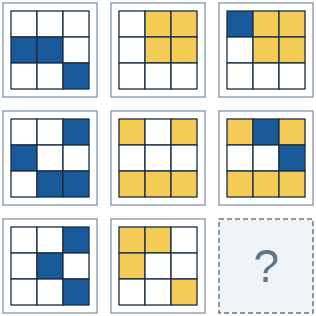
Answer: E. First turn the blue design upside down (a half turn). Then lay the yellow design on top; where both are colored, you see yellow.
Question 5
Look at how the shapes change or combine in the completed examples. Which figure is missing?
Correct answer: D.
Show answer
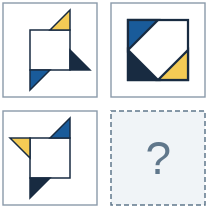
Answer: D. Fold each colored flap over the edge it hangs from, onto the square. Then turn the whole square a quarter turn clockwise, as in the example.
Category complete
Your Spatial visualization practice score
0 correct
Nice work exploring the rules. This short set is for practice only; it is not a school score.
Choose another gradeKeep practicing in NNAT Test Prep
Free practice questions every day at your child’s grade, each with an explanation.
About this grade’s practice
Third-grade Level D includes a wider mix of figure relationships. Some choices look right at first glance but break a color, orientation, or position rule. Encourage your child to compare each answer with the complete pattern rather than choosing the first plausible tile. The explanations are written for a parent and child to read together after a selection, even when the first choice was correct.
Grade 3 (Level D) Pattern completion includes rings with a bar laid on top, a ribbon woven through stripes and a symmetric design where the missing part must be the mirror of its partner. The analogy items include a whole grid that flips or turns so every square moves, and a counting puzzle where the number of sides and the number of dots trade places. Serial reasoning brings stripes that turn while their count cycles, a small shape and a dot stepping across a dot grid, and a square that fills one triangle at a time. In Spatial visualization the child joins outline pieces end to end, folds flaps and, in the last item, folds and then turns the square.
Pearson describes NNAT3 as a 30-minute assessment made of figure questions, with levels A–G. This grade is commonly mapped to Level D; the school confirms the level. Publisher information checked November 2026. This page has a shorter, untimed practice set and does not estimate a school score.
A parent’s guide to this grade 3 set
Use the first item in each category as a warm-up. Ask your child to describe what they see before naming an answer. When a choice is wrong, look at the highlighted correct one and compare the details. A useful question is, “Which part of your idea still works, and which part needs to change?” That keeps the review about reasoning rather than speed.
Reasoning by analogy
A completed pair shows a change, and the child applies that change to a new figure. The change might involve color, position, number of parts, or a turn. Say what happened in the example pair before inspecting the last set of choices.
Pattern completion
A larger design has a piece missing. Look at the borders of the empty area, the fill, and any repeated marks before trying the answer tiles. The piece must continue the design, not simply resemble a shape elsewhere in the picture.
Serial reasoning
A row or grid changes in a sequence. Compare the same position in neighboring figures, and check both direction and count. If one candidate seems right, look for a second rule that might rule it out.
Spatial visualization
These puzzles ask children to imagine a figure moved, turned, folded, or combined. Trace the parts mentally or with a finger, while keeping track of which side is facing up. Slowing down helps when two answers differ by only one small detail.
Each category is arranged in a gentle easy-to-harder order from the app’s own questions. The format is intentionally brief. If a child tires after a category, that is a natural stopping point. You can return another day and revisit the explanation without saving an account or handing over an email address.
Questions parents ask
Which NNAT3 level or format fits grade 3?
Grade 3 maps to NNAT3 Level D in the publisher's grade guidance. Your school can confirm the form it will administer.
How should we use these practice questions?
Try one category at a time. After each answer, read the explanation together and ask your child to describe the rule. The short score describes only this practice set.
Are these NNAT3 questions from the publisher's test?
No. Every question here is an original practice item from NNAT Test Prep. These pages and apps are independent of Pearson.
Can we continue after this grade 3 set?
Yes. NNAT Test Prep is a free download for iPhone, iPad, and Android and includes free daily practice questions. The other grade pages here also have different original items.
Publisher sources
Test structure and timing checked November 2026. Your school’s current administration plan controls local details.
NNAT® is a trademark of Pearson. These pages and apps are independent and are not affiliated with or endorsed by the publisher. Every question is an original practice item from the app, not a publisher test item. iOS: Neobile LLC. Android: KITEBLOOM LLC.