Naglieri General Ability Tests · grade 4 · interactive practice
NGAT practice questions for 4th grade
These original practice questions are written at fourth-grade level in the three NGAT formats: Verbal (one picture breaks the shared rule), Nonverbal (complete a shape grid) and Quantitative (number pairs and a sequence). Tap an answer to check it and read why. They build familiarity with the format; they are not a score.

NGAT Test Prep
NGAT practice for kindergarten to grade 5
Free to download for iPhone, iPad and Android. On Google Play the app is listed as “NGAT Rehearsal: Gifted Prep”.
Let your child answer first, then talk through the explanation. Without JavaScript, open “Show answer” under each question.
Verbal: the picture that breaks the rule
Fourth-grade Verbal questions hide rules with two parts, for example “when the top shows a gap, the two bottom objects match”. Every answer choice fits some rule, so the skill is to test one candidate rule against all six pictures before choosing. Older children often rush here because the pictures look easy; slowing down is the whole trick.
Which picture does not belong?
Answer: C.
- In each picture, look at the top part and at the two objects at the bottom.
- Five pictures follow this rule: whenever the top part shows two boxes with a gap between them, the two objects at the bottom match; otherwise they are different. The other picture breaks it: its top part shows two boxes with a gap between them, but the two objects at the bottom are different.
Show answer
Answer: C. In each picture, look at the top part and at the two objects at the bottom. Five pictures follow this rule: whenever the top part shows two boxes with a gap between them, the two objects at the bottom match; otherwise they are different. The other picture breaks it: its top part shows two boxes with a gap between them, but the two objects at the bottom are different.
Which picture does not belong?
Answer: F.
- Compare the upper and lower rows in each picture.
- Five pictures have new objects in the lower row, but the same pattern of repeats. The picture with the car and the soup on top does not.
Show answer
Answer: F. Compare the upper and lower rows in each picture. Five pictures have new objects in the lower row, but the same pattern of repeats. The picture with the car and the soup on top does not.
Which picture does not belong?
Answer: B.
- Look at all six pictures.
- In five pictures, every object belongs to this group: living things. The other picture has an object outside that group: the snow.
- Careful: the snow is also in the group “things from nature”, like the other pictures, but not in “living things”.
Show answer
Answer: B. Look at all six pictures. In five pictures, every object belongs to this group: living things. The other picture has an object outside that group: the snow. Careful: the snow is also in the group “things from nature”, like the other pictures, but not in “living things”.
Nonverbal: grids with several changes
At grade 4 a single grid can change the number of stars, the direction of a shape and a small corner mark at the same time, or turn a block shape in steps. A reliable habit: list what changes along a row, check the same things down a column, then rule out answers that break even one of them.
Which answer completes the pattern?
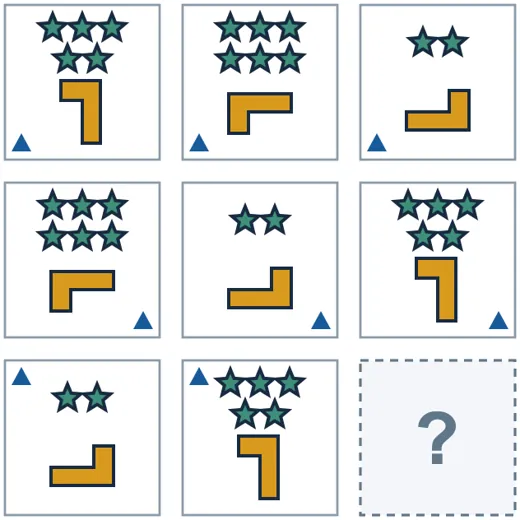
Answer: A.
- Check each row and each column.
- Every row and every column has each number of small shapes once; every row and every column has each direction of the boot shape once; the position of the mark stays the same along each row.
- For the number of small shapes and the direction of the boot shape, the missing picture takes the one that its row and its column do not have yet.
Show answer
Answer: A. Check each row and each column. Every row and every column has each number of small shapes once; every row and every column has each direction of the boot shape once; the position of the mark stays the same along each row. For the number of small shapes and the direction of the boot shape, the missing picture takes the one that its row and its column do not have yet.
Which answer completes the pattern?
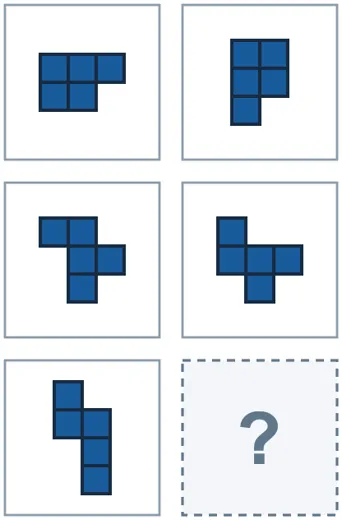
Answer: A.
- Compare the two shapes in each row: the second one is the first one moved.
- Every row uses the same move: flip it over the diagonal line from the top left to the bottom right. Do the same to the last shape.
Show answer
Answer: A. Compare the two shapes in each row: the second one is the first one moved. Every row uses the same move: flip it over the diagonal line from the top left to the bottom right. Do the same to the last shape.
Which answer completes the pattern?
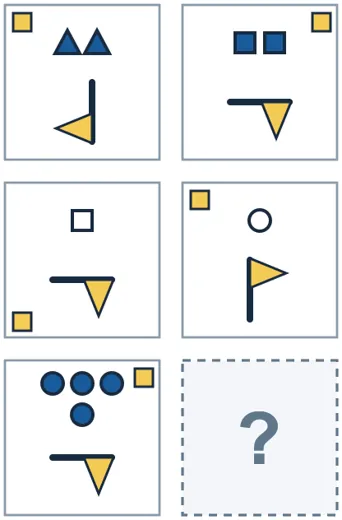
Answer: D.
- Compare the two pictures in each of the first two rows: the same change happens in both.
- The change: change the small shapes in the order circle → triangle → square → circle, turn the flag a quarter turn counterclockwise and move the mark one corner clockwise. Do the same to the third picture.
Show answer
Answer: D. Compare the two pictures in each of the first two rows: the same change happens in both. The change: change the small shapes in the order circle → triangle → square → circle, turn the flag a quarter turn counterclockwise and move the mark one corner clockwise. Do the same to the third picture.
Quantitative: pairs and sequences
Number pairs such as 12 → 84 and 13 → 91 now use multiplication, and sequences grow by multiplying rather than adding. The question is never “can you compute it” but “can you find the rule that works every time”. If two rules seem to fit one pair, the second pair decides.
Which answer completes the pattern?
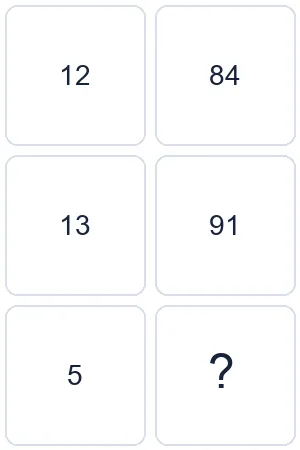
Answer: C.
- Find one rule that turns the first number into the second in both example rows.
- The rule is: multiply by 7. Check: 7 × 12 = 84 and 7 × 13 = 91.
- So 7 × 5 = 35.
Show answer
Answer: C. Find one rule that turns the first number into the second in both example rows. The rule is: multiply by 7. Check: 7 × 12 = 84 and 7 × 13 = 91. So 7 × 5 = 35.
Which answer completes the pattern?

Answer: E.
- Look at how each number changes into the next one.
- Each number is 3 times the one before: 108 × 3 = 324.
Show answer
Answer: E. Look at how each number changes into the next one. Each number is 3 times the one before: 108 × 3 = 324.
Try the new free NGAT practice test by grade →
NGAT Test Prep keeps going at grade 4 in all three areas, explains each multi-part rule step by step, and brings missed questions back for another try.
Using the results
Use the questions your child missed to choose what to practice next, not to predict a percentile. If the test is coming up, a timed rehearsal helps a nine-year-old pace a full NGAT test (40 questions in 35 minutes, as MHS lists it) without panicking at a hard one. More questions for grade 4 in each category are in the free grade 4 practice. Districts use the NGAT differently; your school can tell you how the result fits into its gifted identification.
Sources
Questions people ask
What is on the NGAT in 4th grade?
The same three tests as in other grades, at a harder level: Verbal (which picture does not share the idea), Nonverbal (complete a grid of shapes) and Quantitative (number relationships and sequences). MHS lists 40 items per test and a maximum of 35 minutes per test from grade 3 upward.
Is the 4th grade NGAT harder than the 2nd grade one?
The format is the same, but the rules have more parts: a Verbal rule may depend on how two pictures are boxed, a grid may change three things at once, and number pairs use multiplication rather than adding a small number.
Which school boards give the NGAT in 4th grade?
It varies by district and changes over time. A June 2026 guide from a tutoring centre in Mississauga reports that the Peel District School Board typically screens grade 4 students with the NGAT in late fall; check the current process with your school, which is the only reliable source.
Are these real NGAT questions?
No. MHS does not publish test items. These are original practice questions from the NGAT Test Prep bank, written at fourth-grade level in the three NGAT formats.
How should a 9-year-old prepare?
Short, regular sessions: a handful of questions, explaining the rule before answering, and a timed rehearsal or two near the test so 35 minutes feels normal. Practice builds familiarity with the format; it does not teach the answers to a reasoning test.
