Naglieri General Ability Tests · grade 2 · interactive practice
NGAT practice questions for 2nd grade
Here are original practice questions at second-grade level in the three NGAT formats: Verbal (which picture does not belong), Nonverbal (complete the shape grid) and Quantitative (number rules). Tap a choice and the page tells you if it fits and why. They are practice for a familiar format, not a score.

NGAT Test Prep
NGAT practice for kindergarten to grade 5
Free to download for iPhone, iPad and Android. On Google Play the app is listed as “NGAT Rehearsal: Gifted Prep”.
Give your child time to choose without hints. When a choice gets a green border it fits the rule; go through the explanation together either way. Without JavaScript, open “Show answer” under each question.
Verbal: which picture does not belong?
Each Verbal question shows several pictures that share an idea and one that does not. At second grade the idea can be a category (living things), a pattern in how pictures are arranged, or a state such as how many of something there are. Encourage your child to say the rule out loud before choosing; the wrong answers usually fit a different, more obvious rule.
Which picture does not belong?
Answer: C.
- Look at all six pictures.
- In five pictures, every object belongs to this group: living things. The other picture has an object outside that group: the rain.
- Careful: the rain is also in the group “things from nature”, like the other pictures, but not in “living things”.
Show answer
Answer: C. Look at all six pictures. In five pictures, every object belongs to this group: living things. The other picture has an object outside that group: the rain. Careful: the rain is also in the group “things from nature”, like the other pictures, but not in “living things”.
Which picture does not belong?
Answer: E.
- Compare the upper and lower rows in each picture.
- Five pictures have new objects in the lower row, but the same pattern of repeats. The picture with the door and the soup on top does not.
Show answer
Answer: E. Compare the upper and lower rows in each picture. Five pictures have new objects in the lower row, but the same pattern of repeats. The picture with the door and the soup on top does not.
Which picture does not belong?
Answer: A.
- Count the objects on each side of the line.
- Five pictures show the same number of objects on each side of the line. The picture with the clock has 1 on one side and 3 on the other.
Show answer
Answer: A. Count the objects on each side of the line. Five pictures show the same number of objects on each side of the line. The picture with the clock has 1 on one side and 3 on the other.
Nonverbal: complete the grid
The Nonverbal test shows a grid of shapes with the last cell missing. Second-grade grids often change two things at once, for example the kind of small shape and the direction of a hook. Teach your child to check one row, then one column, and only then look at the answers.
Which answer completes the pattern?
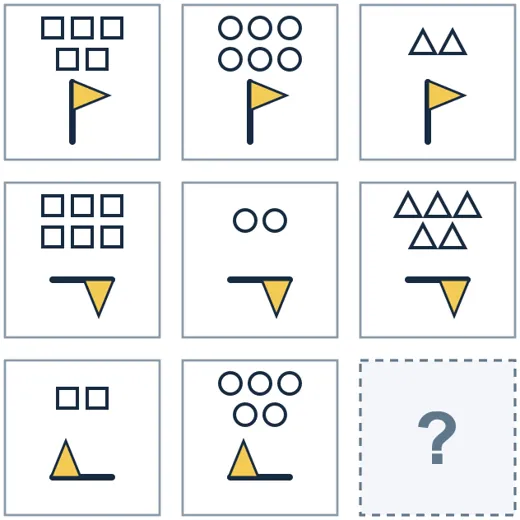
Answer: A.
- Check each row and each column.
- Every row and every column has each number of small shapes once; the direction of the flag stays the same along each row; the kind of small shape stays the same down each column.
- For the number of small shapes, the missing picture takes the one that its row and its column do not have yet.
Show answer
Answer: A. Check each row and each column. Every row and every column has each number of small shapes once; the direction of the flag stays the same along each row; the kind of small shape stays the same down each column. For the number of small shapes, the missing picture takes the one that its row and its column do not have yet.
Which answer completes the pattern?
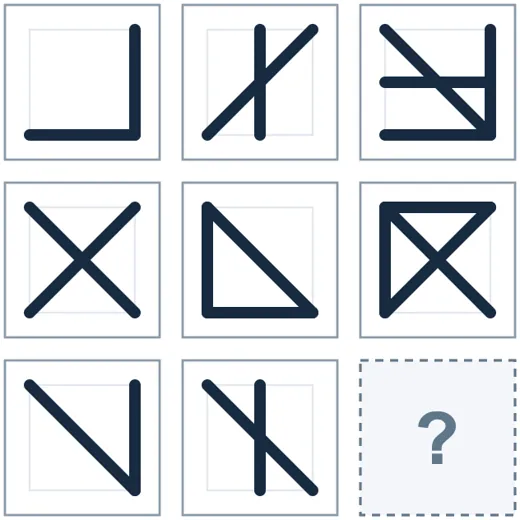
Answer: E.
- In each row, the third figure is made from the first two.
- Turn the second figure a quarter turn clockwise, then put the two figures together.
Show answer
Answer: E. In each row, the third figure is made from the first two. Turn the second figure a quarter turn clockwise, then put the two figures together.
Which answer completes the pattern?
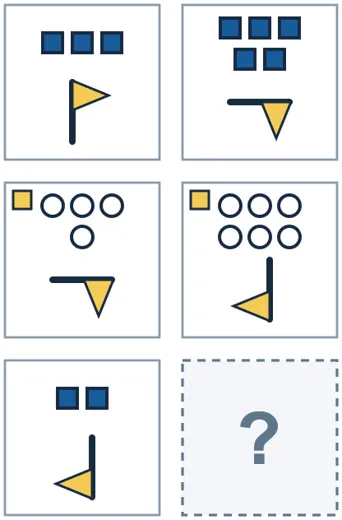
Answer: D.
- Compare the two pictures in each of the first two rows: the same change happens in both.
- The change: add 2 small shapes and turn the flag a quarter turn clockwise. Do the same to the third picture.
Show answer
Answer: D. Compare the two pictures in each of the first two rows: the same change happens in both. The change: add 2 small shapes and turn the flag a quarter turn clockwise. Do the same to the third picture.
Quantitative: find the number rule
Quantitative questions ask for the rule behind numbers rather than for arithmetic speed. A pair such as 6 → 15 and 14 → 31 hides one rule that works for every pair; a picture equation asks what one shape is worth. Writing the rule in words (“double it and add three”) is the habit to build.
Which answer completes the pattern?
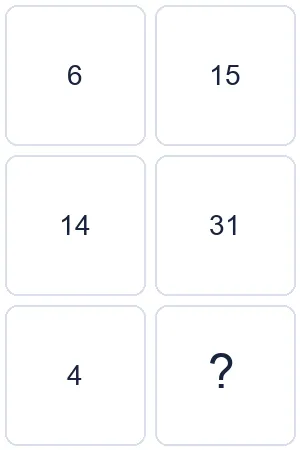
Answer: C.
- Find one rule that turns the first number into the second in both example rows.
- The rule is: multiply by 2, then add 3. Check: 2 × 6 + 3 = 15 and 2 × 14 + 3 = 31.
- So 2 × 4 + 3 = 11.
Show answer
Answer: C. Find one rule that turns the first number into the second in both example rows. The rule is: multiply by 2, then add 3. Check: 2 × 6 + 3 = 15 and 2 × 14 + 3 = 31. So 2 × 4 + 3 = 11.
Which answer completes the pattern?
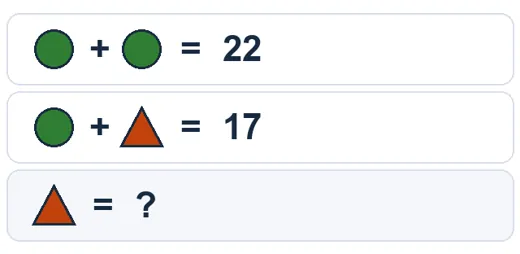
Answer: B.
- Each shape stands for one number. The same shape always has the same value.
- Row 1: two circles make 22, so one circle is 22 ÷ 2 = 11.
- Row 2: one circle + one triangle = 17, so the triangle is 17 − 11 = 6.
Show answer
Answer: B. Each shape stands for one number. The same shape always has the same value. Row 1: two circles make 22, so one circle is 22 ÷ 2 = 11. Row 2: one circle + one triangle = 17, so the triangle is 17 − 11 = 6.
Try the new free NGAT practice test by grade →
NGAT Test Prep has more questions like these at second-grade level in all three areas, a step-by-step explanation after each one, and a parent report that shows which area needs another look.
After these questions
Notice which section felt hardest and come back to that kind of question on another day; one familiar format at a time is better than a long session. For one more question in each category, try the free grade 2 practice. If your child is in Fairfax County, the FCPS NGAT guide explains how the district uses the test. Whatever the district, the NGAT is one piece of information schools look at, and a relaxed, rested child shows their reasoning best.
Sources
Questions people ask
What kinds of questions are on the 2nd grade NGAT?
Three kinds, one per test. Verbal: find the picture that does not share the idea the others have. Nonverbal: complete a grid of shapes. Quantitative: find the rule that links numbers. All are shown as pictures, shapes and numbers, with directions given by animated video.
How long is the NGAT for a 2nd grader?
MHS lists 40 items per test and a maximum of 30 minutes per test for kindergarten through grade 2. A school may give one, two or all three tests, sometimes on different days.
Are these the real FCPS or NGAT questions?
No. MHS does not publish its test items, and schools do not share them. These are original practice items from the NGAT Test Prep bank, written at second-grade level in the three NGAT formats.
My child got several wrong. Should I worry?
No. A short sample says nothing reliable about an ability test result. They show which format is unfamiliar, so you know what to look at together. Read the explanation, then try a similar question another day.
How much should a 7-year-old practice?
A little: a few ten-minute sessions before test day are enough to make the format familiar. Talking through why an answer fits helps more than doing many questions quickly.
