
Gestation calendar for herds and flocks
Livestock Gestation Tracker
Birth windows and a season calendar for your herd or flock
Or scan with your phone’s camera.
 iPhone and iPad
 Android
Livestock Gestation Tracker on iPhone, iPad and Android turns a breeding date, or the days a sire ran with a group, into an earliest, central and latest birth date for cattle, sheep, goats, pigs, horses, alpacas, llamas and rabbits, with every value’s extension source shown, and puts the whole season on one calendar with reminders.
- iPhone, iPad and Android
- Works offline
- No account
- Eight species, sourced
What you can do with Livestock Gestation Tracker
Your whole season on one calendar
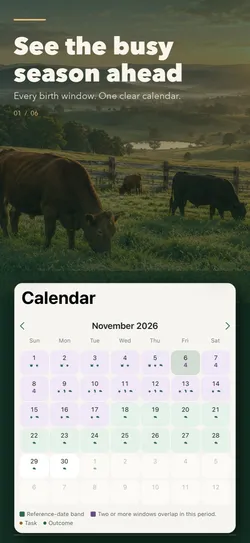
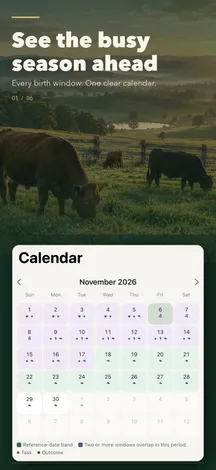
Every calving, lambing, kidding, farrowing and foaling window sits on one month calendar, and the weeks where two or more groups overlap are marked, so you can see when the barn, the pens and your nights will be busiest. A daily agenda lists what is due today.
- Overlapping windows flagged
- Next-window card with what is coming in 30 and 90 days
A birth window for the whole group
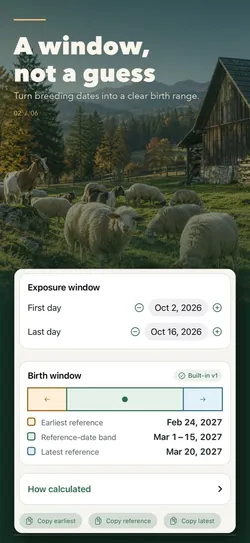
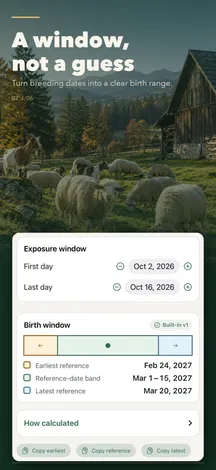
Enter the days a bull, ram, buck or boar ran with the group and get the earliest, central and latest birth date for all of them — or start from an exact breeding date for one animal. Every value shows the extension source it comes from.
- Eight species: cattle, sheep, goats, pigs, horses, alpacas, llamas, rabbits
Plan backwards from the births you want
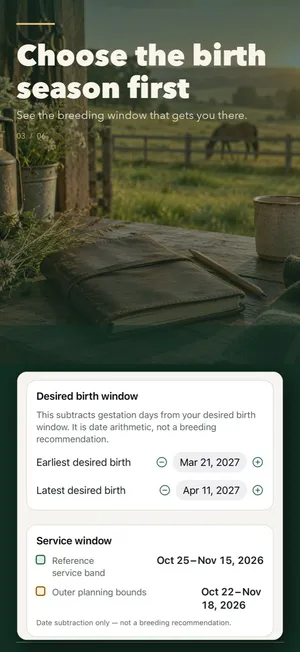
Pick the dates you want calves, lambs or kids on the ground and see the breeding window that gets you there — handy for spring calving, show seasons or a market date.
Every plan with its tasks and reminders
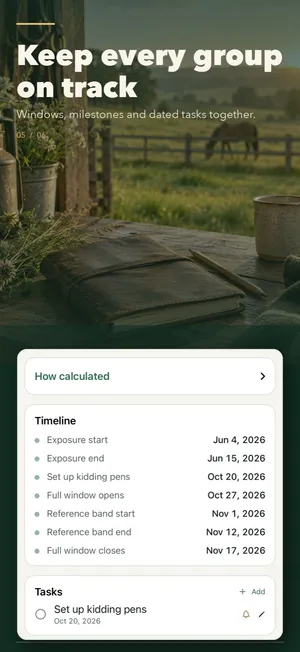
Each animal or group gets a timeline from breeding to the end of the window, your own tasks such as vaccinations or setting up pens, and a reminder before the window opens. Save task templates and copy a season forward a year.
- Reminders before each window opens
- Reusable task templates
Season reports, planned versus observed
Record the first and last births you actually saw, compare them with the plan, and export the season as a PDF or CSV report for your records or your vet. Add your own species profiles when your herd runs longer or shorter than the books.
Everything in the app
A due date calculator that shows a range
- An earliest reference date, a central reference band and a latest reference date instead of one guessed day
- Sire with the group for days or weeks: enter the first and last exposure day and get the window for the whole group
- Reverse planning: choose the birth dates you want and see when to breed
The whole season in one calendar
- Every animal and breeding group on one month calendar, with an agenda for each day
- Overlapping calving, lambing, kidding, farrowing, foaling, cria and kindling windows are marked, so busy weeks stand out
- Tasks appear on the day they are due, next to the window they belong to
A plan for every animal or group
- A timeline from breeding to birth, with your own tasks, pregnancy status and notes
- Reminders before each window opens
- Record first and last observed births and compare them with the planned windows, month by month
- Copy a season forward by a year; PDF and CSV season reports for your records, your veterinarian or a buyer
Numbers you can check
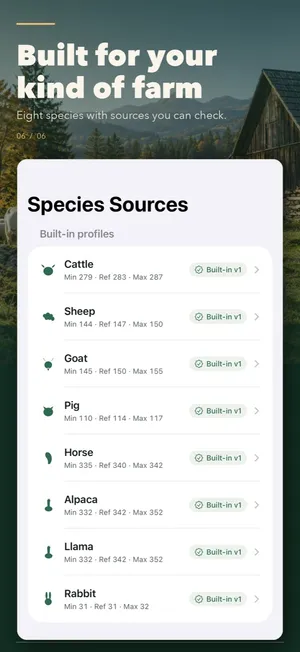
- Eight built-in gestation profiles from university-extension and veterinary references, each shown with its source
- Your own species or gestation length when your animals differ
Who is it for?
- Small farms and homesteads planning calving, lambing, kidding or farrowing
- Breeders who run a bull, ram or buck with a group for days or weeks
- Horse, alpaca and llama owners planning one foaling or cria at a time
- Rabbit breeders tracking kindling dates
- 4-H and FFA members who want a dated record they can show
What makes it different?
A window, not a guess
Most calculators print one due date. The app shows the earliest, central and latest reference dates, because real births come in a range.
Group exposure built in
For a bull or ram turned out with a group, the window runs from the first exposure day plus the minimum gestation to the last exposure day plus the maximum.
Sources on screen
Each profile names its source — University of Nebraska–Lincoln, Penn State Extension, University of Minnesota Extension or the MSD Veterinary Manual — and how the reference value was derived.
Offline and private
No account, no tracking and no cloud. Records stay on the device, and you can back them up to a file and restore them.
Free tools and guides
Requirements
- Devices
- iPhone, iPad and Android devices
- System
- iOS 17.0 or later; Android
- Languages
- English, Spanish, Portuguese, German, Japanese
- Account
- None; works offline
- iOS version
- 1.3.2 · October 28, 2026
iOS: Neobile LLC · Android: KITEBLOOM LLC
Livestock Gestation Tracker is an organizational aid, not veterinary advice. Reference dates vary by animal, breed, pregnancy and management conditions. Use your own records and your veterinarian or a qualified livestock professional for care decisions.
Questions people ask
Does Livestock Gestation Tracker work offline?
Yes. Calculations, plans, the calendar and reports all run on the device. There is no account and no cloud; back up to a file whenever you like.
Which species are built in, and with what gestation lengths?
Cattle 279–287 days (reference 283), sheep 144–150 (147), goats 145–155 (150), pigs 110–117 (114), horses 335–342 (340), alpacas and llamas 332–352 (342) and rabbits 31–32 (31). You can add your own species or length.
Where do the gestation values come from?
From university-extension and veterinary references: University of Nebraska–Lincoln Beef, Penn State Extension, University of Minnesota Extension and the MSD Veterinary Manual. Each profile shows its source and whether the reference is a published value, a rounded planning value or the app’s midpoint of a published range.
Can I see all my breeding groups at once?
Yes. The season calendar shows every animal and group’s birth window together, marks the weeks where windows overlap and lists the day’s tasks in a daily agenda. Each plan also reminds you before its window opens.
Can it tell me if my animal is pregnant?
No. It is an organizational aid that does date arithmetic from your records. Pregnancy checks and care decisions belong with your veterinarian or a qualified livestock professional.
Is there an Android version?
Yes. Livestock Gestation Tracker is available on Google Play for Android, as well as the App Store for iPhone and iPad.
Does it work for a whole breeding group?
Yes. Enter the first and last day the sire was with the group; the app widens the window to cover the earliest and latest possible births and puts the group on the season calendar.
