Cognitive Abilities Test · Level 5/6 practice
CogAT sample questions for kindergarten
Here are eight original kindergarten practice questions, one from each of eight CogAT subtests: picture analogies, picture classification, sentence completion, number analogies, number series, figure matrices, paper folding and figure classification. Read each one aloud, let your child tap a picture, then read the explanation. Practice only, not a score.
Read the question out loud, point to the pictures in the example, and wait. When your child taps a choice, a green border means it fits. The short explanation underneath is written for an adult to say in their own words.
Verbal battery
The first two pictures go together. Which picture goes with the last picture in the same way?
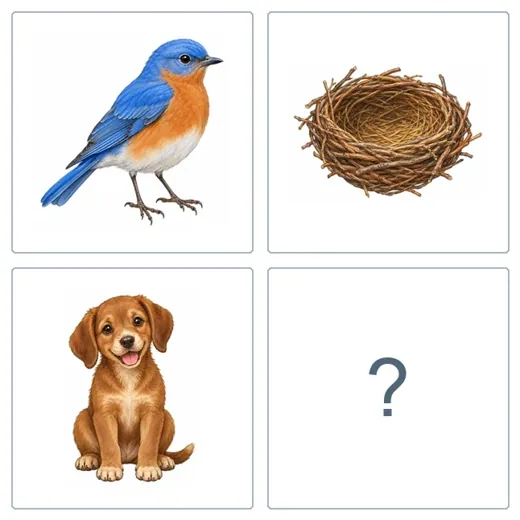
Answer: A (doghouse). Each animal is paired with a place it lives.
Show answer
Answer: A. Each animal is paired with a place it lives.
Which picture belongs with these three pictures?

Answer: C (mitten). All three examples are things worn on the body. Mitten belongs to that group.
Show answer
Answer: C. All three examples are things worn on the body. Mitten belongs to that group.
Sam wants to draw a line. He uses a ____.
Answer: B (pencil). A pencil makes a line on paper.
Show answer
Answer: B. A pencil makes a line on paper.
Quantitative battery
Each row follows the same number rule. What belongs in the empty box?
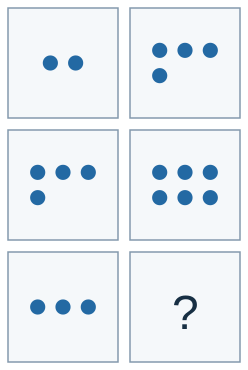
Answer: C. Add 2 to the first group in every row. The last group has 3, so the answer has 5.
Show answer
Answer: C. Add 2 to the first group in every row. The last group has 3, so the answer has 5.
Which group comes next?
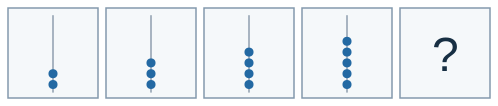
Answer: B. Change by 1 each time. The next number is 6.
Show answer
Answer: B. Change by 1 each time. The next number is 6.
Nonverbal battery
Which figure completes the matrix?
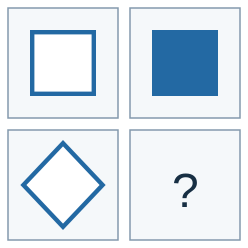
Answer: C. The top shape changes between filled and outline. Make the same change to the bottom shape, keeping its shape and color.
Show answer
Answer: C. The top shape changes between filled and outline. Make the same change to the bottom shape, keeping its shape and color.
The arrows show how the paper is folded. A hole is punched through every layer. What will the paper look like when opened?
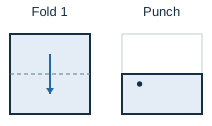
Answer: A. Unfold in the reverse order. At each crease, reflect every hole to the same distance on the other side. 1 punched hole through 2 layers produces 2 holes in the open paper.
Show answer
Answer: A. Unfold in the reverse order. At each crease, reflect every hole to the same distance on the other side. 1 punched hole through 2 layers produces 2 holes in the open paper.
Which figure belongs with all three examples?

Answer: A. All three example shapes are filled in. The correct choice has that same property even though its shape is different.
Show answer
Answer: A. All three example shapes are filled in. The correct choice has that same property even though its shape is different.
What does each kindergarten CogAT subtest ask?
Riverside Insights builds the CogAT from three batteries with three subtests each. At the primary levels the questions are pictures, and the teacher reads the directions. This page skips Number Puzzles (two trains carrying the same number of objects) to keep it short; the other eight appear above.
Verbal battery
Picture Analogies (question 1) pairs two pictures by a relationship, here an animal and its home. Picture Classification (question 2) asks what three pictures have in common. Sentence Completion (question 3) is heard, not read: the child picks the picture that finishes the sentence.
Quantitative battery
Number Analogies (question 4) shows rows of dot groups that all follow one counting rule, the quantitative twin of a picture analogy. Number Series (question 5) shows strings of beads that grow in a pattern, and the child picks the next string.
Nonverbal battery
Figure Matrices (question 6) is the analogy idea with shapes. Paper Folding (question 7) asks where a punched hole lands when the paper is opened. Figure Classification (question 8) asks which shape shares a property with the examples, such as being filled in.
How do you help a five-year-old without giving the answer?
- Say the relationship as a sentence. “A bird lives in a nest. A puppy lives in a …?” Then stop and let the child finish it.
- Ask “what is the same?” For classification, have your child name what the three examples share before looking at the choices.
- Count with a finger. On dot and bead questions, touching each dot keeps the count honest and shows the change from one box to the next.
- Use real paper. Fold a sheet once, punch a hole with a pencil, and unfold it. One try makes paper folding concrete.
- Keep it short. Three or four questions are plenty for a kindergartner in one sitting; the real subtests are only 10 to 15 minutes each.
Practice, not an official CogAT score
The CogAT compares a child with others of the same age in years and months, using national norms behind the Standard Age Score and the age percentile rank. Nothing on this page is normed, so a perfect run here does not mean a high score, and a few misses mean nothing either. Districts pick the form, the level, the cut-off and the other evidence they combine with the test, so ask your school how its process works.
CogAT Test Prep is an independent app by Neobile LLC, not connected with Riverside Insights; the questions here come from its own bank.
Sources
Questions people ask
Which CogAT level do kindergartners take?
Riverside Insights groups the primary levels as 5/6 to 8 for kindergarten through grade 2; kindergarten uses Level 5/6. At these levels every subtest is picture-based, and Sentence Completion is read aloud to the child in English or Spanish.
How long is the kindergarten CogAT?
Riverside’s timing table gives roughly 10–15 minutes for each of the nine primary-level subtests. A district that uses the shorter Screening Form, made of the three analogy-type subtests, needs about 30 minutes in total.
Are these the real CogAT questions?
No. They are original practice items from the CogAT Test Prep question bank, chosen to show one example from eight of the nine subtests. Riverside’s own sample items are in its CogAT brochure, linked below.
My child cannot read yet. Can they still do this page?
Yes. Read the question aloud, including the sentence in question 3, and let your child point. That is how the real primary levels work: the child listens and chooses a picture.
What does a good result here mean?
Only that your child understood these formats today. The CogAT reports a Standard Age Score, percentile ranks and stanines from a normed test; eight practice items cannot estimate any of them.