A calm, day-by-day K–5 practice plan
A two-week CogAT study plan for busy families
Use ten short practice days, two lighter review days, and two rest days. Start untimed with one reasoning area at a time, review why answers work, then finish with a small amount of mixed practice. Keep school, play, sleep, and family routines intact.
This is a flexible family routine, not a promise of a score. Confirm the school’s level, form, batteries, dates, and timing before you start, then adjust the plan to your child’s attention and energy.
Free practice questions each day
01 / Before day one
Get the school details and set one realistic goal
Ask the school which CogAT form and level it plans to use, whether students will take the full assessment or a screening form, which batteries are included, when testing happens, and whether timing or accommodations apply. If the school uses several measures for advanced learning identification, ask how CogAT fits with the rest.
Your family goal can be simple: help your child understand unfamiliar directions, recognize the main reasoning formats, explain an answer, and move on calmly after a difficult question. That goal is useful whether testing is two weeks away or farther out.
Set up the routine once
- Choose a consistent time when your child is fed and reasonably rested.
- Keep paper nearby for number or figure reasoning when it helps.
- Silence unrelated notifications and stop after the planned short session.
- Use praise for careful thinking, explaining, and trying another strategy.
- Write down one format to revisit rather than extending the session.
The National Association for Gifted Children says tests should be used with other objective and subjective information rather than as the sole source of identification. See its guidance on assessments and tests.
02 / The 14-day schedule
Short sessions that build from familiar to mixed
Each practice day below has one job. If your child needs more time with a format, repeat the day with fresh questions and move the calendar back. If attention drops, stop early. Consistency matters more than completing a fixed number of items.
Week 1 · Learn the formats
- Day 1: Try a small mixed sample without a timer. Notice which directions are new.
- Day 2: Practice verbal reasoning. Discuss analogies, sentence relationships, and classification.
- Day 3: Practice quantitative reasoning. Look for number relationships, balance, and sequences.
- Day 4: Practice nonverbal reasoning. Name the change in shapes, matrices, or spatial patterns.
- Day 5: Review a few saved mistakes. Ask your child to explain the corrected rule.
- Day 6: Use a short mixed set and practice moving on when one item feels hard.
- Day 7: Rest. Keep the normal weekend routine.
Week 2 · Apply and taper
- Day 8: Return to the least familiar battery with untimed explanation-first practice.
- Day 9: Practice a stronger battery to reinforce confidence and careful checking.
- Day 10: Use a mixed set. If the real test is timed, introduce gentle pacing.
- Day 11: Review only the most useful mistakes and one fresh example of each rule.
- Day 12: Complete a short mock session with normal directions and no coaching during answers.
- Day 13: Do a light confidence review or skip practice if your child is tired.
- Day 14: Rest, prepare the morning routine, and protect bedtime.
03 / Make review useful
Talk about the rule behind the answer
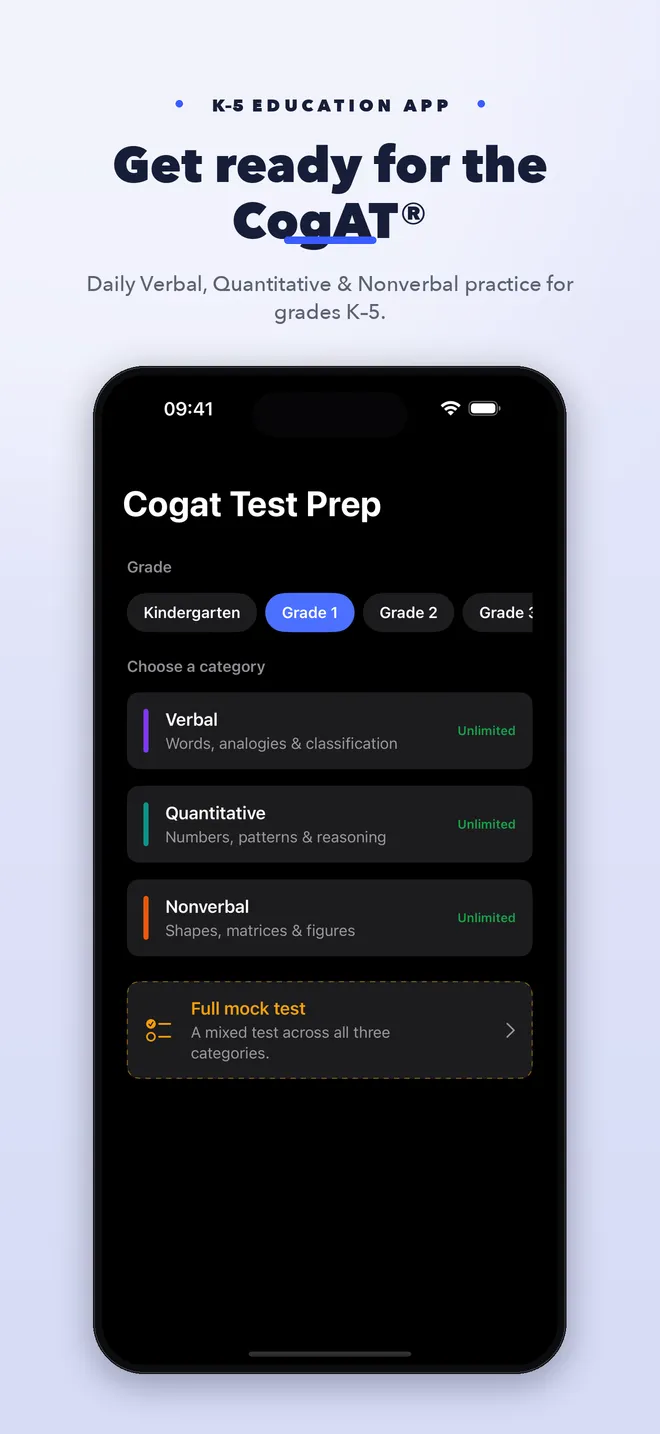
When an answer is wrong, begin with curiosity: “Show me what you noticed.” A child may have found a real pattern that was incomplete, misunderstood one part of the directions, or chosen the first plausible answer without checking the rest. Each cause needs a different response.
Name the relationship
Say what changes from the first part to the second. Use precise words such as rotate, add, remove, group, opposite, or same category.
Check the full rule
Test the relationship against every part of the prompt. A tempting answer often matches one detail while breaking another.
Use elimination
Remove choices that cannot follow the rule, then compare the remaining options carefully.
Try a fresh example
Later, use a different original question that applies the same reasoning. Transfer shows more understanding than memorizing one answer.
A routine you can see
Use progress and mistakes to choose tomorrow’s session
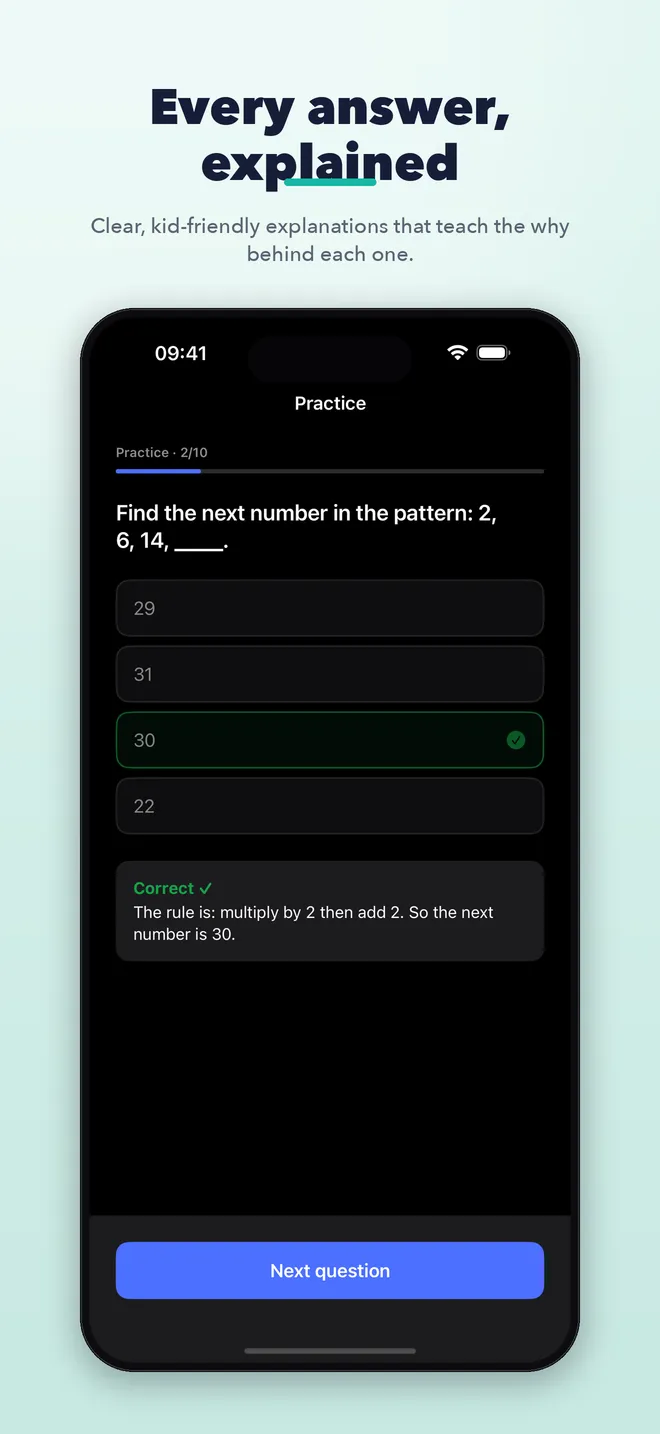
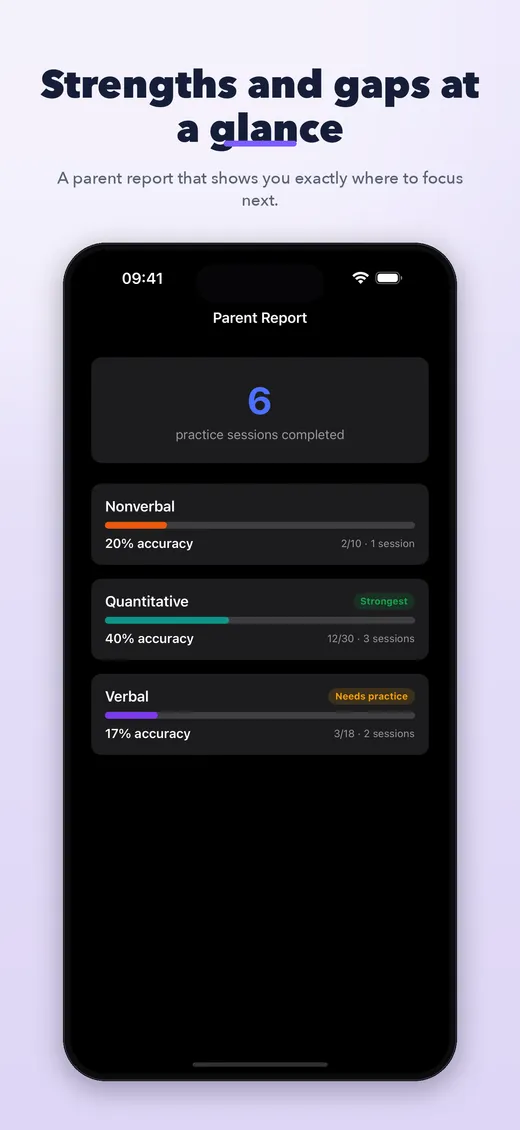
CogAT Test Prep includes grade choices from kindergarten through fifth, practice across verbal, quantitative, and nonverbal reasoning, child-friendly explanations, mock tests, a mistakes notebook, and parent reports. Use the information to keep sessions focused instead of guessing what to repeat.
- Original K–5 questions
- English and Spanish
- Free practice questions each day
- No advertising inside the app
Free practice questions each day
04 / Learn what comes next
Use the guide that answers today’s question
Parent FAQ
Two-week CogAT plan FAQ
Is two weeks enough to prepare for the CogAT?
Two weeks can be enough to introduce common reasoning formats and create a calm routine, especially when a child already has the underlying reasoning skills. It is not a guarantee of a score. If more time is available, repeat the pattern with fresh original questions rather than making each session longer.
How many minutes should each CogAT practice session take?
This sample plan uses short sessions that many families can fit into a normal school day. The right length depends on the child. Stop while attention is still good, and shorten or skip a session if practice is creating frustration or interfering with sleep.
Should my child practice with a timer?
Learn each format without a timer first. If the school confirms that timing matters, add a gentle timed mixed set after the child understands the directions. A timer should rehearse pacing, not create panic.
What should we do after a wrong answer?
Ask your child to explain what they noticed. Then identify the complete rule, compare it with every answer choice, and try one fresh example later. A mistake is useful when it changes the next approach.
What if our school uses CogAT only as one measure?
That is common. Ask the school for its full identification policy and support the other parts of the process, such as classroom work, teacher information, achievement measures, portfolios, or parent input. Practice should stay in proportion to the role CogAT actually plays.
CogAT® is a registered trademark of Riverside Insights. CogAT Test Prep is an independent Neobile LLC product. It is not affiliated with, authorized by, or endorsed by Riverside Insights and does not guarantee any score or program placement.