Free tool · VINsight
VIN decoder and check-digit checker
Type or paste a 17-character VIN. The decoder checks the ninth-character check digit, reads the model year from the 10th character and the region of manufacture from the first, and splits out the manufacturer code, descriptor, plant and serial. 1HGCM82633A004352 passes its check digit, is a 2003 model and was built in the United States.

VINsight: VIN Decoder & Check
Know a used car’s problems before you buy it
VINsight: VIN Decoder & Check is for iPhone and iPad; there is no Android version.
Free to download for iPhone and iPad.
Works offline: nothing you enter leaves your browser. Spaces, dashes and lower case are fine.
| Check digit | 3: passes |
|---|---|
| Model year | 2003 (code 3; 2033 on the other 30-year cycle) |
| Made in | United States, North America |
| Manufacturer code (WMI) | 1HG |
| Vehicle descriptor | CM8263 |
| Plant code · serial | A · 004352 |
See this car’s make, model, owner complaints and recalls
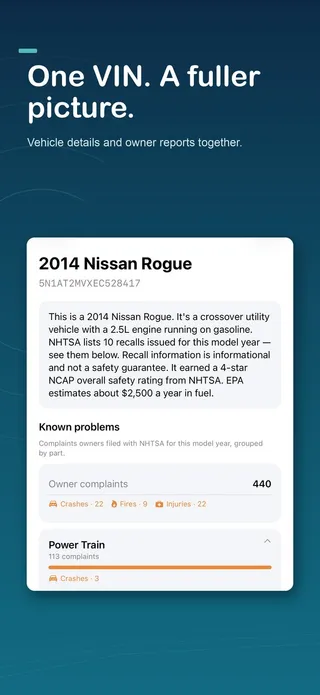
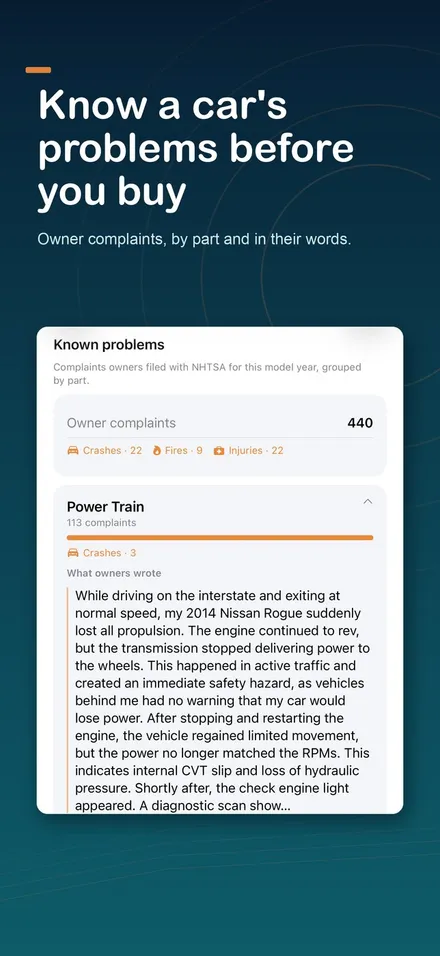
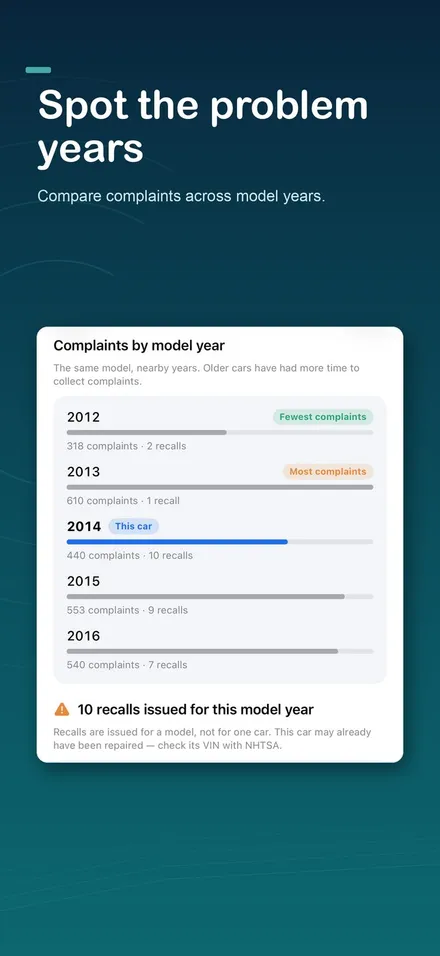
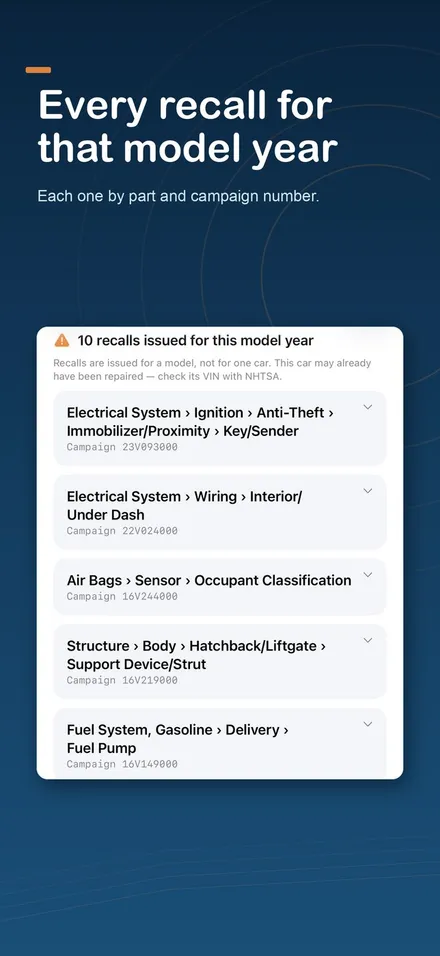
VINsight: VIN Decoder & Check looks this VIN up in NHTSA’s data: owner complaints for the model year grouped by part, the problem years around it, and every recall with its remedy.
VINsight: VIN Decoder & Check is for iPhone and iPad; there is no Android version.
Everything in the app
- Owner complaints for the model year grouped by part, with what owners wrote
- The problem years around it, every recall with its remedy, and new-recall alerts
- Crash-test stars, fuel economy detail, a PDF report and car comparison
- Scan the VIN with the camera or type it
- A full sample report the first time you open the app
What the 17 characters mean
Every car and light truck sold in the United States since model year 1981 carries a 17-character vehicle identification number. It is printed on a plate at the base of the windshield on the driver’s side, on the label in the driver’s door jamb, and on the title, registration and insurance card. The letters I, O and Q never appear, so they cannot be confused with 1 and 0.
- Positions 1–3, the world manufacturer identifier (WMI). The first character is the region where the vehicle was built: 1, 4 and 5 for the United States, 2 for Canada, 3 for Mexico, J for Japan, K for South Korea, W for Germany. The next two identify the manufacturer and often the vehicle type.
- Positions 4–8, the vehicle descriptor. Model, body, engine, restraint system and similar attributes, coded differently by each manufacturer. Reading them needs the manufacturer’s own table, which is what NHTSA’s VIN decoder holds.
- Position 9, the check digit. A single number or X computed from the other sixteen characters.
- Position 10, the model year; position 11, the plant; positions 12–17, the serial number.
How the check digit catches a typo
Each letter is given a number (A and J are 1, B, K and S are 2, and so on), each position has a weight from 2 to 10 (position 9 itself weighs nothing), and the weighted sum is divided by 11. The remainder is the check digit, written as X when it is 10. A single mistyped character almost always changes the remainder: 1HGCM82633A004352 gives 3, matching its ninth character, while 1HGCM82633A004353, one digit different at the end, would need a check digit of 5 and fails.
VINsight runs the same check on the phone before any lookup, whether you scan the VIN with the camera or type it, so a misread character is caught before it turns into the wrong car’s recalls.
Reading the model year
The 10th character cycles through 30 codes: the letters A to Y without I, O, Q, U and Z, then the digits 1 to 9. A stands for 1980 and again for 2010, so the same letter can mean two years 30 years apart. For cars, light trucks and SUVs made for North America, the 7th character settles it: a letter there means the 2010 cycle, a digit the 1980 one. The decoder lists the likely year first and the other cycle after it; for vehicles from other markets, use common sense about the car in front of you.
What the VIN alone cannot tell you
Make, model, trim and engine need the manufacturer’s descriptor table, and the history that matters to a buyer lives in other databases. The recall list and the complaints owners file with NHTSA describe the model year; a vehicle history report covers accidents, titles and mileage, which no VIN decoder can read from the number itself. Run the recall search with the VIN before you buy, and see the recall guide for how to read the result.
Questions people ask
How do I check if a VIN is valid?
A VIN has exactly 17 characters and never uses the letters I, O or Q. For vehicles sold in North America, the ninth character is a check digit computed from the other sixteen. In 1HGCM82633A004352 the check digit is 3, and the calculation gives 3, so the VIN is consistent; change the last character to 3 and it is not.
How do I tell the model year from a VIN?
Look at the 10th character. Letters A to Y (without I, O, Q, U, Z and 0) and the digits 1 to 9 run through a 30-year cycle: A is 1980 or 2010, Y is 2000 or 2030, 1 to 9 are 2001 to 2009 or 2031 to 2039. On North American cars and light trucks, a letter in the 7th position points to 2010 or later and a digit to 1980–2009. 1HGCM82633A004352 has a 3 in position 10 and a 6 in position 7: model year 2003.
Does this decoder show the make, model and recalls?
No. It decodes only what is written into the VIN itself and works offline. Make, model, trim, engine and recalls come from NHTSA’s databases; VINsight looks those up, along with owner complaints, crash-test stars and fuel economy.
What does a failed check digit mean?
Usually a typo: a 5 read as an S, a 0 as a D, a missing character. Recheck the VIN on the dashboard plate and the door-jamb label. Some vehicles built before 1981 or for markets outside North America do not use the check digit, so a mismatch there is not proof of anything.
Can a VIN tell me who owns the car?
No. A VIN identifies the vehicle, not a person. Neither this page nor VINsight returns an owner’s name or address.
