Free, official, and quick
How to check your car for recalls by VIN
Enter the 17-character VIN at NHTSA.gov/recalls. The search tells you whether that exact vehicle has an unrepaired safety recall. If it does, the manufacturer’s dealer fixes it for free. Because new recalls are added all the time, check again at least twice a year and every time you are about to buy a used car.

VINsight: VIN Decoder & Check
Know a used car’s problems before you buy it
VINsight: VIN Decoder & Check is for iPhone and iPad; there is no Android version.
Free to download for iPhone and iPad.
A recall check covers safety recalls only. It is not a vehicle history report and says nothing about accidents, title problems, or mileage.
01 / Find the VIN
Where to find your car’s VIN
Every car and light truck sold in the United States since model year 1981 has a 17-character vehicle identification number, or VIN. It works like a serial number: no two vehicles share one, and recall systems use it to tell your car apart from every other car of the same model. NHTSA lists these places to look:
Where the VIN is printed
- The windshield. Stand outside the car on the driver’s side and look through the lower left corner of the windshield, where the glass meets the dashboard.
- The driver-side door jamb. Open the driver’s door and look for the label on the pillar or the edge of the door.
- Your registration card. The VIN is printed on it, and it is usually on your insurance card or insurance documents too.
- The title and the loan paperwork, if you have them at hand.
A VIN never uses the letters I, O, or Q, which are too easy to confuse with 1 and 0, so if you think you see an O, it is a zero. Under NHTSA’s VIN rule (49 CFR Part 565), the characters are grouped by meaning:
Who made it
The world manufacturer identifier, which also reveals the country or region of the maker.
What it is
Positions 4–8 describe attributes such as model, body, and engine. Position 9 is a check digit calculated from the other 16 characters.
Which one
Position 10 is the model year and position 11 the assembly plant; the last six characters are the production number.
Take a photo of the VIN, or copy it character by character and read it back once. One wrong character usually returns “not found” or, worse, a different vehicle. On a used car, compare the windshield VIN with the door-jamb label and the title. They should match exactly.
VIN locations follow NHTSA’s Check for Recalls and Vehicle Safety Recalls Week pages; the character groups follow 49 CFR Part 565.
02 / Search NHTSA
Run the free recall search on NHTSA.gov
The National Highway Traffic Safety Administration (NHTSA) runs the official U.S. recall search. It is free, it needs no account, and it is the place to start whether or not you use an app.
- Open NHTSA.gov/recalls
Choose the Vehicle tab. You can search by VIN or by state and license plate. The plate search looks the vehicle up in state motor vehicle records.
- Enter all 17 characters
Type the VIN exactly as printed, with no spaces. If the plate search shows a car you used to own, search by VIN instead and ask your state DMV to update its record.
- Read every listed recall
Each open recall names the problem, the risk, and the remedy. Note the NHTSA campaign number; the dealer will ask for it or look it up from the VIN.
- Check the brand’s site as well
NHTSA suggests the manufacturer’s own recall lookup too. Its VIN tool also uses recall information supplied by the manufacturer, which can appear before it is posted elsewhere on NHTSA’s site.
Fleet owners and families with several cars can check up to 100 VINs at once with NHTSA’s bulk search, and the same page covers recalls for car seats, tires, and equipment such as trailers.
03 / Read the result
What the VIN search result means, and what it leaves out
Recall incomplete
The vehicle is part of a safety recall that has not been repaired yet. Follow the remedy instructions and contact a dealer for the brand.
Remedy not yet available
The recall applies, but the manufacturer does not have the repair ready yet. Follow any interim safety advice in the notice and check back.
0 unrepaired recalls
No open safety recall was found. The car was never included in one, or the work has already been done.
“Zero” is good news with limits. According to NHTSA, the license plate and VIN search does not show:
Outside the VIN search
- Recalls that have already been repaired on that vehicle.
- Some recently announced recalls whose VINs have not all been identified yet. VINs are added continuously, so check again.
- Recalls more than 15 years old, unless the manufacturer offers more coverage.
- Recalls by small manufacturers, including some ultra-luxury brands and specialty vehicles.
- Customer-service or other non-safety campaigns run by a manufacturer.
- Recalls involving an international vehicle.
For an older car, a low-volume brand, an import, or a recall you have just read about in the news, call a dealer for the brand with the VIN in hand. A dealer can usually look the VIN up in the manufacturer’s own records, which also list service campaigns that are not safety recalls.
Result wording and search limits follow NHTSA’s Check for Recalls page and its recall FAQ.
04 / VIN vs model
A VIN search and a model search answer different questions
NHTSA also lets you search by year, make, and model, and most recall apps and car sites work at that level. The two searches are easy to confuse, and the difference matters.
Search by VIN or plateDoes this exact car still need a recall repair?
Search by year, make, modelWhich recall campaigns has this model ever had?
A model-level list is the complete recall history of the model: every campaign, with its component, consequence, and remedy. Some of those campaigns cover only vehicles built in certain months or at certain plants, and many cars have already had the work done, so a long list does not mean your car has that many open recalls. The VIN search narrows the list to the recalls your car still needs.
Use both. The model list shows how a model has held up and which systems were affected, which is useful when you compare cars to buy. The VIN result tells you what to book at the dealer.
05 / If a recall is open
What to do when your car has an open recall
- Read the safety advice first
Some notices include interim instructions, such as not letting anyone sit in a particular seat or parking outdoors until the repair is done. Follow them now.
- Call a dealer for your brand
Any franchised dealer for the brand can usually do the work, not only the one that sold you the car. Give them the VIN and the campaign number and ask how long the repair takes and whether parts are in stock.
- Expect no bill for the recall work
NHTSA’s guidance is that the dealer fixes the recalled part for free. The manufacturer may repair or replace the part, offer a refund, or in rare cases buy the vehicle back.
- Keep the paperwork
Keep the repair order that shows the campaign was completed. It shows the next owner that the work was done.
- Escalate if needed
If a dealer refuses to do the repair described in the recall notice, notify the manufacturer right away and file a complaint with NHTSA, with the dealer’s name and what happened.
If the result said “remedy not yet available,” ask the dealer to put you on a notification list for parts, and run the VIN search again every few weeks.
Remedy and complaint guidance follows NHTSA’s Check for Recalls page and recall FAQ.
06 / Buying used
Check a used car for recalls before you buy
New cars must be sold free of open recalls. Used cars are different: in a 2016 statement, the Federal Trade Commission noted that federal law does not prohibit dealers from selling used cars with open recalls. A certified inspection or a clean-looking listing is not proof that the recall work was done, and private sellers may not know either.
A recall routine for used-car shopping
- Ask for the VIN before you visit, and search it at NHTSA.gov/recalls.
- At the car, read the VIN from the windshield and the door jamb yourself and make sure both match the listing and the title.
- If a recall is open, ask the seller to have it repaired before the sale and to give you the dealer’s repair order.
- If you buy with a recall still open, book the free repair right away and follow any interim safety advice until then.
- Run the search again the day you sign. Recalls are added continuously.
- Look up the model’s recall and complaint history by year, make, and model when you compare candidates, not just the one car you like.
- Remember what a recall check does not cover: order a vehicle history report and pay for an independent pre-purchase inspection.
The used-car point comes from the FTC’s Statement of the Commission of December 16, 2016. State rules and later law can differ; check the rules where you buy.
Before the lookup, a quick sanity check catches a mistyped VIN: the free VIN decoder on this site verifies the check digit and reads the model year and region of manufacture from the VIN itself.
VINsight: VIN Decoder & Check shows what owners reported going wrong with this model year, grouped by part, which nearby years drew the most complaints, and every recall with its remedy, before you buy.
VINsight: VIN Decoder & Check is for iPhone and iPad; there is no Android version.
07 / New recalls
Keep watching for new recalls
A clean result today does not stay clean forever. NHTSA counted 997 recalls in 2025 across vehicles, car seats, tires, RVs, and other equipment, and more than 29 million vehicles were recalled in the United States that year. Some existing recalls are also expanded or updated.
Manufacturer letters
Manufacturers mail registered owners within 60 days of notifying NHTSA of a recall. Keep your registration address up to date so the letter reaches you.
NHTSA SaferCar
NHTSA’s free SaferCar app sends an alert when a recall is issued for a vehicle or piece of equipment you add. Email alerts are also available.
Twice a year
NHTSA recommends checking for recalls at least twice a year. Pair it with something regular, such as a tire rotation or daylight saving time.
Recall counts, alert options, and the twice-a-year advice come from NHTSA’s Vehicle Safety Recalls Week and Check for Recalls pages.
The same data, in your pocket
Decode a VIN and follow its recalls with VINsight
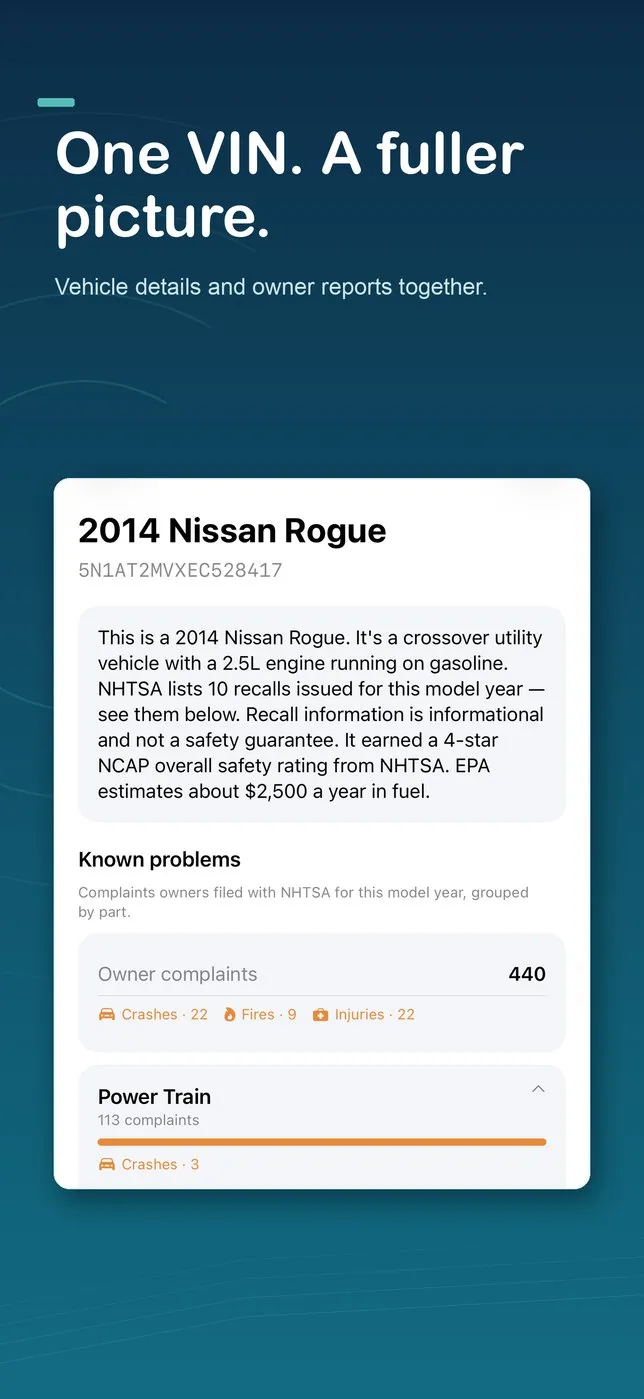
VINsight, listed on the App Store as “VINsight: VIN Decoder & Check,” puts the model-level side of this guide on your iPhone or iPad, and adds what a recall list cannot tell you: what owners say goes wrong. Point the camera at a printed VIN or type it in; the app checks the 17 characters and the check digit on the device, then decodes it with NHTSA’s public VIN decoder: year, make, model, trim, body, engine, horsepower, transmission, drivetrain and assembly plant.
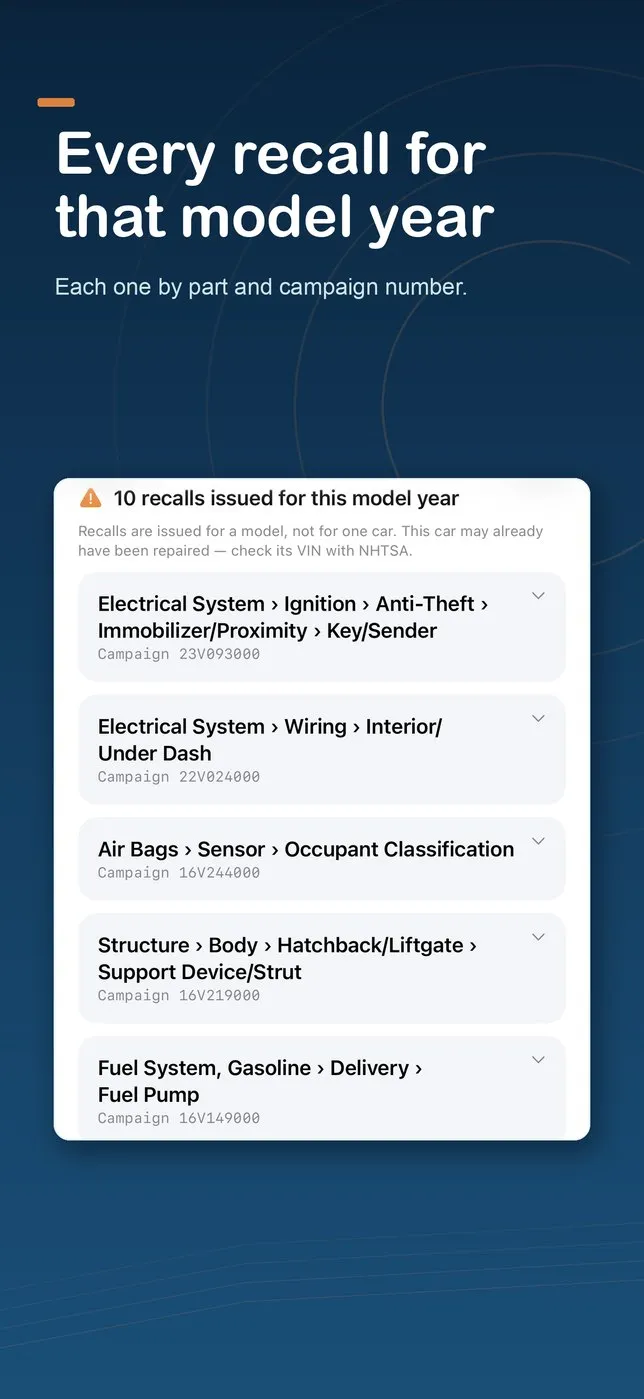
Below the specs come the owner complaints filed with NHTSA for that model year, grouped by part (power train, engine, electrical, brakes and more) with crash, fire and injury counts and the newest reports in the owners’ own words. The same model two years either side is lined up next to it, with the year that drew the most complaints and the one that drew the fewest marked. Every recall NHTSA has issued for the year, make, and model follows, newest first, with its campaign number, risk and remedy and a clear warning when owners are told to park the car. NHTSA crash-test stars and EPA fuel economy with a yearly fuel cost complete the picture.
Read the recall list the way section 4 explains: it is the model’s recall history, and it does not show whether a particular car’s repair has already been done. VINsight says so under the list and links to NHTSA’s VIN search for the repair status. Save a car to your garage and turn on new-recall alerts, and the app notifies you when NHTSA issues a new recall for it; iOS decides when background checks run, so an alert can arrive a little after the recall is posted. Put two cars side by side, or export a PDF report for a buyer, a seller or your mechanic. It is not a vehicle history report and has no accident, title, odometer, owner or valuation data.
The VIN is sent to NHTSA’s decoder, and the decoded year, make, and model go to NHTSA’s recall, rating, and complaint services and to the EPA’s fueleconomy.gov. Nothing goes to a Neobile server, and there is no account, no ads, and no tracking. The app never returns an owner’s name or address and is not a tool for finding people.
- For iPhone and iPad · iOS 17.0 or later
- Camera VIN scan or typed entry
- Specs from NHTSA’s VIN decoder
- NHTSA recall campaigns with remedies
- Owner complaints by part, and the problem years
- New-recall alerts for saved cars
- Crash-test stars and EPA fuel figures
- No account, no ads, no tracking; English only
VINsight: VIN Decoder & Check is for iPhone and iPad; there is no Android version.
No account · no ads · Garage stays on your device
Vehicle data only. Your Garage stays on your iPhone or iPad.
Frequently asked questions
Car recall check FAQ
How do I check if my car has a recall?
Find the 17-character VIN on the lower left of the windshield, on the label inside the driver-side door jamb, or on your registration or insurance card. Enter it at NHTSA.gov/recalls, or choose your state and enter your license plate. The result tells you whether that specific vehicle has an unrepaired safety recall from a participating manufacturer. You can also check on the manufacturer’s own website with the same VIN.
Is it free to check for recalls and to get a recall fixed?
Yes to both. NHTSA’s VIN and license plate search costs nothing, and so do manufacturer recall lookups. When a vehicle is under a safety recall, the manufacturer’s dealer fixes the recalled part for free; NHTSA monitors recalls to make sure owners receive safe, free, and effective remedies. If a dealer refuses to do a recall repair, tell the manufacturer and file a complaint with NHTSA.
What does “0 unrepaired recalls associated with this VIN” mean?
It means NHTSA’s search found no open safety recall for that vehicle among the recalls it covers. Either the vehicle was never included in a recall or the recall work has already been done. It does not cover recalls older than 15 years (unless the manufacturer offers more), some recently announced recalls whose VINs are still being added, small manufacturers, non-safety service campaigns, or international vehicles. Check again later, and ask a dealer for the brand if you have doubts.
Why does a year, make, and model search show more recalls than the VIN search?
They answer different questions. A year, make, and model search lists every recall campaign filed for that model, including recalls that affect only some build dates or plants and recalls your car may already have had repaired. The VIN search checks your exact vehicle and shows only the recalls it still needs. Use the model list to understand a car’s history and the VIN search to decide what still needs fixing.
Can a dealer sell me a used car with an open recall?
Often, yes. In a 2016 statement the Federal Trade Commission noted that federal law requires new cars to be sold free of recalls but does not prohibit dealers from selling used cars with open recalls. Run the VIN search yourself before you buy, ask the seller to complete any open recall first, and get the repair invoice. Private sellers are in the same position, so the check matters just as much at a private sale.
How will I find out about a new recall on my car?
Manufacturers mail recall notices to registered owners within 60 days of telling NHTSA about the recall, so keep your registration and mailing address current. NHTSA’s free SaferCar app can alert you when a recall is issued for a vehicle you add, and NHTSA also offers email recall alerts. NHTSA recommends checking for recalls at least twice a year because hundreds of recalls are issued every year and some are updated.
Is a recall check the same as a vehicle history report?
No. A recall check covers safety recalls only. It says nothing about accidents, title brands such as salvage or flood, odometer readings, or ownership history, and neither NHTSA’s search nor VINsight provides that information. For a used car, pair the recall check with a vehicle history report and a pre-purchase inspection by an independent mechanic.
What does VINsight check, and where does its data come from?
VINsight decodes the VIN with NHTSA’s public VIN decoder, then shows the recall campaigns in NHTSA’s recall data for that model year, make, and model, with each campaign’s component, summary, consequence, and remedy. It also shows NHTSA crash-test stars and complaint counts and EPA fuel figures for that model. It does not show whether a particular car’s recall repair has been done, so confirm the status of a specific vehicle with NHTSA’s VIN search or a dealer. It covers vehicles NHTSA’s decoder can read, which generally means U.S.-market vehicles from model year 1981 on.
VINsight is an independent product of Neobile LLC. It is not affiliated with, endorsed by, or operated by the National Highway Traffic Safety Administration, the U.S. Environmental Protection Agency, the Federal Trade Commission, or any vehicle manufacturer. Vehicle names are shown only to identify vehicles. iPhone and iPad are trademarks of Apple Inc. Recall, rating, complaint, and fuel information is reported by NHTSA and the EPA, can change or lag behind announcements, and is not a safety guarantee; confirm the recall status of a specific vehicle with NHTSA’s VIN search or an authorized dealer.
