Free tool · Salon Pricing Calculator
Salon service price calculator
Price a salon service as (hourly rate × hours of seat time + product + assistant) ÷ (1 − target margin), then round up. At 75.57 an hour, a 150-minute highlight with 18 of product marked up 50% and a 20% margin comes to 269.91, which rounds up to 270.00; never charge below 215.93.
Amounts in your own currency, percentages as numbers (20 = 20%). Nothing you enter leaves your browser.
Price for the sample service: 270.00. Turn on JavaScript to enter your own.
What goes into a service price?
A service price has to pay for the time it takes, the product it uses and the profit you plan to keep. Salon Pricing Calculator builds it in that order, and so does this page. Nothing is rounded until the end, and the round-up only ever goes up, so the price you post is never below the margin you asked for.
- Your time = minutes ÷ 60 × hourly rate.
- Product with markup = product cost × (1 + markup). Leave markup at 0 to charge product at cost.
- Your cost = time + product with markup + assistant cost. With no fees this is the price never to go below: margin zero.
- Price at your margin = cost ÷ (1 − margin), the division form. Multiplying by (1 + margin) would be a markup and leave you short.
- Rounded up to the next 1, 5 or 10, if you round your menu.
Worked example: what should a 2.5-hour highlight cost?
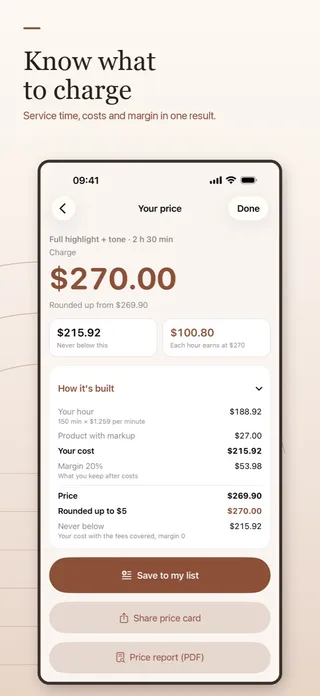
The service from the app's screenshot: a full highlight with toner, 150 minutes in the chair, 18 of product marked up 50%, a 20% margin and prices rounded up to the next 5. The hourly rate of 75.57 comes from the hourly rate calculator's sample stylist.
- Your time
- 2.5 h × 75.57 = 188.93
- Product with markup
- 18.00 × 1.5 = 27.00
- Never below this
- 188.93 + 27.00 = 215.93
- Price at 20% margin
- 215.93 ÷ 0.80 = 269.91
- Rounded up to 5
- 270.00 (+0.09)
- Each hour earns
- (270.00 − 18.00) ÷ 2.5 = 100.80
The app shows 215.92 for the floor because it carries the hourly rate unrounded (75.5696…); entering 75.57 here moves it by a cent. The charged price is the same.
The same service with a 3% card fee and 8% sales tax on top
Fees and tax are shares of the price, so they join the margin in the divisor: 1 − 0.03 × 1.08 − 0.20 = 0.7676. The price before tax becomes 281.30, rounded up to 285.00; the client pays 307.80 with tax, the card fee on that is 9.23, and each hour still earns 103.11. The floor with the card fee covered rises to 223.16.
Is my current price too low?
Open "Assistant, card fee, salon share, tax and today's price" and type what you charge now. The calculator places it the way the app does: below cost if it is under the floor (the service loses money every time), below target if it covers cost but misses your margin, and on target otherwise, with the gap per client. A gap of 15 on a service you do 12 times a month is 180 a month you are giving away.
If many services come out below target, raise them in one planned step rather than one at a time; the raise guide has the method and a client notice you can adapt.
What if I work on commission or the salon takes a share?
Enter the salon's share in the extra fields. The price then rises until your part, after the salon's cut, still covers your time, product and margin. If the salon takes the product cost out before it splits the price, tick the box: the share is then applied to the price minus product. For the bigger question of renting a booth instead, compare the two models month by month in the booth rent vs commission calculator.
Every figure here comes from the numbers you type. The page does not know what other salons in your area charge, and neither does the app; that judgment stays yours.
Sources
Questions people ask
How do I price a hair service?
Multiply your hourly rate by the full seat time in hours, add the product the service uses (with any markup you choose) and any assistant cost. That is your floor. Divide the floor by (1 − your target margin) to get the price, then round up the way your menu rounds.
What is the difference between margin and markup?
Markup is profit as a share of cost; margin is profit as a share of the price. Adding 20% to a floor of 100 gives 120, which is a 20% markup but only a 16.7% margin. A true 20% margin is 100 ÷ 0.80 = 125.
Should processing time count as seat time?
Count every minute the appointment blocks your chair or your hands from another paying client. If you can genuinely book someone else while color processes, you may leave that time out; if you cannot, it belongs in the price.
How do card fees and sales tax change the price?
They are shares of the price, so they go in the divisor with the margin: price = cost ÷ (1 − card fee × (1 + tax) − salon share − margin) when tax is added on top. A flat surcharge added after the fact would leave you short, because the fee is also charged on itself.
What does "each hour earns" mean?
What one hour of the service keeps at the price you charge, after tax, the card fee, the salon’s share, the product and the assistant. Compare it with your hourly rate: if it is lower, the service is under-priced for the time it takes.