A practical guide for independent beauty pros
How to price salon services from your true hourly rate
First calculate what each realistically booked hour must earn from your income goal and business costs. Then multiply that rate by the service’s full seat time, add direct product and assistant cost, and apply any target profit margin with the margin formula—not a markup shortcut.
Your result is a business scenario based on your inputs. Local demand, taxes, employment structure, and professional advice still matter.
Service pricing for independent beauty professionals
01 / Price the year before the appointment
Calculate a realistic salon hourly rate
Your hourly rate should carry the business costs that exist whether or not a particular client uses more color. Start with the annual take-home goal you want the business to support and your own tax set-aside estimate. Add annual fixed costs such as rent, insurance, education, software, equipment, and other overhead.
Gross income needed
Income goal ÷ (1 − tax set-aside estimate)
Required revenue
(Gross income needed + annual fixed costs) ÷ (1 − variable cost rate)
Billable hours
Bookable hours per week × utilization × working weeks
Base hourly rate
Required annual revenue ÷ billable hours
Use booked utilization rather than assuming every open chair hour produces revenue. Gaps, cancellations, cleaning, setup, inventory, messages, and administrative work reduce client-facing time. If only 27 of 30 available weekly hours are normally booked, the calculation should use 27.
Run your own numbers in the free salon hourly rate calculator: it uses the app's exact formula and shows every line of the math, including cost per minute and clients per week.
Keep revenue-percentage costs, such as card fees, in the required-revenue denominator. Keep per-service color, disposables, and assistant cost in the service calculation. This separation avoids charging for one cost twice.
02 / Price the complete appointment
Turn seat time and direct cost into a floor price
Use the full seat time that blocks the appointment book, including processing time when you cannot use that capacity elsewhere. Multiply those hours by your calculated hourly rate. Add the true product cost used by that service, any product markup you deliberately apply, and a direct assistant cost.
Labor chargeSeat-time hours × hourly rate
Product with markupProduct cost × (1 + markup)
Floor priceLabor + product + assistant
Price at target marginFloor ÷ (1 − margin)
The floor is the price before a target profit margin. A 20% target margin does not mean multiplying the floor by 1.20: that produces a 20% markup. Dividing by 0.80 produces a selling price where the difference between price and floor is 20% of the price.
Price one service at a time in the free salon service price calculator, with optional card fee, salon share and sales tax built into the price.
Competitor tools from Vagaro, Kitomba, and other salon platforms consistently center the same useful inputs: real costs, productive time, and profit. Your own business assumptions determine the answer.
03 / Follow one transparent example
Example: a 2.5-hour color service
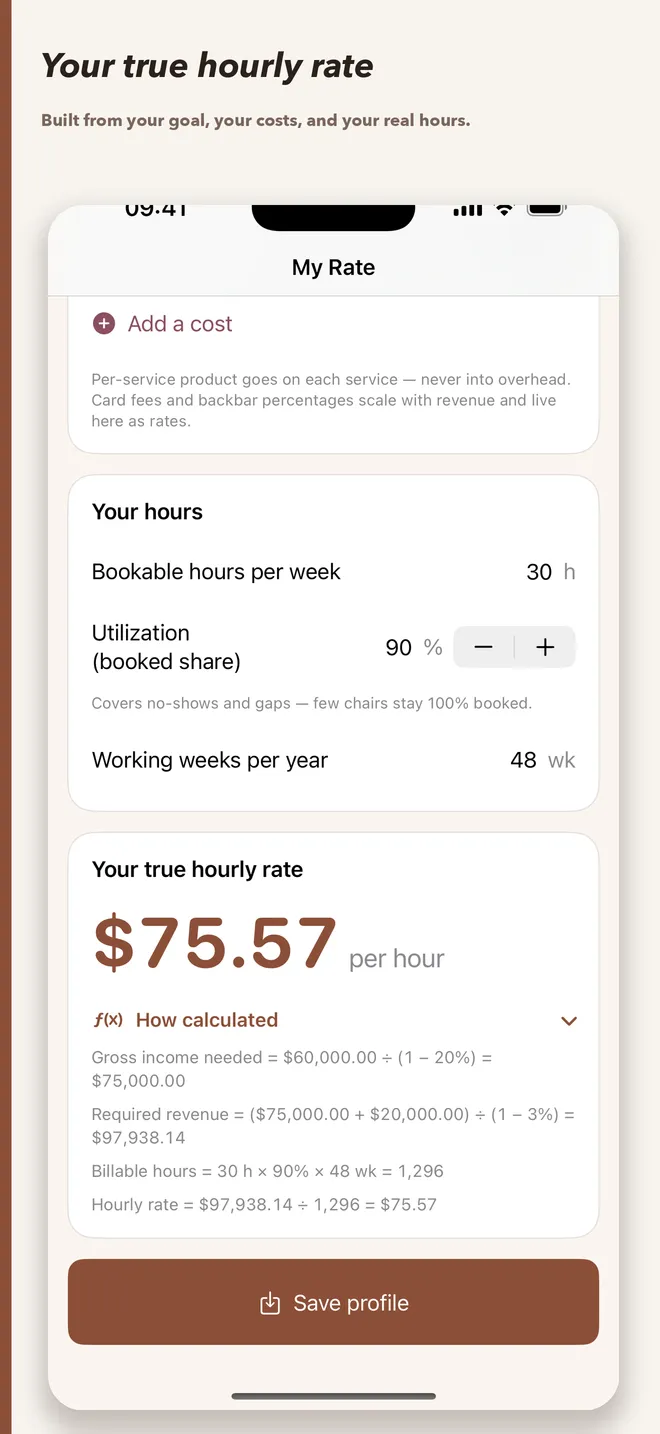
Assume a $60,000 annual take-home goal, a 20% set-aside estimate, $20,000 in annual fixed costs, 3% in revenue-based costs, 30 bookable hours per week, 90% utilization, and 48 working weeks.
Gross income needed$60,000 ÷ 0.80 = $75,000
Required revenue($75,000 + $20,000) ÷ 0.97 = $97,938.14
Billable hours30 × 90% × 48 = 1,296
Hourly rate$97,938.14 ÷ 1,296 = $75.57
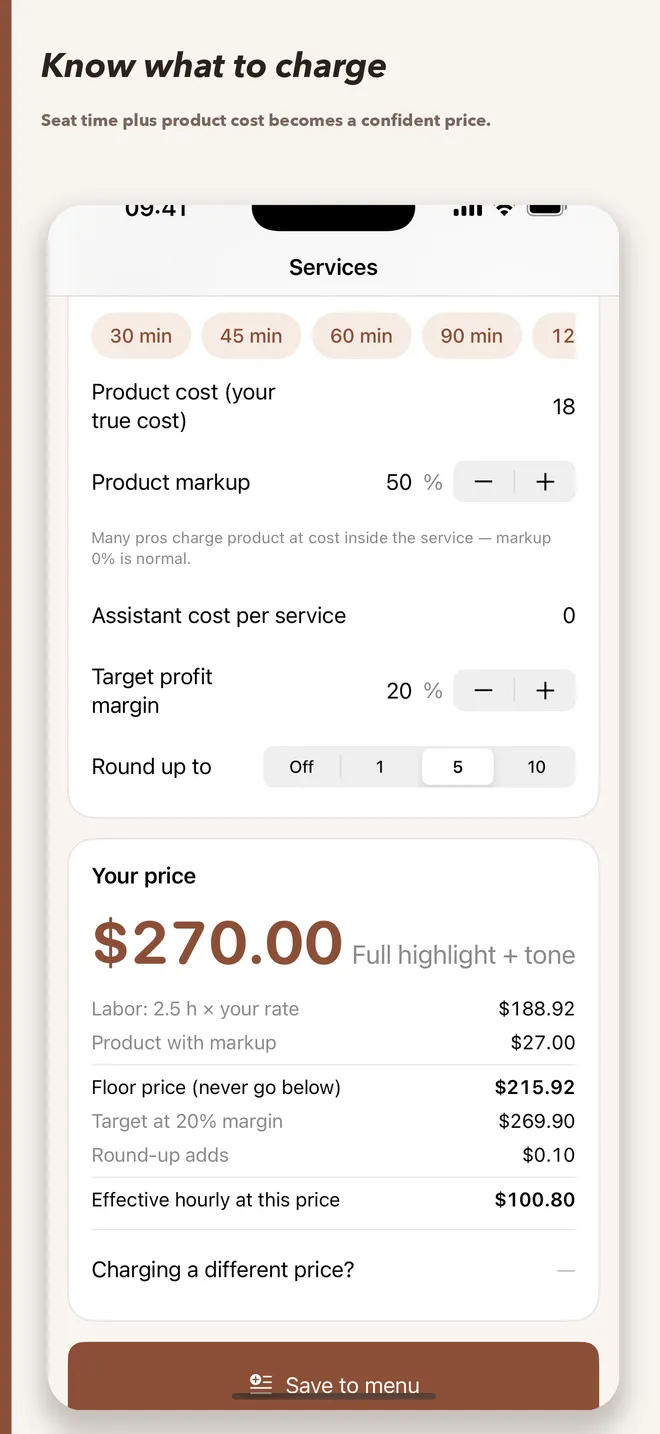
For a 2.5-hour service, labor is about $188.92. If product costs $18 and carries a 50% markup, its line is $27. The floor is about $215.92. Dividing by 0.80 for a 20% target margin gives about $269.90; an optional round-up to the next $5 gives $270.
The example explains the screenshot, not what another salon should charge. Replace every assumption with your own figures and review whether the result fits your services, positioning, and clients.
04 / Review the menu as a system
Check every service against the same business model
Once the base hourly rate changes, reprice each service from its current seat time and direct costs. Look for prices below the calculated floor, outdated product inputs, services that block more capacity than their duration suggests, and inconsistent margin treatment. A what-if copy lets you test utilization, rent, working weeks, or product changes without overwriting the current scenario.
If the review shows prices below target, plan the change in one step with how to raise salon prices, which includes a client notice you can adapt. Weighing a move from commission to a rented booth? Compare both with the booth rent vs commission calculator.
Pricing with the math visible
Salon Pricing Calculator connects the annual goal to the service menu
Calculate a true hourly rate, price individual services, compare booth rent with commission using the same assumptions, and test a change in a what-if sandbox. Each result shows how it was calculated from the numbers you entered.
- Income and cost model
- Realistic utilization
- Seat-time pricing
- Product and assistant cost
- True margin formula
- Booth-versus-commission comparison
Service pricing for independent beauty professionals

Runs offline and calculates only from the numbers you provide.
Frequently asked questions
Salon service pricing FAQ
What costs should be included when pricing a salon service?
Start with the labor value of the full seat time, the products and disposables used for that service, any assistant cost assigned directly to it, and a share of business overhead already built into your hourly rate. Keep each cost in one place so it is not counted twice.
How do I calculate my salon hourly rate?
Estimate the annual income your business must support, add annual fixed costs, account for revenue-based costs, and divide the required revenue by realistic billable hours. Billable hours are bookable hours multiplied by expected utilization and working weeks.
What is the difference between markup and profit margin?
Markup is profit divided by cost. Margin is profit divided by the final selling price. To add a true target margin m to a floor price, divide the floor by 1 − m; multiplying by 1 + m applies markup instead.
Should I copy a nearby salon’s prices?
Competitor prices provide market context, but they do not reveal another business’s rent, booked utilization, product use, assistant cost, income goal, or profit. Calculate your own floor first, then evaluate positioning and client demand separately.
Does Salon Pricing Calculator provide tax or accounting advice?
No. It calculates the consequences of numbers you enter and does not prescribe tax set-asides, classify workers, suggest market rates, or replace tax, legal, or accounting advice.
Salon Pricing Calculator is an educational business calculator. It does not recommend market prices, tax rates, employment structures, or legal decisions. Review your assumptions and consult qualified tax, legal, or accounting professionals when appropriate.