Free tool · Restoration Drying Calc
GPP and dew point calculator
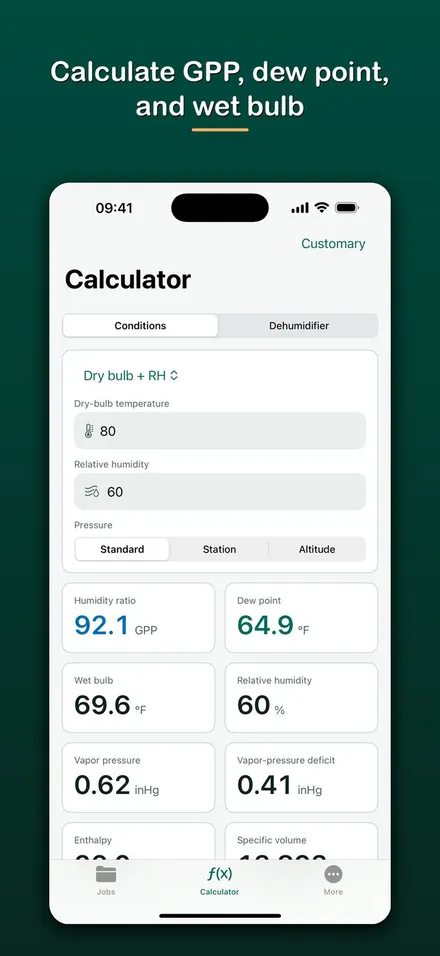
Enter dry-bulb temperature and relative humidity to get grains per pound (GPP), dew point, wet bulb and vapor pressure deficit. At sea level, 80 °F and 60 % RH is 92.1 GPP with a 64.9 °F dew point. Add a second condition to see the GPP difference and, with airflow, what a dehumidifier removes a day.

Restoration Drying Calc
Psychrometry and moisture logs for water-damage drying
Restoration Drying Calc is for iPhone and iPad; there is no Android version.
Free to download for iPhone and iPad.
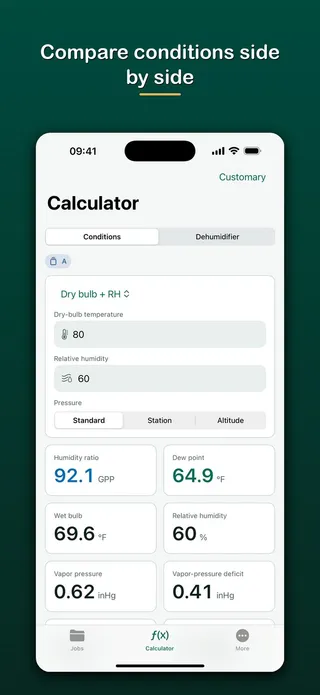
Condition A is usually the affected room or the dehumidifier intake; condition B the drier air or the exhaust. Nothing you enter leaves your browser.
| Value | A | B |
|---|---|---|
| GPP | 92.1 | 57.0 |
| g/kg | 13.16 | 8.15 |
| Dew point | 64.9 °F | 51.8 °F |
| Wet bulb | 69.6 °F | 69.1 °F |
| VPD | 0.413 inHg | 1.548 inHg |
35.0 GPP drier in condition B than in A. At 300 CFM through a dehumidifier with A as intake and B as exhaust, that is about 149.2 pints a day (155.7 lb) of water removed. Pressure 101.33 kPa (sea level).
Restoration Drying Calc logs these readings in the room you measured, starts each visit blank so no number is carried over, charts GPP and moisture points across visits and exports the drying report.
Restoration Drying Calc is for iPhone and iPad; there is no Android version.


Everything in the app
- GPP, dew point, wet bulb, vapor pressure and VPD live from temperature and RH
- Jobs, drying zones and rooms, with monitoring visits and moisture goals
- Room-by-room drying reports as PDF or CSV
- Compare two conditions side by side
- Works offline, with no account
What GPP tells you on a water loss
Relative humidity says how close the air is to saturation at its own temperature, so it moves every time the room warms or cools. Grains per pound (GPP) is the actual weight of water vapor carried by a pound of dry air, so it stays put when only the temperature changes. That is why drying crews compare GPP, not RH, between the affected area, an unaffected room, the outdoors and the dehumidifier exhaust: the comparison shows where the water vapor is and whether the equipment is taking it out.
The calculator uses the same perfect-gas equations from the ASHRAE Handbook of Fundamentals that Restoration Drying Calc uses: the saturation pressure over water or ice, the humidity ratio from the vapor pressure, and a bisection solver for dew point and wet bulb. It reproduces the app’s test values, for example 54.5 GPP with a 50.5 °F dew point and a 58.5 °F wet bulb at 70 °F and 50 % RH.
Comparing two conditions
Enter the affected room as condition A and the air you are drying with as condition B. A positive difference means B holds less water vapor, so moving it across the wet materials helps. For a dehumidifier, take A at the intake and B at the exhaust a short distance from the unit; the difference is the grain depression. In the sample, 92.1 GPP in and 57.0 GPP out is a depression of 35.0 grains.
With the process airflow in CFM, the water removed per day follows from the mass of dry air moving through the unit: airflow ÷ the intake air’s specific volume × the humidity-ratio difference × 1,440 minutes. At 300 CFM the sample gives about 149.2 US pints a day. Use the airflow the manufacturer states for the unit, or a measured one; the result is an estimate of performance, not a rating under test conditions.
Altitude and pressure
At altitude the same temperature and RH mean more water per pound of dry air, because the dry air itself is thinner. Leave altitude blank for sea level, or enter it to use the standard-atmosphere pressure for that height: 80 °F at 60 % RH is 92.1 GPP at sea level and 110.8 GPP at about 1,500 m. Restoration Drying Calc also accepts a measured station pressure.
What the numbers do not decide
A calculator describes the air. Whether a wall, a subfloor or a cabinet is dry depends on material readings at the same points visit after visit, compared with a reference you took from unaffected material, and on your protocol. Record each air pair with its location and time, never only the result, so anyone reviewing the job can follow the math.
Questions people ask
How do you calculate GPP from temperature and relative humidity?
Find the saturation vapor pressure at the dry-bulb temperature, multiply by the RH to get the actual vapor pressure, turn that into a humidity ratio (0.621945 × pw ÷ (p − pw)) and multiply by 7,000 grains per pound. At 80 °F and 60 % RH at sea level that is 92.1 GPP.
What is a good GPP for drying?
There is no single number. What matters is the difference between the air around the wet materials and the drier air you are bringing in or the dehumidifier exhaust, and how the material readings move toward the goal you set from an unaffected reference. Your company protocol and the applicable standard decide the targets.
What is grain depression?
The GPP of the air going into a dehumidifier minus the GPP of the air coming out. For 92.1 GPP in and 57.0 GPP out, the depression is 35.0 grains.
Why does altitude change GPP?
Thinner air holds the same water vapor against less dry air, so the same temperature and RH give a higher humidity ratio. 80 °F at 60 % RH is 92.1 GPP at sea level but 110.8 GPP at about 1,500 m (4,920 ft).
Is the dew point the same as the wet bulb?
No. Dew point is the temperature at which the air’s vapor would start to condense; wet bulb is the temperature of a wetted thermometer cooled by evaporation. Wet bulb sits between dew point and dry bulb unless the air is saturated, when all three match.
