Free tool · Jewelry Pricing Calculator
Permanent jewelry price calculator
Price a permanent-jewelry piece from the chain’s cost per inch × (length + wastage), plus charms and connectors, a share of the booth fee, the card fee and a re-weld allowance, then solve the charge that keeps your margin after those fees. A 7-inch bracelet on chain at 24 a foot comes to 59.32 at a 50% margin; break-even is 28.13.

Jewelry Pricing Calculator
Price permanent jewelry and run your pop-ups
Free to download for iPhone, iPad and Android.
Amounts in your own currency, percentages as numbers (50 = 50%). Nothing you enter leaves your browser.
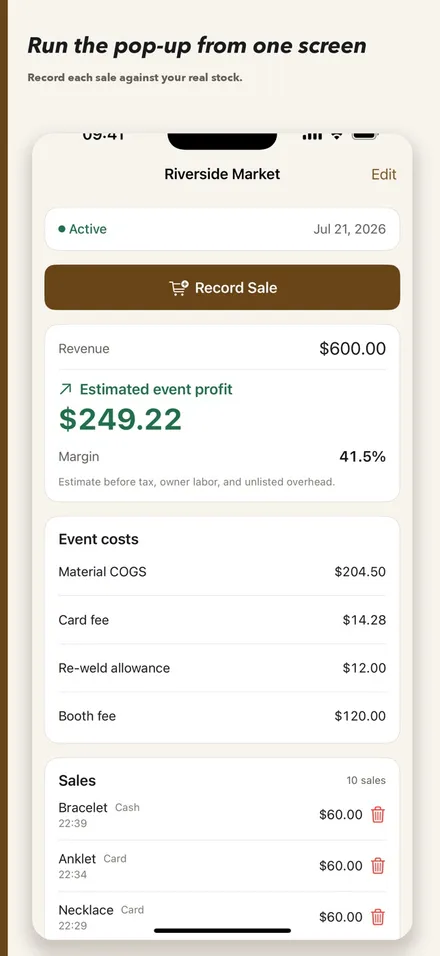
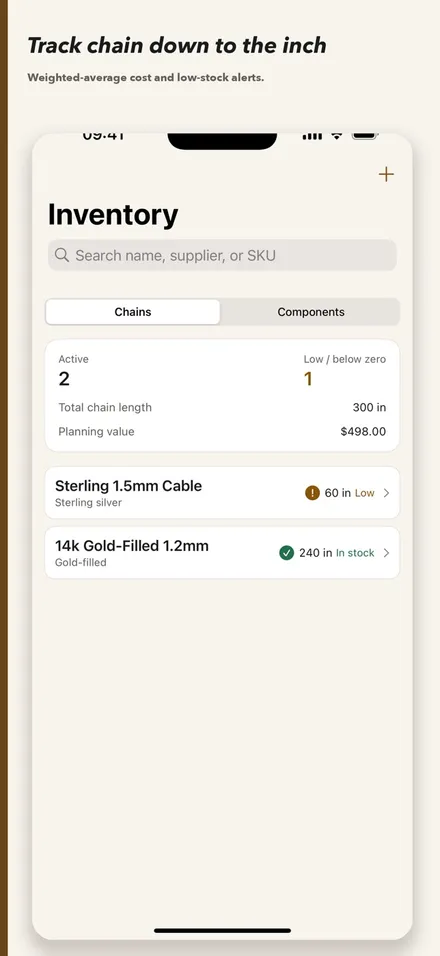
Jewelry Pricing Calculator saves this quote for the customer, tracks the chain you have left to the inch, and at a pop-up records each sale against your stock so you see what the event earned.
Everything in the app
- Saved quotes you can revisit and revise
- Chain and component inventory to the inch, with low-stock alerts
- Pop-up events with every sale and the event’s profit, plus CSV export
- Cost per inch, wastage, booth and card fees and target margin in one price
- Works offline, with no account
How do you price permanent jewelry?
Permanent jewelry is sold by length but bought by length too, which makes it easy to price badly. Chain arrives priced per foot, per meter or as a spool, while the client pays per piece, and in between sit the offcuts, the jump ring and charm, the booth at the weekend market and the card reader’s cut. The calculator follows the same order as the Jewelry Pricing Calculator app:
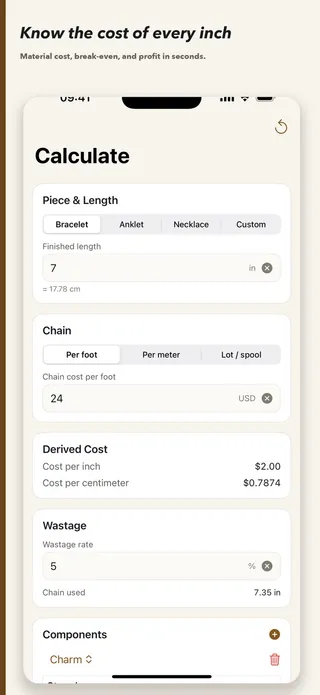
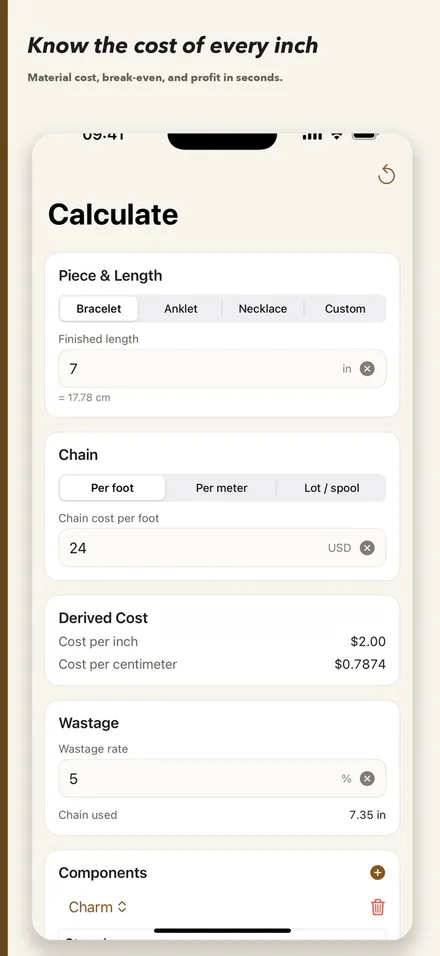
- Cost per inch: price per foot ÷ 12, price per meter × 0.0254, or spool price ÷ usable inches.
- Chain used: finished length + finished length × wastage. Chain cost = chain used × cost per inch.
- Material cost (COGS): chain cost + every component’s quantity × unit cost.
- Booth share: booth fee ÷ pieces you expect to sell there.
- Charge: the smallest price, to the cent, whose profit after the card fee and re-weld allowance is at least your margin. Break-even is the same search at 0%.
The card fee and a percentage re-weld allowance are rounded to the cent once per sale, as a card reader does, and the charge is solved after that rounding. That is why the result can differ by a cent from a quick formula: it is the price that actually leaves your margin.
Worked example: a 7-inch bracelet at a market
These are the app’s own test numbers: chain bought at 24 a foot, a 7-inch bracelet with 5% wastage, two charms at 2.50 and a connector at 0.75, a 120 booth where the artist expects 20 sales, card payments at 2.9% plus 0.30, and a 2% re-weld allowance.
| Step | Math | Result |
|---|---|---|
| Cost per inch | 24.00 ÷ 12 | 2.00 |
| Chain used | 7 + 7 × 5% | 7.35 in |
| Chain cost | 7.35 × 2.00 | 14.70 |
| Components | 2 × 2.50 + 1 × 0.75 | 5.75 |
| Booth share | 120.00 ÷ 20 | 6.00 |
| Charge at 50% margin | after a card fee of 2.02 and re-weld of 1.19 | 59.32 |
| Estimated profit | 59.32 − 29.66 | 29.66 |
| Break-even charge | margin 0% | 28.13 |
A common shortcut would double the 26.45 of material and booth share to 52.90 and call it a 50% margin. After the card fee and the re-weld allowance, that price leaves less than half, which is why the calculator solves the charge instead of multiplying.
Choices that move the price most
Expected sales at an event. The booth share is the number artists most often guess. Twenty expected sales put 6.00 on each piece; ten would put 12.00. Be honest about a slow market, and compare afterwards with what sold.
Wastage. Short offcuts you cannot sell are real chain. Five percent on a 7-inch bracelet is a third of an inch; on fine, expensive chain that adds up across a weekend.
Your margin. The calculator does not include your time. Chain and charms may be a small part of the price; the margin is what pays for the consultation, sizing, the weld and the clean-up, so choose it with that in mind.
The result is an estimate before tax and before any overhead you have not entered. It is not accounting or tax advice, and it does not suggest what other artists charge.
Questions people ask
How much should I charge per inch for permanent jewelry?
Start from what the chain costs you per inch, not from a per-inch price you have seen elsewhere. Chain at 24 a foot costs 2.00 an inch; a 7-inch bracelet with 5% wastage uses 7.35 inches, or 14.70 of chain. Add charms, a share of the booth fee, the card fee and any re-weld allowance, then solve the charge for your margin: 59.32 at 50% in this example.
What is the difference between markup and margin for jewelry?
Markup measures profit against cost, while margin measures it against the selling price. Doubling a 20 cost to 40 is a 100% markup and a 50% margin. A 50% markup on the same cost gives 30, which is only a 33.3% margin. The calculator works in true margin.
How do I spread a booth fee over each piece?
Divide the booth fee by the number of pieces you realistically expect to sell at that event. A 120 booth over 20 expected sales adds 6.00 to each piece. If you sell more, each piece carried more than its share; if you sell fewer, less. The app later shows what the whole event actually earned.
Should I include card processing fees in the price?
Yes, if you take cards. A fee of 2.9% plus 0.30 on a 60.00 charge is 2.04. Because the fee is a share of the price, the calculator solves the charge so your margin survives it; on a cash sale of the same piece the profit is 32.35 instead of 30.31.
What is a re-weld allowance?
Money set aside on every sale for re-welding pieces that break later, as a fixed amount or a percentage of the charge. Counting it as a cost means a free re-weld promise does not come out of your margin.
Does this include my time?
No. Like the app, the calculator counts chain, wastage, components, a booth share, the card fee and a re-weld allowance. Your own time is paid by the margin you choose, so pick one that covers the consultation, sizing, welding and reset.
