Jewelry Pricing Calculator / maker guide
How to price permanent jewelry without guessing
Calculate the cost of every piece before choosing a selling price. Measure chain used, add findings and charms, account for labor and allocated event costs, then apply the margin you actually want and review the result against your market.
Your numbers and positioning determine the price. A calculator makes the arithmetic visible; it does not choose your market strategy.
Offline pricing for permanent jewelry makers
01 / Practical steps
Measure the true material cost
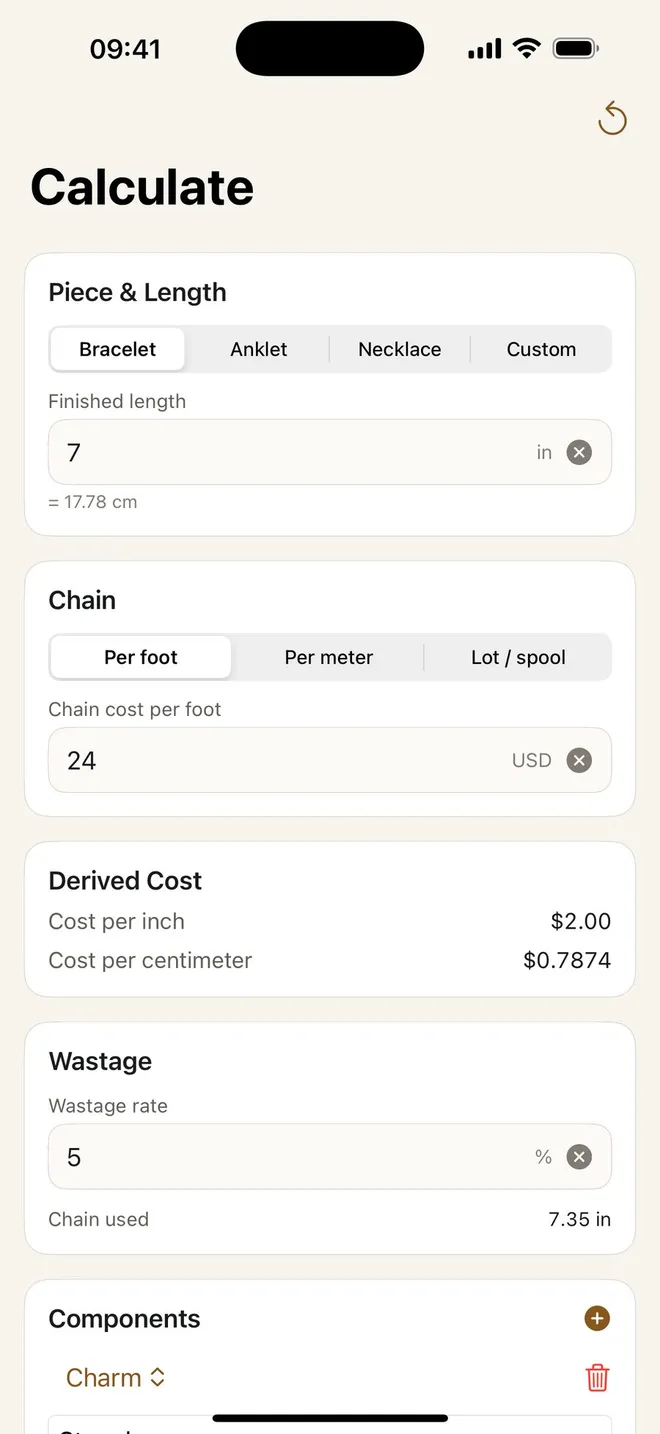
Start with chain cost per unit and the length actually used for a bracelet, anklet, or necklace. Add the clasp or connector, jump rings, charms, packaging, and any other component that belongs to that piece. If short leftover cuts are not usable, include a reasonable waste allowance instead of treating every purchased inch as sellable.
Keep purchase cost and selling price separate. A popular charm may justify a different retail price, but its cost of goods is still what you paid for it. Jewelry Pricing Calculator helps you build the calculation from chain and components so the quote has a traceable starting point.
- Enter chain length and unit cost.
- Add findings, charms, and packaging.
- Account for material waste.
02 / Practical steps
Add time and event costs
Time the full service, including consultation, sizing, welding, checking the fit, payment, and reset. Multiply that time by a labor rate that supports your business, rather than counting only the seconds at the welder. At pop-up events, include booth fees and travel in your broader pricing model; those costs exist even when a particular piece uses little material.
You can allocate event costs across a realistic number of sales for planning, then compare the estimate with the actual event record later. If your forecast is too optimistic, a seemingly healthy piece price may still leave the event short of its target.
Use the real app
Jewelry Pricing Calculator
Add chain, charms, labor, and other costs to see the cost of goods and a price based on your chosen margin. Keep the quote with your inventory and event records.
Offline pricing for permanent jewelry makers

Build a quote from the materials and work that go into a permanent jewelry piece.
03 / Practical steps
Choose margin deliberately
Markup and margin answer different questions. A 50% markup on a $20 cost gives a $30 price and a $10 contribution. That is a 33.3% margin, because the $10 is one third of the $30 selling price. For a target margin of 50% on the same $20 cost base, divide $20 by 1 − 0.50 to get $40. Add or allocate any other costs before applying the target.
Use the calculated result as a decision point. Compare nearby offers, the customer experience, the quality of the components, and the service you provide. If the market will not bear the price, review costs or positioning rather than silently erasing the labor line.
Source: U.S. Small Business Administration: break-even and contribution margin.
04 / Practical steps
Keep a quote you can revisit
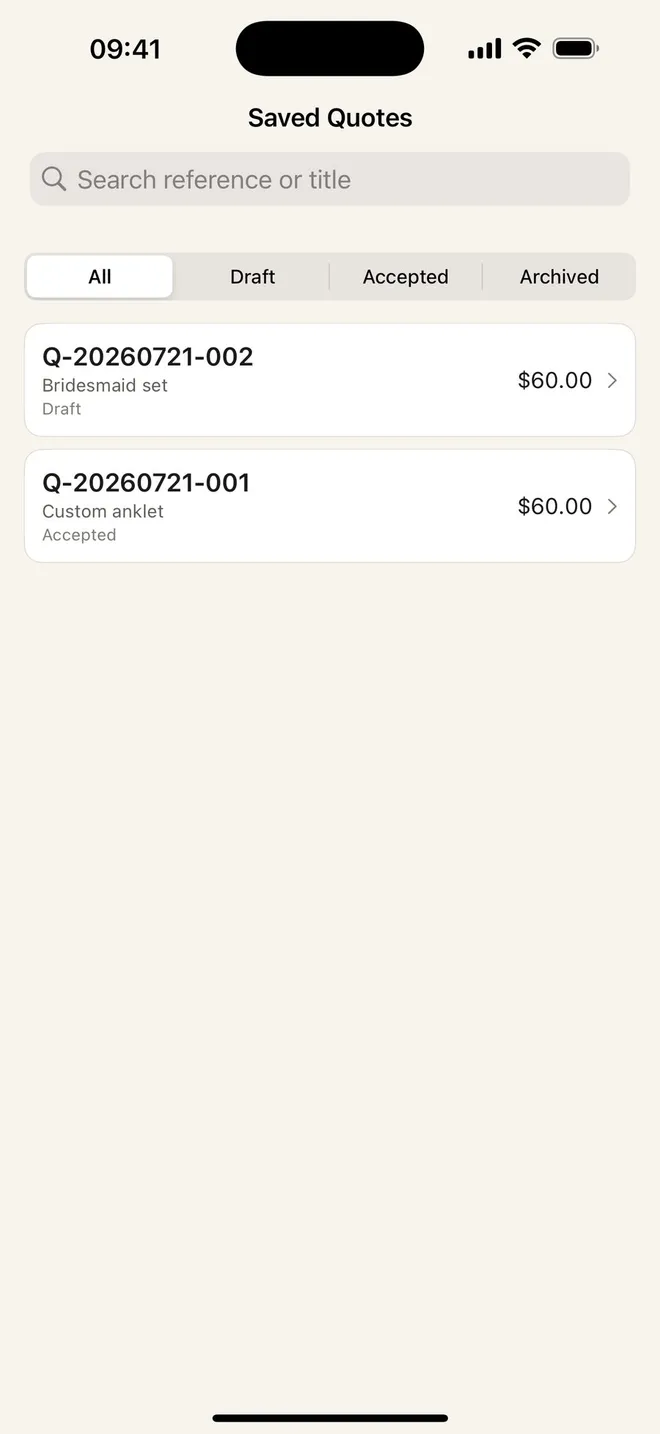
A useful quote records what was included, not just the final number. If a client changes a charm or chain, revise the inputs and let the calculation follow. Keep inventory close to the quote so you can see whether the components are on hand. For an event, record which quotes converted and what was actually used.
Jewelry Pricing Calculator keeps its calculator, inventory, quotes, and pop-up event records offline. That is useful at markets with unreliable service and at a bench where you want the cost breakdown available before you commit to a price.
Frequently asked questions
Permanent jewelry pricing FAQ
What should permanent jewelry pricing include?
Include chain, findings, charms, packaging, material waste, service labor, payment costs, and a sensible share of overhead or event expense.
Is a 50% markup the same as a 50% margin?
No. A 50% markup on $20 cost gives a $30 price and 33.3% margin. A 50% margin on $20 cost requires a $40 price.
Should booth fees be charged to one piece?
Usually plan an allocation across expected event sales, then compare the estimate with the actual event result.
Can I use the calculator at an event without service?
The app is designed as an offline calculator with inventory, quotes, and pop-up event records.
Business examples are illustrative. Review your own costs, taxes, and market before setting a price.