Free tool · Hair Color Formula Book
Hair color developer ratio calculator
Enter the bowl weight you want and the ratio from your product’s instructions. Color is the bowl ÷ (1 + the developer side of the ratio), and developer is the rest: a 60 g bowl at 1:1 is 30.0 g and 30.0 g; a 90 g bowl at 1:2 is 30 g and 60 g. Shade percentages split only the color part.

Hair Color Formula Book
Every client’s color formula, and the bowl math to mix it
Hair Color Formula Book is for iPhone and iPad; there is no Android version.
Free to download for iPhone and iPad.
Grams only. Use the ratio printed in the instructions for the product in your bowl. Nothing you enter leaves your browser.
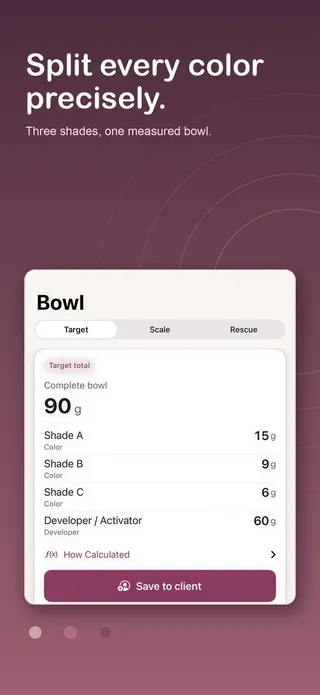
| Shade A | 15.0 g |
|---|---|
| Shade B | 9.0 g |
| Shade C | 6.0 g |
| Developer | 60.0 g |
| Bowl total | 90.0 g |
Sample: a 90 g bowl at 1:2 with a 50 / 30 / 20 shade split. Change any value to recalculate (needs JavaScript).
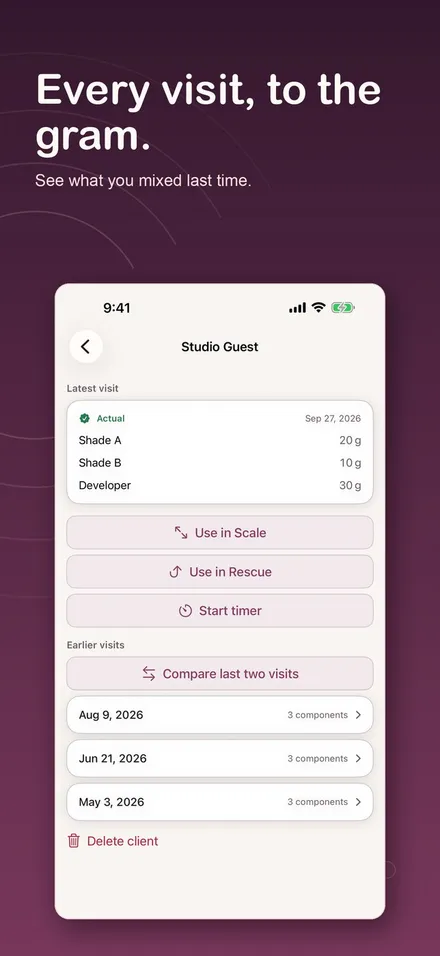
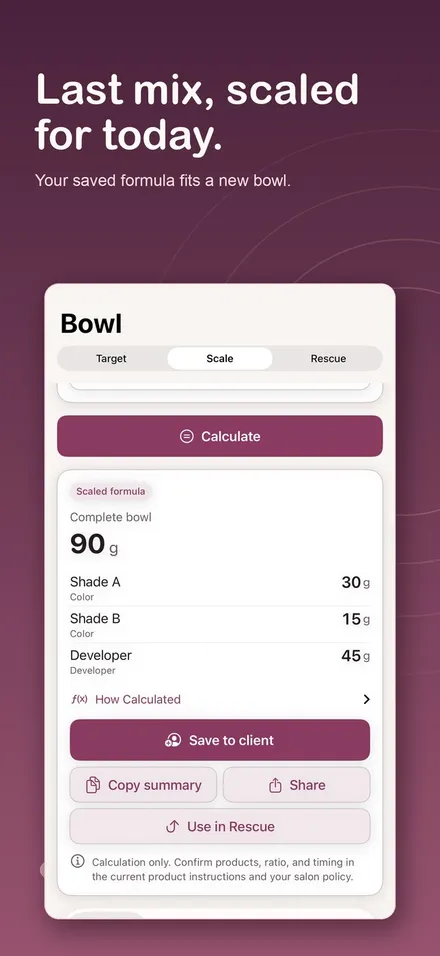
Hair Color Formula Book saves this bowl to the client with the ratio and processing time, so next visit you bring it back and scale it to the new bowl in one tap.
Hair Color Formula Book is for iPhone and iPad; there is no Android version.
Everything in the app
- Every client’s formula visit by visit, to the gram
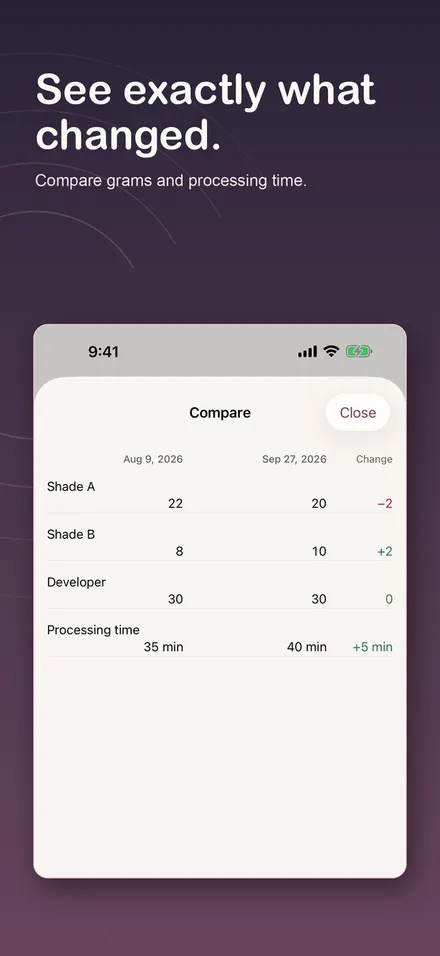
- Compare the last two visits, then bring back the last formula and scale it to today’s bowl
- A PDF formula card, CSV export and up to four processing timers
- Grams of each shade and developer for any ratio
- Over-pour rescue with proportional additions
The bowl-weight formula
Most permanent and demi-permanent color is mixed by weight at a ratio the manufacturer prints on the box or in the technical guide: one part color to one, one and a half or two parts developer, sometimes something else entirely for a lightener or a gloss. Working from the finished bowl you want, rather than from a tube or a fraction of one, keeps waste down and makes the next visit repeatable.
For a ratio of 1:r, the bowl holds 1 + r parts. The color is the bowl weight divided by 1 + r, and the developer is everything else:
- 1:1 — a 60 g bowl is 30.0 g of color and 30.0 g of developer.
- 1:1.5 — a 75 g bowl is 30.0 g of color and 45.0 g of developer.
- 1:2 — an 80 g bowl is 26.67 g of color and 53.33 g of developer before rounding, which you pour as 26.7 g and 53.3 g.
- Custom 1:2.5 — a 175 g bowl is 50.0 g of color and 125.0 g of developer.
These are the same cases Hair Color Formula Book is tested against, so the numbers here match what the app shows at the chair.
Splitting several shades
When a formula uses more than one shade, the percentages describe the color part only. Work out the color first, then share it out. In the sample above, the 90 g bowl at 1:2 has 30 g of color; 50 % of it is 15.0 g, 30 % is 9.0 g and 20 % is 6.0 g, and the developer stays at 60.0 g. Applying the percentages to the whole bowl would put far too much color in it.
The percentages must add up to exactly 100. The calculator, like the app, tells you when they do not instead of quietly rebalancing them, because a silent correction is how a formula drifts from visit to visit.
Rounding to your scale
A salon scale reads to a tenth of a gram or to a whole gram, so the exact figures have to be rounded. Rounding each line separately can leave the bowl a little over or under. The calculator rounds the way the app does: it takes the bowl total to the chosen step, then hands the remaining tenths to the lines with the largest remainders, earlier lines first on a tie. Thirds of 40, 80 and 40 g become 13.3, 26.7 and 40.0 g, which add up to the 80.0 g bowl.
When a shade is over-poured
If one component goes in heavier than planned, you cannot take it back out by eye. You can add the others in proportion so the planned relationship returns. Take the largest ratio of poured to planned weight, here 12 g of a planned 10 g, a scale of 1.2; every component should end at its planned weight times 1.2. For a plan of 20, 10 and 30 g, that means adding 4 g, 0 g, 6 g. Hair Color Formula Book does this from what is already in the bowl, and only adds. Whether a corrected bowl is still right for the service is your professional call and the product’s instructions.
What this calculator does not decide
It does arithmetic with the ratio you enter. It does not choose a product, a developer strength, a processing time or a ratio, and it is not a substitute for patch and strand tests, the manufacturer’s directions or your training.
Questions people ask
How do I work out hair color and developer from a bowl weight?
Divide the bowl weight by 1 plus the developer side of the ratio to get the color; the rest is developer. A 90 g bowl at 1:2 is 90 ÷ 3 = 30 g of color and 60 g of developer.
How much developer for 60 g of color at 1:1.5?
Multiply the color by 1.5: 60 g of color takes 90 g of developer, a 150 g bowl. To start from the bowl instead, a 75 g bowl at 1:1.5 is 30 g of color and 45 g of developer.
Do shade percentages include the developer?
No. Percentages split only the color part. In a 90 g bowl at 1:2, a 50 / 30 / 20 formula is 15.0, 9.0 and 6.0 g of color plus 60.0 g of developer, not 45, 27 and 18 g of the whole bowl.
Why do the rounded grams not match a simple rounding of each line?
Rounding each line on its own can make the bowl a tenth of a gram heavier or lighter. The calculator gives the leftover tenths to the lines with the largest remainders, so the poured grams always add up to the rounded bowl, as the app does.
Which ratio should I use?
The one in the current instructions for the exact color, lightener or toner in your bowl. Ratios differ between brands, lines and services. This calculator, like Hair Color Formula Book, never chooses one for you.
