Fast bowl math for working colorists
How to calculate hair color and developer by total bowl weight
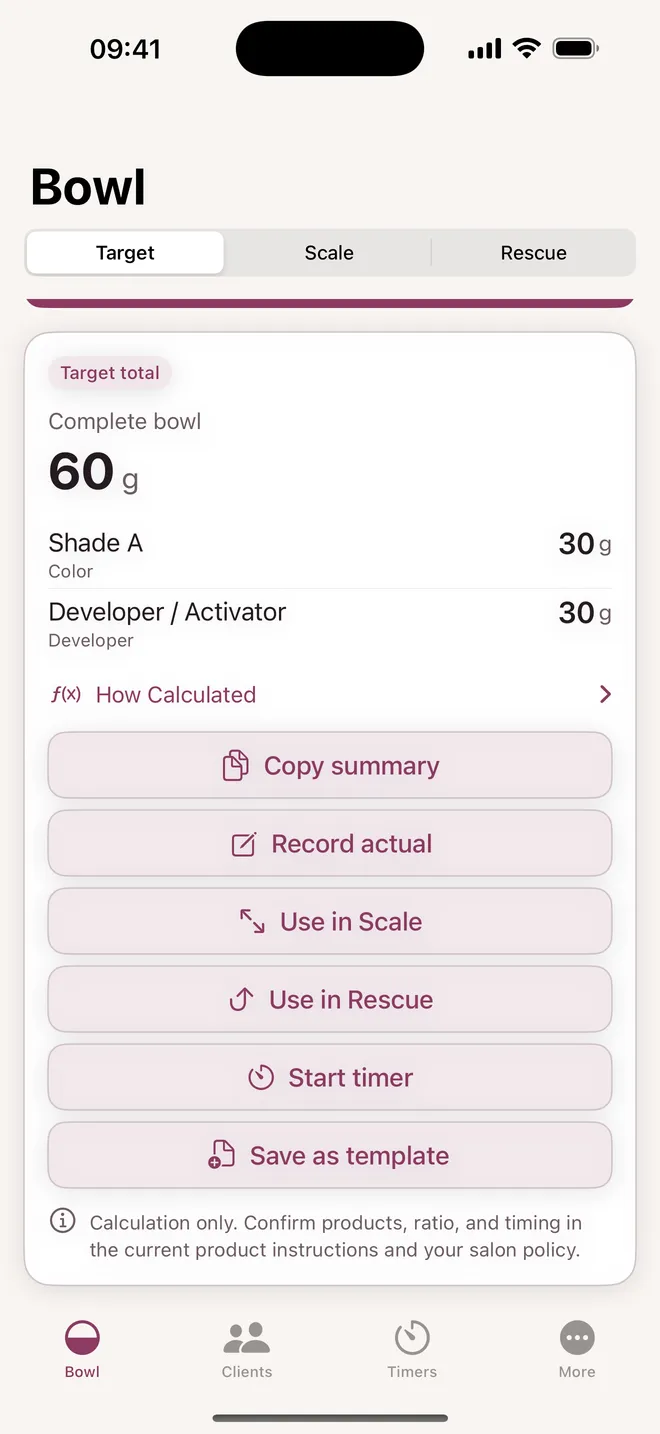
Take the manufacturer’s mixing ratio, add its parts, and divide your target bowl weight by that total. Multiply the result by each component’s parts. For a 60 g bowl at 1:1, weigh 30 g color and 30 g developer. For a 90 g bowl at 1:2, weigh 30 g color and 60 g developer.
Always use the ratio, developer strength, application method, timing, and safety directions for the exact product. This guide explains the weight calculation only.
Fast bowl math for working colorists
01 / Start from the total
The hair color mixing formula
A mixing ratio describes relative parts. In a 1:1 color-to-developer ratio, the finished mixture has two total parts. In a 1:2 ratio, it has three total parts. Once you know the total bowl weight you want, the calculation is straightforward.
Weight of one part
Target bowl weight ÷ total ratio parts
Each component
Weight of one part × that component’s ratio parts
This total-first method is useful when experience tells you how much finished product a service typically needs. It also helps reduce leftover product because the calculation begins with the amount you intend to use rather than an arbitrary tube fraction.
Mixing ratios are product-specific. For example, Wella’s professional product guide gives a 1:2 example for one color family; that does not make 1:2 universal. Check the instructions for the product in your bowl.
02 / Check the arithmetic
Two bowl-weight examples
60 g target at 1:160 ÷ 2 = 30 g per part
Color30 g
Developer30 g
90 g target at 1:290 ÷ 3 = 30 g per part
Color30 g
Developer60 g
Use grams consistently and keep the scale tared between container changes. If the product uses a different structure, such as 1:1.5 or three components, add all entered parts and apply the same method. Round only to the precision supported by your scale and professional protocol.
03 / Separate shade split from developer ratio
Calculate a multi-shade formula in two stages
When the color portion contains more than one shade, first calculate the total color weight. Then divide that color weight by the shade percentages. The percentages should total 100%.
For a 60 g bowl at 1:1, the color portion is 30 g. If the color formula is 70% Shade A and 30% Shade B, weigh 21 g of Shade A and 9 g of Shade B. Developer remains 30 g. Keeping these two calculations separate prevents the shade percentages from being applied to the full finished bowl.
Before pouring
- Confirm the target total
- Confirm the manufacturer ratio
- Confirm all shade percentages total 100%
- Tare the bowl and use one weight unit
- Record actual poured amounts when they differ from the plan
04 / Adapt without starting over
Scale, record, and correct real salon bowls
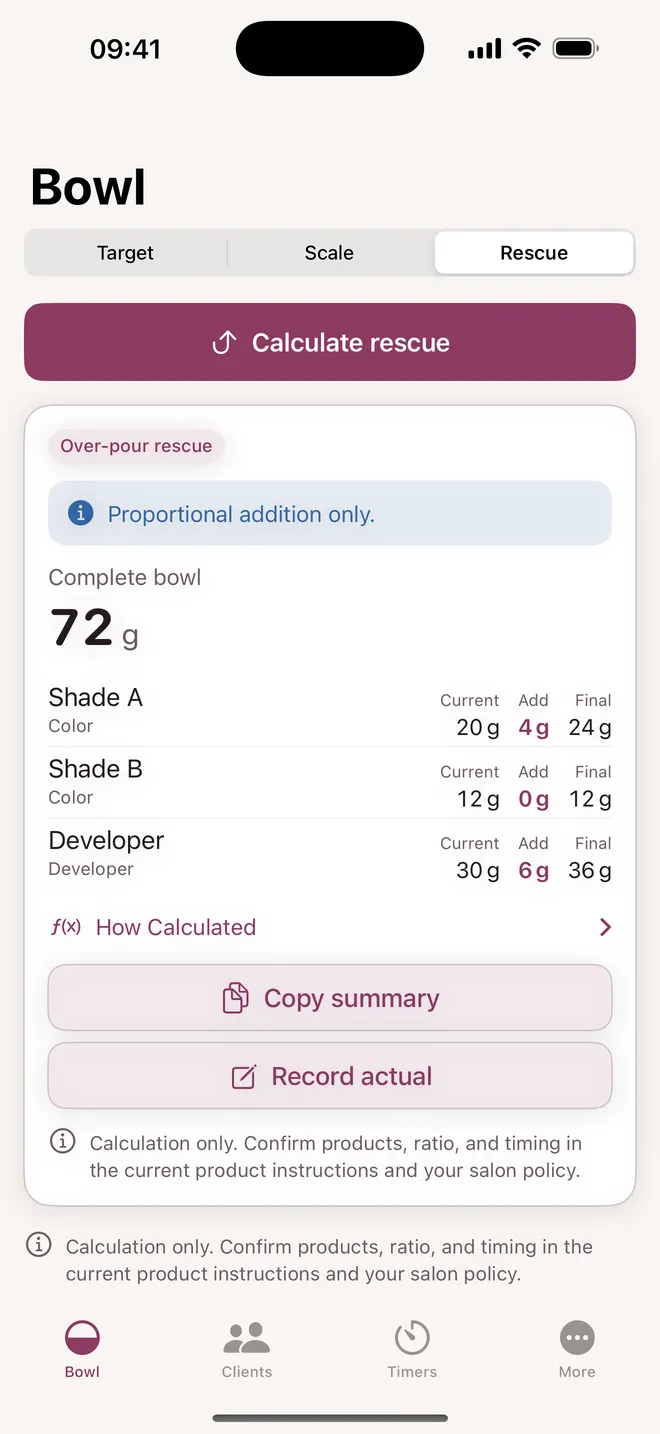
A formula often needs adjustment because hair density, section size, or the service plan changes. If a previous actual formula was correct but the new service needs a different total, scale every component by the same factor. This preserves the ratio and shade percentages.
An over-pour creates the opposite problem: one component is already heavier than planned. When the product instructions and professional judgment allow a correction, calculate proportional additions for the other components so the entered relationship is restored. Do not remove product from a mixed bowl by estimation or use a corrected bowl when safety, timing, or product compatibility is uncertain.
Chair-side calculation
Hair Color Bowl Calculator turns a target into exact grams
Enter the amount you want and a preset or custom product ratio. Split the color portion across multiple shades, scale a previous actual formula, or calculate proportional additions after an over-pour. Client records and the processing timer stay on the device.
- Total-first calculation
- Preset and custom ratios
- Multi-shade percentages
- Formula scaling
- Over-pour rescue math
- Local client history
Fast bowl math for working colorists
Your product directions supply the ratio. The app handles the math.
Frequently asked questions
Hair color mixing ratio FAQ
How do I calculate hair color and developer from a total bowl weight?
Add the ratio parts, divide the target total by that sum, then multiply by each component’s parts. For a 1:1 ratio and a 60 g bowl, each component is 30 g.
How much color and developer do I need for a 1:2 ratio?
There are three total parts. Divide the target bowl weight by three for the color amount and multiply that amount by two for the developer. A 90 g bowl would contain 30 g of color and 60 g of developer.
Where should I get the mixing ratio?
Use the current instructions supplied by the product manufacturer for the exact color, lightener, or treatment in use. Ratios vary by product and service, so a calculator should not guess one for you.
Can the calculator choose developer strength or processing time?
No. Hair Color Bowl Calculator performs ratio and weight math. Product choice, developer strength, suitability, allergy precautions, strand testing, application, and processing follow the manufacturer’s directions and the colorist’s professional judgment.
What if I pour too much of one component?
If the formula and product instructions allow the mix to be corrected, an over-pour calculator can show the proportional amounts needed to restore the entered ratio. The colorist still decides whether the bowl is safe and appropriate to use.
Hair Color Bowl Calculator is a measurement aid, not a product recommendation or safety system. Follow the current manufacturer instructions and professional salon protocols for product selection, developer strength, patch or strand testing, application, processing, and disposal.