Free oral reading fluency tool
WCPM calculator
Words correct per minute is (words read − errors) ÷ seconds × 60. Enter the words the student read, the errors you marked and the reading time; the calculator returns WCPM, accuracy, words per minute and both ratios, using the same ORF formulas as the FluencyCalc app.
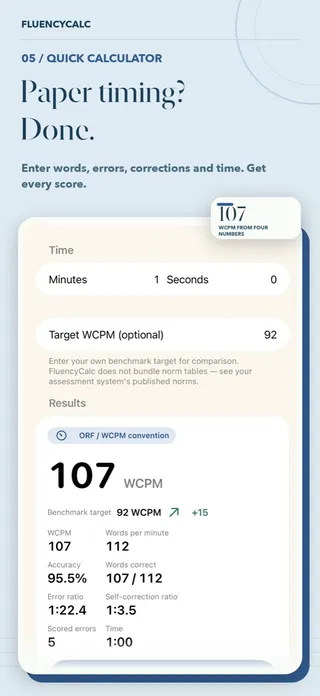
WCPM calculator
Type the counts from your probe. Results follow the ORF/WCPM convention: insertions are not errors and a self-corrected word counts as correct.
- WCPM
- 107
- Accuracy
- 95.5%
- Words correct
- 107 / 112
- Words per minute
- 112
- Error ratio
- 1:22.4
- Self-correction ratio
- —
(112 − 5) ÷ 60 s × 60 = 107 WCPM · 107 ÷ 112 × 100 = 95.5%
Nothing you enter leaves your browser.
How do you calculate WCPM?
Count every word the student attempted up to the stopping point, subtract the words you scored as errors, then scale the result to one minute. The method is the one used by curriculum-based measurement of oral reading fluency, and it is exactly what the calculator above does:
- Words correct = words read − errors.
- WCPM = words correct ÷ seconds × 60.
- Accuracy = words correct ÷ words read × 100.
- Words per minute (all attempted words) = words read ÷ seconds × 60.
Errors are words read incorrectly, omitted or substituted, and words you supply after the student hesitates for three seconds; repetitions and insertions are not errors. Follow your assessment’s own directions where they differ. A self-corrected word is counted as correct, and an inserted word does not lower the score. If the counts are impossible — more errors and self-corrections than words read, or a time of zero — the calculator shows a message instead of a number, the same rule the app uses.
Worked example: a 60-second probe
A second grader reads a passage for one minute and stops at word 112. You marked five errors along the way.
Words correct: 112 − 5 = 107
WCPM: 107 ÷ 60 × 60 = 107
Accuracy: 107 ÷ 112 × 100 = 95.5%
Error ratio: 112 ÷ 5 = 1:22.4
In a one-minute probe the score is the words read minus the errors. That is why the 60-second mode locks the time field at 60: you only need the stopping word and the error count.
Worked example: a whole passage read at the student’s pace
Some teachers let the student finish the passage and time the whole read. Here a student reads a 186-word passage in 2 minutes 14 seconds (134 seconds) with nine errors.
Words correct: 186 − 9 = 177
WCPM: 177 ÷ 134 × 60 = 79.3
Accuracy: 177 ÷ 186 × 100 = 95.2%
Reporting 177 as the score would more than double the real rate, because the read took longer than a minute. Always divide by the real elapsed time. A stopwatch that records seconds is precise enough; the calculator accepts decimals if your timer shows tenths.
How do I know whether a WCPM score is on track?
A WCPM number means little until you compare it with a norm or benchmark for the same grade and season. The most cited compilation is Jan Hasbrouck and Gerald Tindal’s 2017 update of oral reading fluency norms, published by Behavioral Research and Teaching at the University of Oregon. It reports WCPM at the 10th, 25th, 50th, 75th and 90th percentiles for fall, winter and spring of grades 1 to 6 (winter and spring only in grade 1), compiled from millions of DIBELS 6, DIBELS Next and easyCBM scores on one-minute readings of unpracticed passages. Read Naturally’s handout of the same norms adds a rule of thumb: students scoring 10 or more words below the 50th percentile, averaged over two unpracticed grade-level readings, need a fluency-building program. Fluency is one piece of evidence, alongside accuracy and comprehension.
We describe the norms instead of copying the table: use the original report (linked in the sources) or the norms chosen by your district or assessment system, such as DIBELS or Acadience benchmarks. Compare like with like — a one-minute probe on grade-level text, scored with the same rules the norm sample used.
Accuracy matters too. A student can read fast but guess at many words; a high WCPM with accuracy below about 95% tells a different story from the same rate at 98% accuracy. FluencyCalc prints both on every report for that reason.
What does the app add to this calculator?
The web calculator handles one read at a time and forgets it. FluencyCalc: Running Record is built for the weekly routine of K–5 teachers, interventionists, tutors and homeschool parents:
- Paste a passage you own and tap words while the student reads; the timer, the stopping word and the running WCPM are handled for you.
- Switch between the ORF/WCPM convention and the running-record convention, clearly labeled and never blended.
- Save each read to a student (initials are enough) and watch WCPM and accuracy charts against your own benchmark line.
- Export a PDF report for the file or a CSV for one student or the whole class.
The quick calculator and live tap-marking are free in the app. Saving reads to students, growth charts, the passage library and PDF or CSV exports need an in-app purchase. There are no accounts, ads or network calls; records stay on the device.
Sources
- Hasbrouck, J. & Tindal, G. (2017). An update to compiled ORF norms (Technical Report No. 1702). Behavioral Research and Teaching, University of Oregon
- Read Naturally — 2017 Hasbrouck & Tindal oral reading fluency norms handout (hosted by Kirtland Local Schools)
- IRIS Center, Vanderbilt University — Scoring an oral reading fluency probe
- Appalachian State University — Fluency criteria and the WCPM formula
Questions people ask
What is the formula for words correct per minute?
WCPM = (words read − errors) ÷ seconds × 60. In a 60-second probe the seconds and the 60 cancel, so WCPM is simply the words read minus the errors.
Do self-corrections count as errors in WCPM?
No. In curriculum-based oral reading fluency scoring a word the student corrects on their own counts as correct. This calculator and FluencyCalc both follow that rule; the self-correction count is kept only for the self-correction ratio.
Do insertions count as errors in WCPM?
Not in the ORF/WCPM convention used here: an added word does not reduce words correct. Running records treat insertions differently; use the running record calculator for that convention.
What if the student read for more or less than one minute?
Choose “Timed passage” and enter the exact time in seconds. The calculator divides words correct by the elapsed minutes, so 95 correct words in 75 seconds becomes 76 WCPM rather than 95.
What is a good WCPM score?
It depends on grade and time of year. Most schools compare scores with published oral reading fluency norms such as Hasbrouck and Tindal’s 2017 compilation, or with the benchmarks of their own assessment system. This calculator gives the number; the comparison belongs to your norm source.
Is anything I type saved or sent anywhere?
No. The arithmetic runs in your browser and nothing you enter leaves it. Closing the page clears the numbers. FluencyCalc on iPhone and iPad keeps saved reads on the device, also without an account.