Naglieri Nonverbal Ability Test · kindergarten to grade 2
NNAT sample questions for Levels A, B and C
These seven original figure puzzles cover the four NNAT question types at Levels A (kindergarten), B (grade 1) and C (grade 2): pattern completion, reasoning by analogy, serial reasoning and spatial visualization. Tap a choice to check it and read the rule. Treat them as practice, not as a score.
Before you start: the puzzles are pictures only, so your child can work without reading. Ask them to point to an answer, then tap it. If it is wrong, the explanation names the rule; let them try another choice before you read it aloud.
Level A (kindergarten)
Which piece completes the picture?
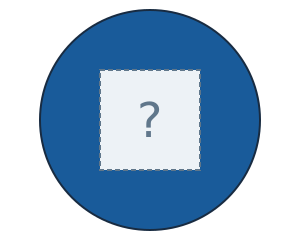
Answer: C. The missing piece lies inside one solid colored region. Continue that same solid color.
Show answer
Answer: C. The missing piece lies inside one solid colored region. Continue that same solid color.
The completed pairs show the same change. Which figure completes the last pair?

Answer: D. In the example, the left half of the empty shape is colored yellow. Do the same to the new shape. A colors the opposite half. B colors a different half in a new color. C colors the right half, but in the wrong color. E colors the opposite half in the wrong color. Choose D.
Show answer
Answer: D. In the example, the left half of the empty shape is colored yellow. Do the same to the new shape. A colors the opposite half. B colors a different half in a new color. C colors the right half, but in the wrong color. E colors the opposite half in the wrong color. Choose D.
Level B (grade 1)
Find the pattern across the rows and down the columns. Which figure is missing?
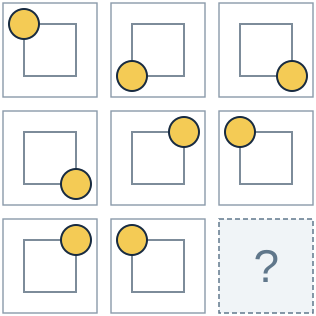
Answer: A. Along each row the dot moves one corner counterclockwise around the square. Take the next step in the last row. B repeats the corner of the first box, in the wrong color. C copies the middle box of the row. D has the right corner but the wrong color. E repeats the corner of the middle box, in the wrong color. Choose A.
Show answer
Answer: A. Along each row the dot moves one corner counterclockwise around the square. Take the next step in the last row. B repeats the corner of the first box, in the wrong color. C copies the middle box of the row. D has the right corner but the wrong color. E repeats the corner of the middle box, in the wrong color. Choose A.
Which piece completes the picture?

Answer: A. Continue the filled regions and their boundaries across the edges of the missing piece. Match the positions, colors and directions of the visible boundaries.
Show answer
Answer: A. Continue the filled regions and their boundaries across the edges of the missing piece. Match the positions, colors and directions of the visible boundaries.
Level C (grade 2)
The completed pairs show the same change. Which figure completes the last pair?
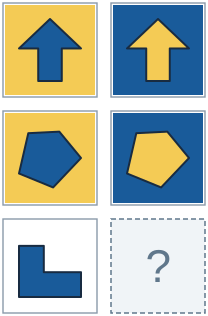
Answer: B. Exchange the shape color and the background color. Keep its shape and orientation unchanged. Apply every part of that rule to the last input.
Show answer
Answer: B. Exchange the shape color and the background color. Keep its shape and orientation unchanged. Apply every part of that rule to the last input.
Look at how the shapes change or combine in the completed examples. Which figure is missing?
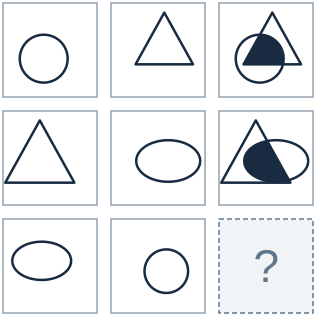
Answer: D. In each row the two shapes are put on top of each other, and only the part they share is shaded. Do the same with the last two shapes. A shades only the part of the other shape that is not shared. B shades only the part of one shape that is not shared. C shades the other whole shape. E shades both whole shapes. Choose D.
Show answer
Answer: D. In each row the two shapes are put on top of each other, and only the part they share is shaded. Do the same with the last two shapes. A shades only the part of the other shape that is not shared. B shades only the part of one shape that is not shared. C shades the other whole shape. E shades both whole shapes. Choose D.
Find the pattern across the rows and down the columns. Which figure is missing?
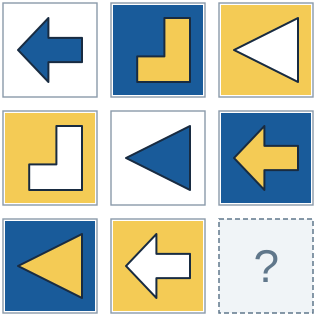
Answer: C. Across each row, the three shape types appear once each. Their order shifts one place in the next row. The three background colors also cycle, with the figure color moving with its background. The orientation stays fixed.
Show answer
Answer: C. Across each row, the three shape types appear once each. Their order shifts one place in the next row. The three background colors also cycle, with the figure color moving with its background. The orientation stays fixed.
What does each NNAT question type test?
The NNAT3 is a single test of 48 figure items. Pearson’s Levels A–D manual describes easy items as a large design with a piece missing and harder ones as 2-by-2, 2-by-3 or 3-by-3 arrays whose figures change in more ways at once. Test-prep material usually names four families, which the app uses too:
Pattern completion
Puzzles 1 and 4. The child continues colours, regions and edges into the gap. Level A starts with one solid region; by Level B a boundary curves through the missing square, so the edges of the piece must line up.
Reasoning by analogy
Puzzles 2 and 5. A completed pair shows one change, such as colouring a half or swapping shape and background colour. The child applies the identical change to a new figure, keeping everything else the same.
Serial reasoning
Puzzles 3 and 7. Figures move or cycle along each row of a grid: a dot steps around a square corner by corner, or three shape types rotate their order from row to row.
Spatial visualization
Puzzle 6. Two figures are placed on top of each other and only the shared part is shaded. Later levels add folding and turning, which ask the child to hold a picture in mind and change it.
How can parents coach without telling the answer?
- Cover the choices first. Ask your child to describe what the missing piece should look like before they look at the options. Then they search for that piece instead of being pulled toward a look-alike.
- Use “what stays, what changes”. For analogies and grids, ask which parts stay the same and which part moves, turns or swaps colour.
- Trace with a finger. On pattern completion, following the edge of a colour across the gap shows which piece lines up.
- Accept slow answers. Pearson calls the NNAT a power test: most children finish within 30 minutes, and extra time did not raise scores in its study. Careful beats fast.
- End on a success. If a puzzle frustrates your child, finish with an easier Level A item and stop for the day.
These puzzles are practice, not an official score
Seven puzzles cannot produce a Naglieri Ability Index, percentile or stanine; those come only from the real, normed test. The goal here is familiarity: knowing that a puzzle can ask for a missing piece, a copied change, the next step in a row, or a combination of shapes. Each school sets its own identification steps and decides how the NNAT result is used.
Neobile LLC makes NNAT Test Prep independently of Pearson; every figure on this page was drawn for the app.
Sources
Questions people ask
Which NNAT level does my child take?
Pearson builds the NNAT3 in seven levels, A to G, chosen by grade. Its Levels A–D manual assigns Level A to kindergarten, B to grade 1, C to grade 2 and D to grades 3 and 4. Your school confirms the level when it schedules testing.
How long is the NNAT?
Pearson lists 48 multiple-choice items and 30 minutes of testing time at every level. With directions and sample items, the whole session takes about 35 to 45 minutes.
Are these questions from the real NNAT?
No. Pearson keeps its items secure. The seven figures here are original puzzles from the NNAT Test Prep bank, built to show the four item types the NNAT is known for.
My kindergartner got the analogy wrong. Is that a problem?
No. Analogies are the hardest idea for many five-year-olds, because the child must see a change and then copy it to a new shape. Talk through the example pair and try again tomorrow.
Does the NNAT need reading or English?
No. The NNAT3 uses figures and pictorial directions, and Pearson describes it as requiring no spoken or written language, which is why schools use it for English learners.